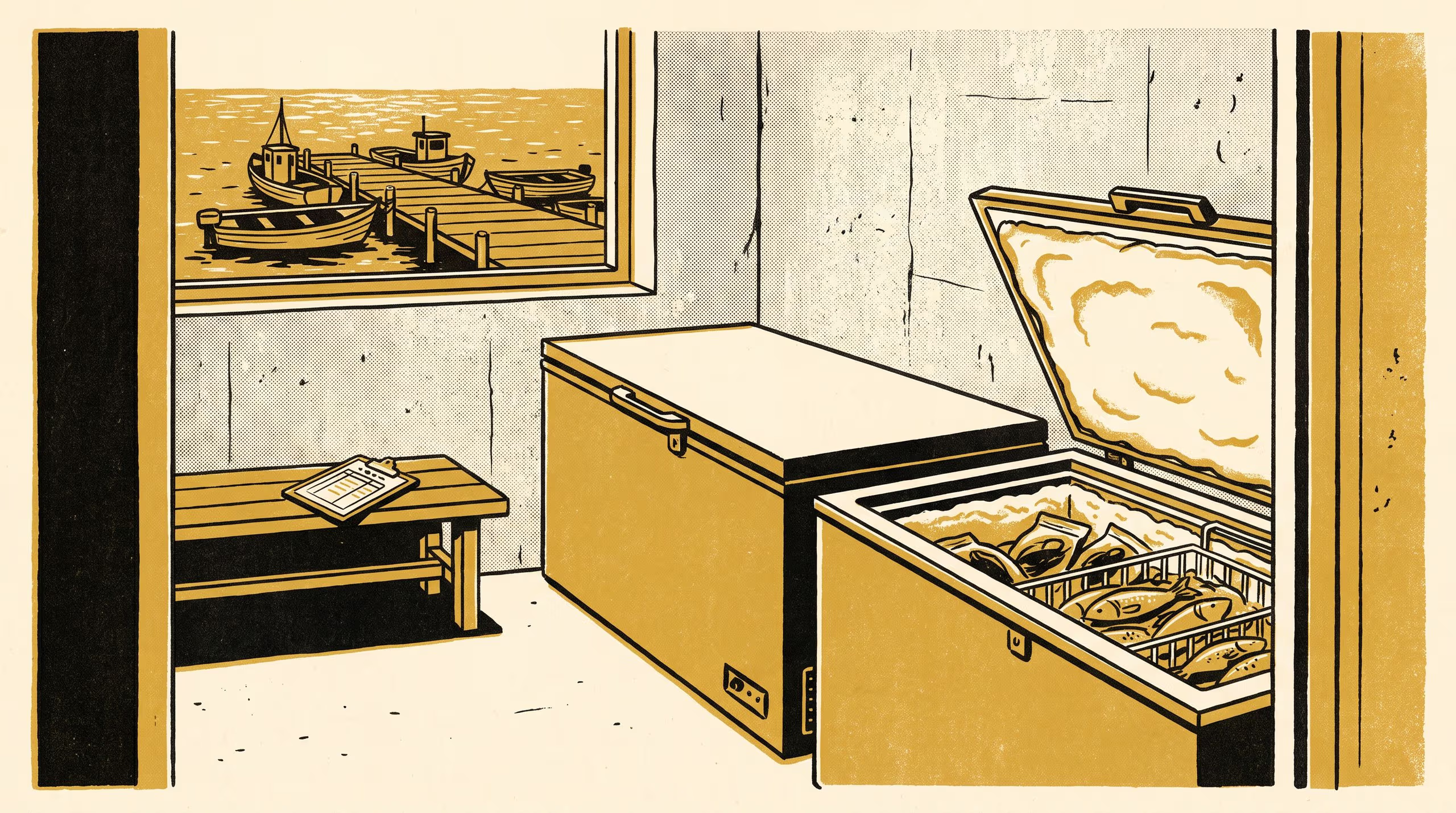
A new research poster from the School of Emergent Priorities reports that ice-glazed catfish fillets kept near the lid of a busy chest freezer lose their glaze within weeks, whatever the set temperature, while fillets packed low keep theirs.
A storage study with a fishing village's frozen-food group follows the ice glaze on catfish fillets from the top basket to the frost on the lid
Four chest freezers, eight weeks and several hundred fillets weighed twice each sit behind the School of Emergent Priorities’ latest contribution to the University’s growing interest in how food keeps.
The Top Layer of the Chest Freezer is by Dr Fenna Okoro, Senior Lecturer and Convenor of the Horizon Register, with Dr Ingrid Vasseur, Lecturer and Convenor of Futures in Committee, and Signy Okpara, Doctoral Candidate in the School of Continuous Improvement. The poster reports that the thin shell of ice protecting a fillet in frozen storage is lost fastest at the top of a freezer that is opened all day, and that turning the thermostat down does far less to slow it than keeping the lid closed.
We came to measure a freezer and were shown a whole working day. The women who run that kitchen knew where the cold went long before our loggers did, and we are grateful they let us write it down.
— Dr Fenna Okoro, Senior Lecturer and Convenor, Horizon Register, School of Emergent Priorities
The study brings together careful weighing, layer-by-layer temperature monitoring and close partnership with a community enterprise, building a practical picture of how storage habits and storage settings interact across the small-scale seafood value chain.
Ms Okpara said the team had “come away with a new respect for the bottom of the basket”, and that the School would carry the lesson into its future fieldwork.
The University counts the poster among the quieter ways its research reaches the places where food is made and sold.
The full poster is available from the University’s research repository under an open licence, doi:10.5555/slop.8gbp5n.