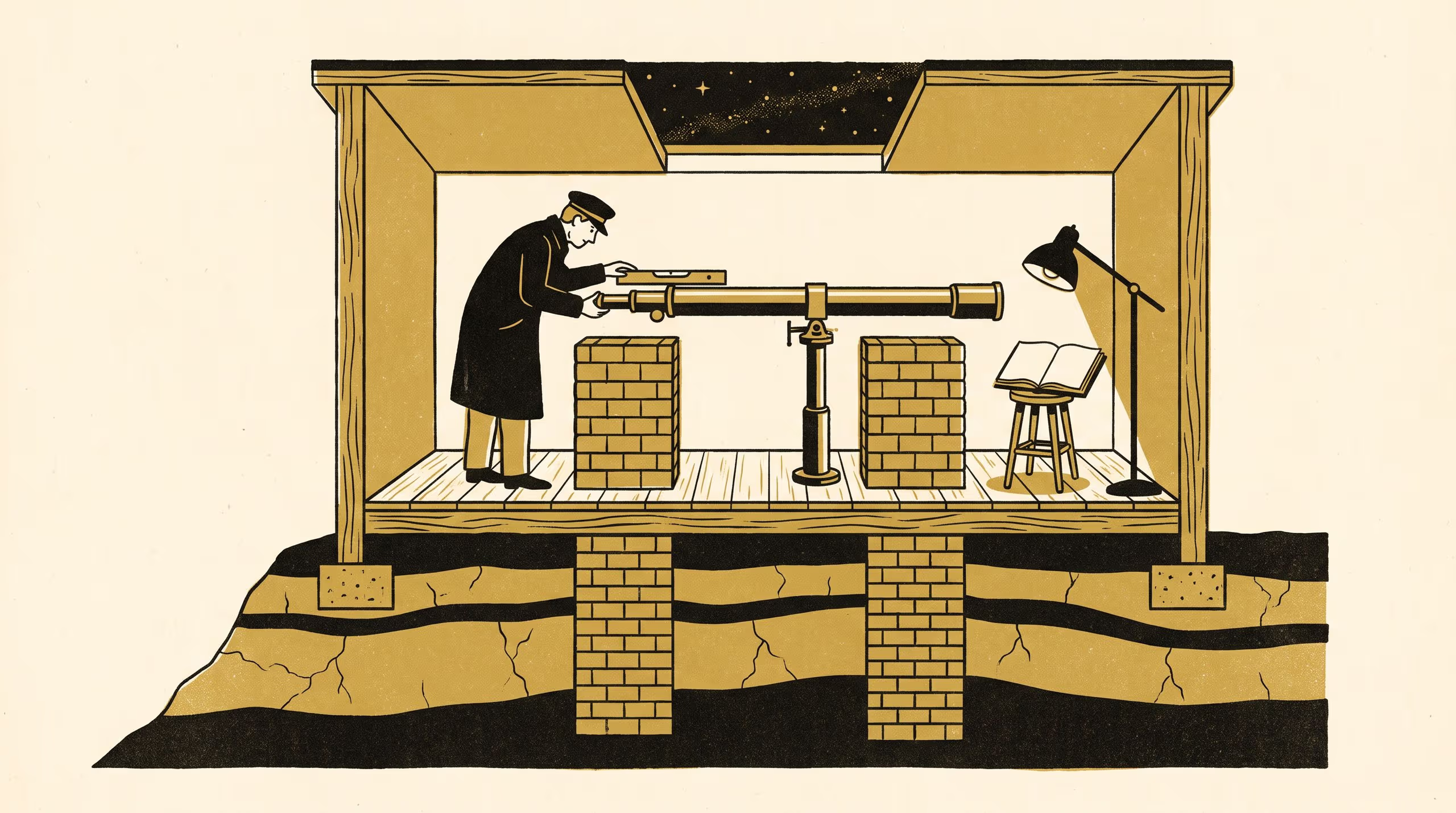
A new research poster from the School of Emergent Priorities reads seventy years of nightly spirit-level readings from one hilltop observatory as a slow, seasonal record of the clay beneath its telescope.
A research poster from the School of Emergent Priorities reads seventy years of transit-circle level readings as a record of the ground beneath two piers
For most of the twentieth century, an observer at a small hilltop observatory began each clear night by checking that a telescope’s axis sat level. A new research poster from the School of Emergent Priorities suggests the hill was taking part in that check all along.
The Level Book as a Creep Gauge is by Ylva Ogunbanjo, Doctoral Candidate, with Dr Brynjar Obiora, Senior Research Fellow in the School of Underlying Conditions, and Dr Runa Adegoke, Senior Lecturer and Convenor of the Strategic Drift Survey. Working from 13,874 nightly entries kept between 1903 and 1972, the team finds one of the instrument’s two piers settling slowly against the other, and rising and falling with the seasons.
The University has a long-standing interest in things that move slowly enough to pass for standing still. It is good to see that interest taken outdoors, and a little way into the ground.
— Dr Runa Adegoke, Senior Lecturer and Convenor, Strategic Drift Survey, School of Emergent Priorities
The project brings archival transcription, field soil survey and the observatory’s own weather record into a single conversation, aligning a long-retired instrument practice with contemporary understandings of landscape change and anchoring the School’s work on slow signals within the earth sciences.
Ms Ogunbanjo said the work had “changed which way I look whenever someone tells me a reading has already been corrected”.
The University is pleased to add the poster to a body of work that has never been in a hurry.
The full poster is available from the University’s research repository under an open licence, doi:10.5555/slop.br2e15.