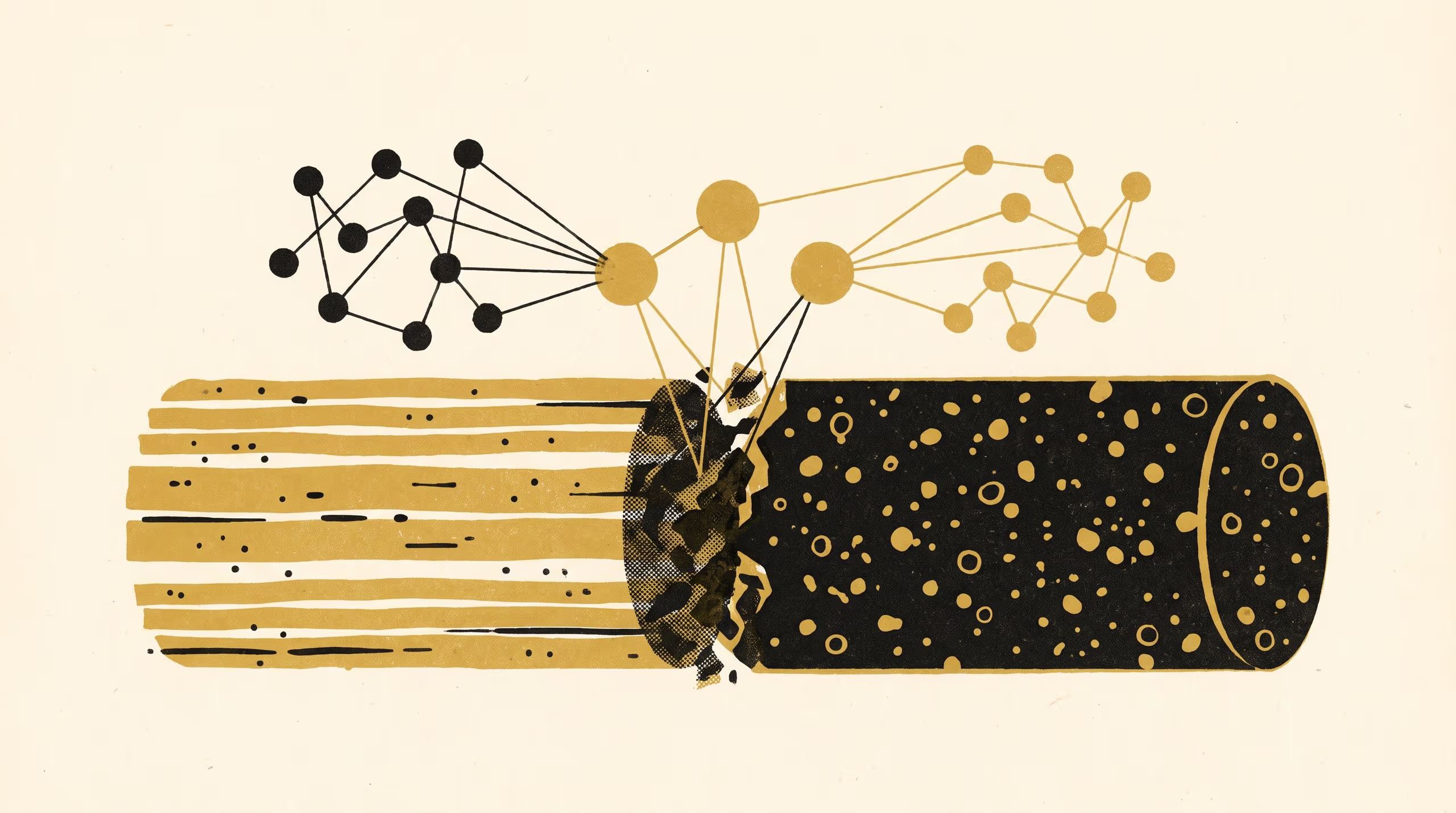
A new research poster from the School of Underlying Conditions finds that two underground microbial communities, one in sediment and one in fractured bedrock, are joined by a handful of genomes living in the weathered rock between them.
Genomes recovered from one cored borehole suggest a few microbes in weathered rock link the communities above and below
A few metres of weathered rock beneath a single borehole appear to carry most of the exchange between two otherwise separate underground communities, according to a new research poster from the School of Underlying Conditions.
Brokers at the Unconformity is by Associate Professor Ragnhild Uzoma, Lead of the Basement Relations Group, and Dr Vigdis Emenike, Senior Lecturer in the School.
For years the Group has drawn this contact as a line on a log. It is a little humbling to learn that something has been living along it the whole time, keeping its own accounts of what passes from one side to the other.
— Associate Professor Ragnhild Uzoma, Lead, Basement Relations Group, School of Underlying Conditions
The team paired careful handling of fresh core with genome-resolved sequencing and network modelling, building a picture of which residents of the subsurface are equipped to supply which others. The resulting map separates neatly into a sediment community and a bedrock community, with nine genomes, most of them drawn from the lower palaeoregolith, standing between the two.
The work deepens the School’s long-running attention to what the surface rests on, and turns it toward what lives there. Dr Emenike said the poster had left the team “with better questions than we arrived with, which feels like the right way round for a first look underground.”
The full poster is available from the University’s research repository under an open licence, doi:10.5555/slop.34xx0i.