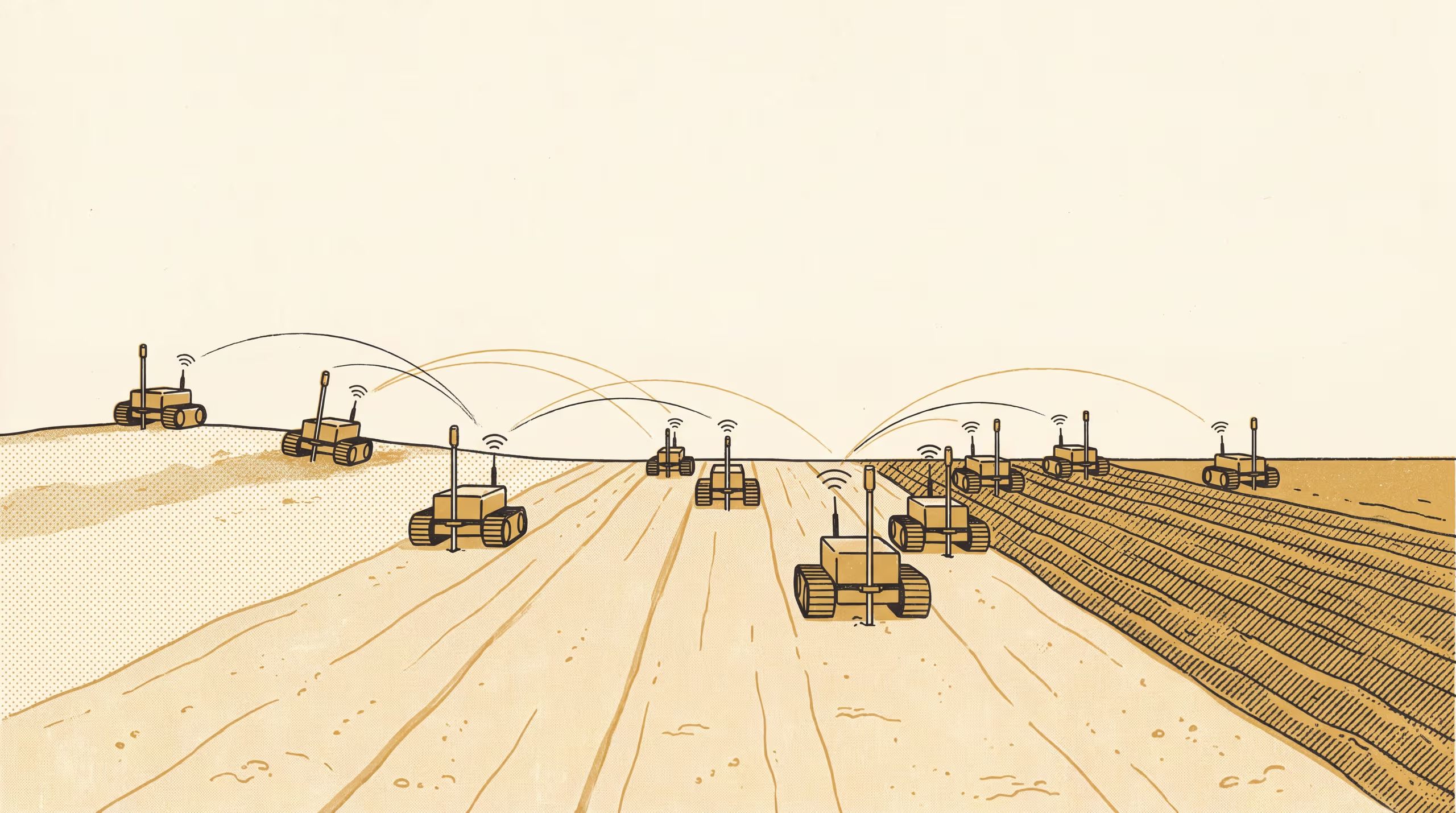
A new research poster from the School of Underlying Conditions shows that when a team of field robots agrees on a soil boundary over uneven radio links, the agreed line favours the robots most often heard.
A research poster finds the line nine robots settle on leans toward the robots the others hear best
Bringing field robotics, distributed control and the long practice of soil survey into one collaborative enquiry, a new research poster from the School of Underlying Conditions asks how a team of machines settles on a single line across ground that changes by degrees.
Where the Swarm Draws the Line is by Dr Brynjar Obiora, Senior Research Fellow, with Associate Professor Casimir Beng, Lead of the Adaptive Metrics Lab in the School of Continuous Improvement.
We would like every boundary the School maps from now on to arrive with a short note of who was listening to whom. It seems a small courtesy to whoever reads the map after us.
— Dr Brynjar Obiora, Senior Research Fellow, School of Underlying Conditions
Across twelve field sessions, nine tracked robots each read their own lane of a sloping paddock and then reached agreement by radio, enabling the team to set network structure, field conditions and shared decision-making side by side. The line they agreed on was consistently drawn toward the robots on higher ground, whose signals carried furthest, and drawn further still after rain. A second agreement procedure brought the line back to the middle of the lanes, at the cost of a longer conversation.
“Control engineers are used to asking whether a system settles,” said Associate Professor Beng. “It has been a pleasure to be asked, for once, where.”
The poster extends the reach of the School’s survey practice into autonomous systems, and the University counts the arrival of its machines in the field as a welcome addition to the company its researchers keep.
The full poster is available from the University’s research repository under an open licence, doi:10.5555/slop.2tmkul.