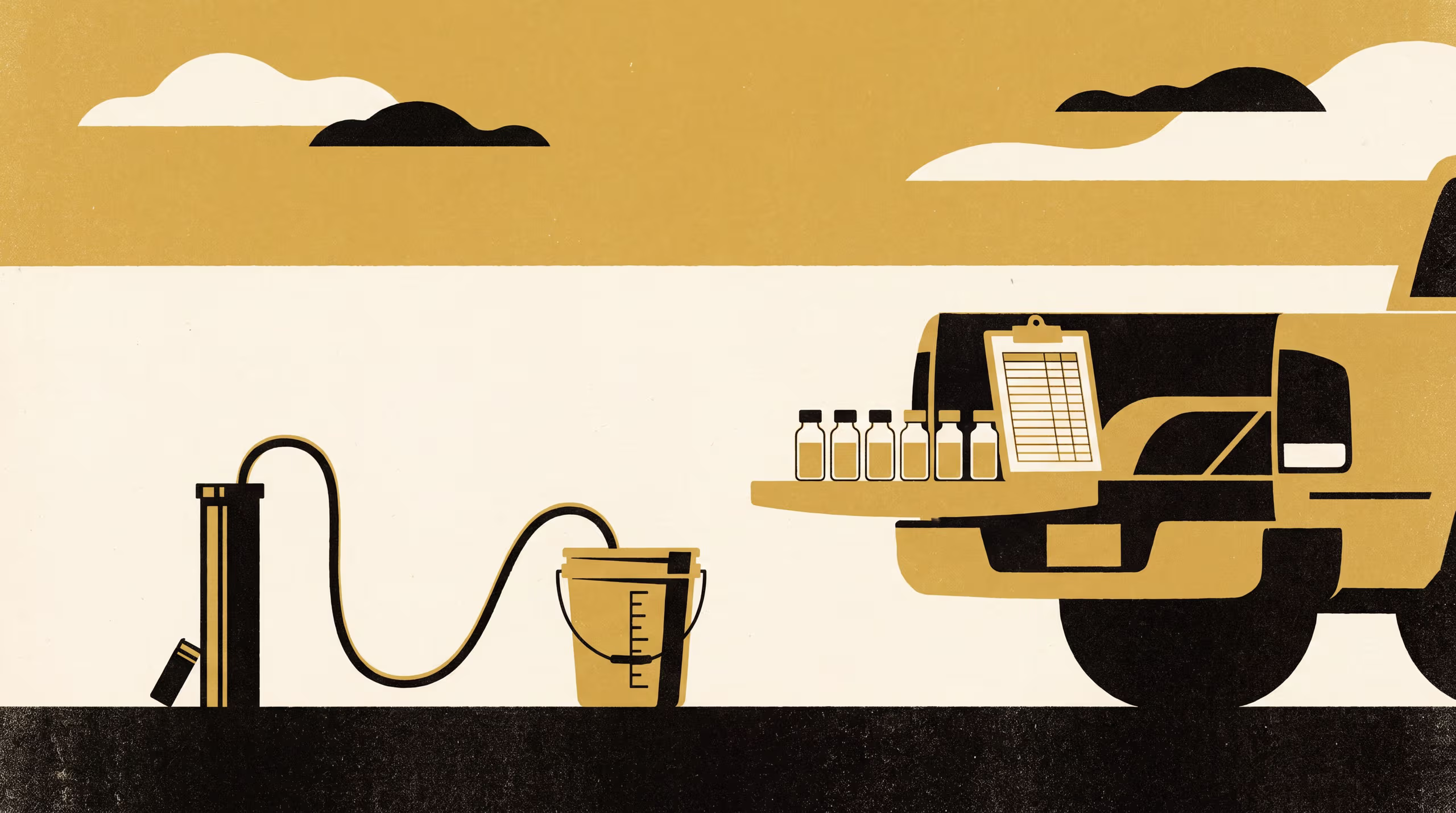
A research poster from the School of Underlying Conditions resolves three decades of archived spectra from one monitoring bore and finds a long rise in its organic-matter record followed how briefly the bore was purged.
A research poster separates thirty years of archived water spectra and finds part of the signal belongs to the pipe, not the aquifer
Thirty years of water samples from a single monitoring bore have turned out to be saying something about the bore itself. What the Casing Kept, a research poster by Dr Vigdis Emenike, Senior Lecturer, and Associate Professor Ragnhild Uzoma, Lead of the Basement Relations Group, in the School of Underlying Conditions, finds that a steady rise in the bore’s organic-matter record came not from the groundwater but from the standing water left in the pipe when a visit was cut short.
The bottles were always filled with care, and it seems they kept a little more of each visit than anyone wrote down. It has been a pleasure to read the rest of it.
— Dr Vigdis Emenike, Senior Lecturer, School of Underlying Conditions
The team brought the School’s shelved spectral holdings together with the paper record of each sampling visit, applying an advanced resolution approach that lets overlapping signals in a sample be told apart without assuming in advance what they are. Of the three signals it recovered, one matched neither the aquifer’s organic matter nor its nitrate, and it faded steadily the longer the bore had been pumped before the bottle was filled.
The poster sits within the School’s sustained interest in what a single reading taken down a pipe can be asked to say about the ground around it, an interest the University regards as a distinctive strength of its earth sciences.
Associate Professor Uzoma described the work as “an invitation to look again at what is already on the shelf, in our own store and in every store like it.”
The full poster is available from the University’s research repository under an open licence, doi:10.5555/slop.hqf3dm.