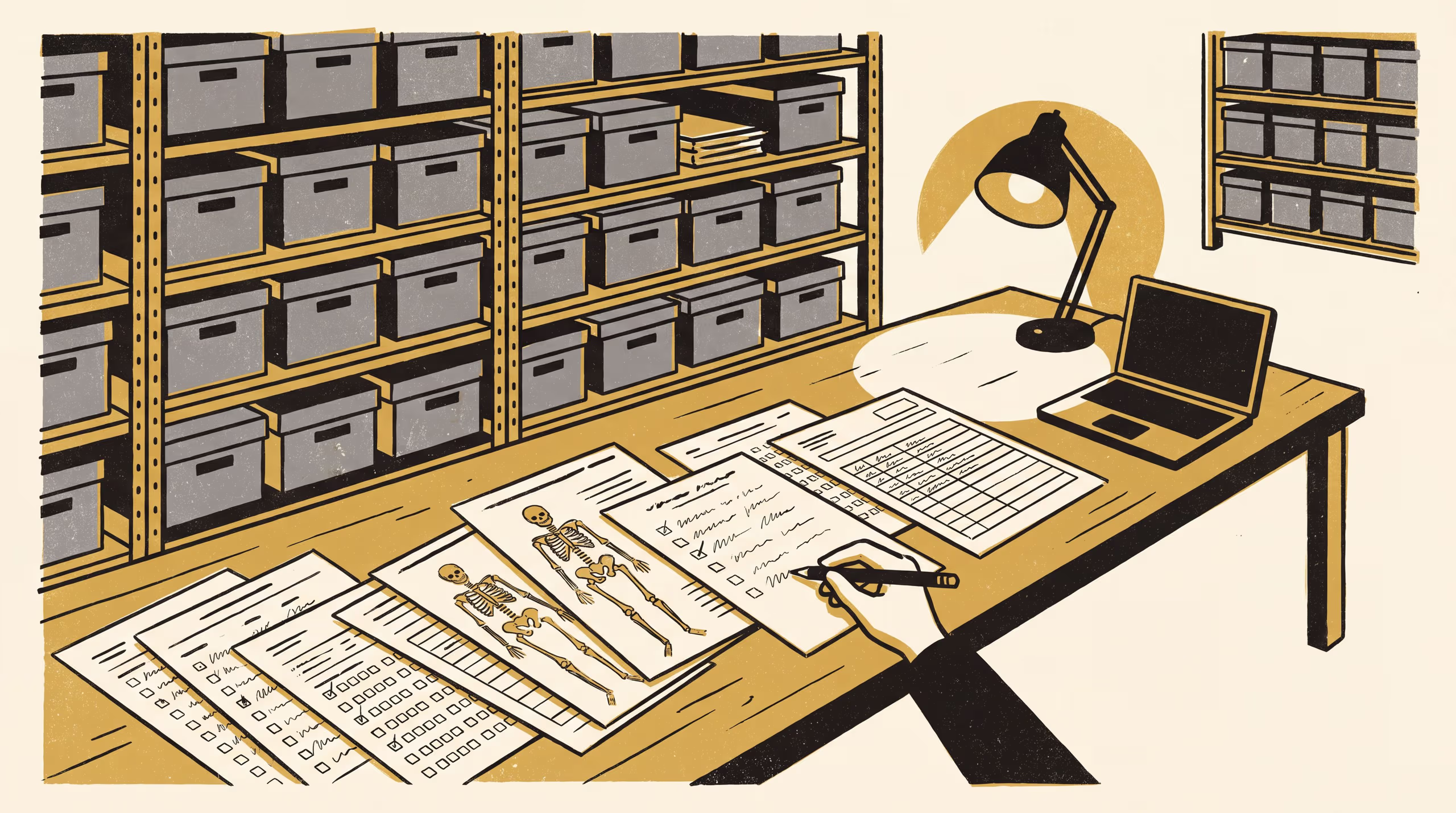
A new research poster from the School of Emergent Priorities follows the ancient-DNA results that reached one cemetery's excavation archive without a box on the recording sheet to receive them.
A research poster on where an excavation archive keeps the genomic results its skeleton sheets have no box for
Every skeleton recording sheet in one cemetery’s excavation archive offers its recorder four boxes for sex. A new research poster from the School of Emergent Priorities asks what happens when an answer arrives that none of them was built to hold.
The Fourth Box is by Halvard Nnamani, Doctoral Candidate in the School, with Associate Professor Ragnhild Uzoma, Lead of the Basement Relations Group, and Sunniva Balogun, Doctoral Candidate. It sets the recorders’ original judgements for 212 burials beside the genomic results that came back decades later, and follows seven of those results through margins, comment fields and a spreadsheet column to where they rest today.
I came to this archive thinking I would be reading forms. I left reading the edges of them first, and I suspect I will be doing that for the rest of my career.
— Halvard Nnamani, Doctoral Candidate, School of Emergent Priorities
The work brings the recording traditions of field archaeology into conversation with the School’s longstanding interest in how institutions hold what their instruments were not designed to receive, and closes with a practical recommendation for how the next edition of the sheet might be arranged.
Ms Balogun described the project as “a useful reminder that an archive is something an institution keeps writing long after the digging has stopped.”
The School regards the poster as a characteristically patient contribution to its growing body of work on the residual spaces of the record.
The full poster is available from the University’s research repository under an open licence, doi:10.5555/slop.xmdv5p.