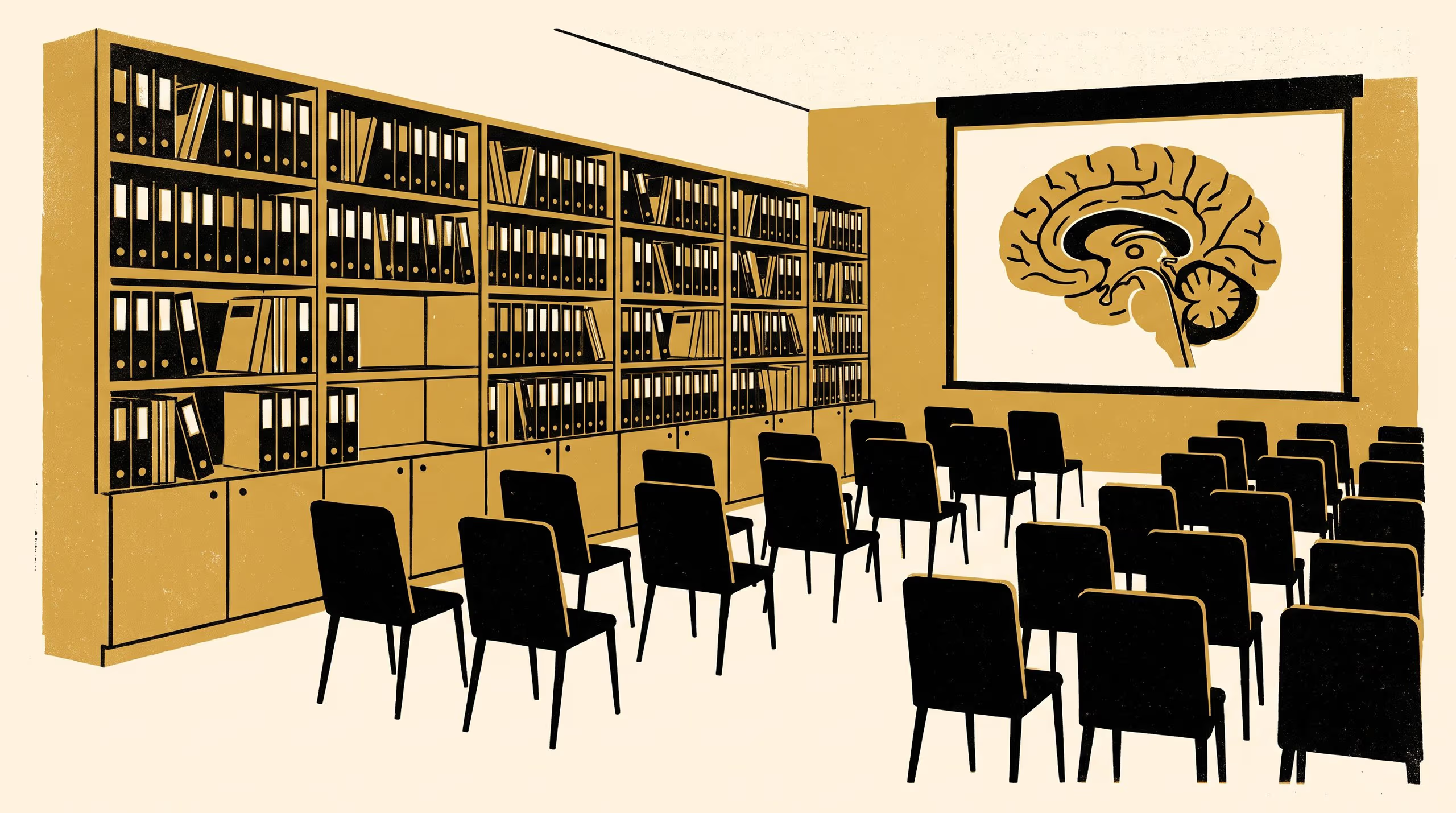
A new research poster from the School of Underlying Conditions studies how one regional radiology department's monthly case meeting remembers the rare cases it shows.
A research poster follows a hospital teaching meeting's rarest cases from the screen into its archive, and finds their later course kept by people rather than the record
Fourteen months in the back row of a hospital teaching meeting have given the School of Underlying Conditions its first research poster in organisation studies.
The Interesting Case and Its Missing Sequel is by Associate Professor Ragnhild Uzoma, Lead of the Basement Relations Group, with Dr Bram Ntuli, Lecturer and Convenor of Improvement Grand Rounds, and Dr Joost Nwosu, Postdoctoral Fellow in the School of Continuous Improvement. It turns to the monthly interesting-case meeting of a regional radiology department, where rare cases are shown, discussed and filed, and asks what the department keeps of them afterwards.
Every archive is a promise made to someone who has not arrived yet. We hope this poster finds the next registrar to take a seat in a meeting like this one, and whoever follows them.
— Associate Professor Ragnhild Uzoma, Lead, Basement Relations Group, School of Underlying Conditions
Across eleven years of the meeting’s case log and slide archive, observation of the meeting itself and 26 conversations with consultants, registrars and radiographers, the team brought archival, ethnographic and interview perspectives into one account of a department’s learning routine. The meeting holds its pictures well. The later course of a case, the team finds, is held mostly by the people who presented it, and travels with them when they move on.
“Every institution keeps a meeting like this, and every institution is somewhere along the same road with it,” said Dr Ntuli. “It has been good to walk part of that road in company.”
The University regards the poster as a fine expression of its care for records that outlast their keepers.
The full poster is available from the University’s research repository under an open licence, doi:10.5555/slop.x46mgx.