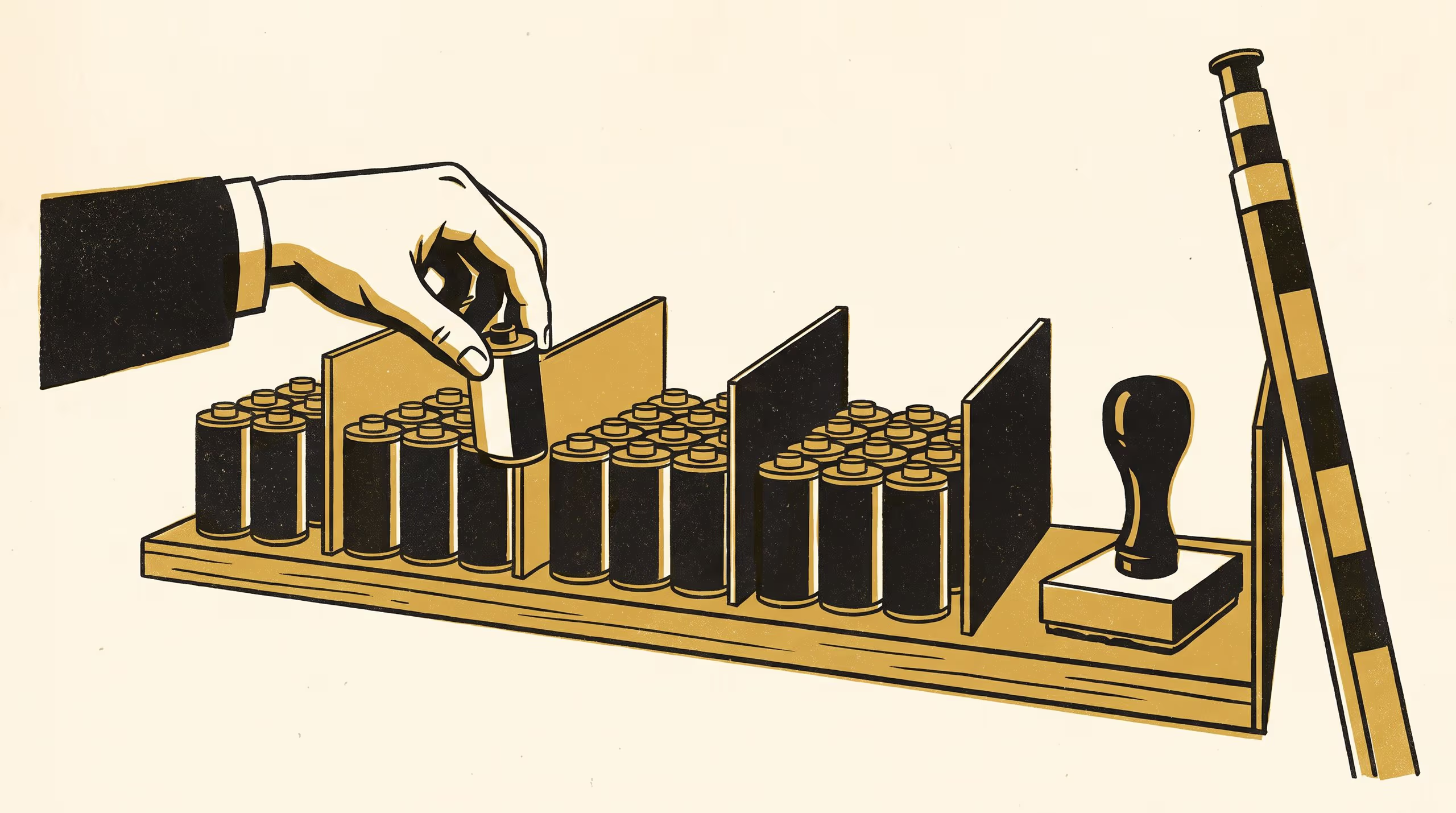
A new paper from the School of Underlying Conditions argues that a streaming provider banding its own titles is safely trusted across most of its catalogue, and that the real difficulty lies in the narrow strip of titles at the edge of each rating band.
A new paper reads streaming services' self-classification through the old rule against judging one's own cause
Most of what a streaming service decides about its own catalogue, a new paper argues, it can safely be trusted to decide. The difficulty lies in a narrow strip of titles at the edge of each rating band, and that strip is the subject of Judge in Its Own Catalogue, by Dr Brynjar Obiora, Senior Research Fellow in the School of Underlying Conditions.
A university sorts things all day long, and it is easy to forget that someone is standing at every one of those lines. I would be glad if the paper helped a few more of us notice where we are standing.
— Dr Brynjar Obiora, Senior Research Fellow, School of Underlying Conditions
Situated where political theory, regulatory scholarship and the governance of digital platforms meet, the paper brings a long-standing principle of impartial judgment to bear on schemes in which providers classify their own titles. It positions the borderline case, rather than the catalogue as a whole, as the place where institutional design must concentrate its attention, and it sets out a declared-margin arrangement through which providers and reviewers might share that work.
For Dr Obiora, whose earlier work asks how a line drawn through gradual ground comes to be read as a fact about it, the rating band is new ground to survey. The University is pleased to watch one of political theory’s oldest questions settle so comfortably into its earth sciences school.
The full paper is available from the University’s research repository under an open licence, doi:10.5555/slop.l1tdg9.