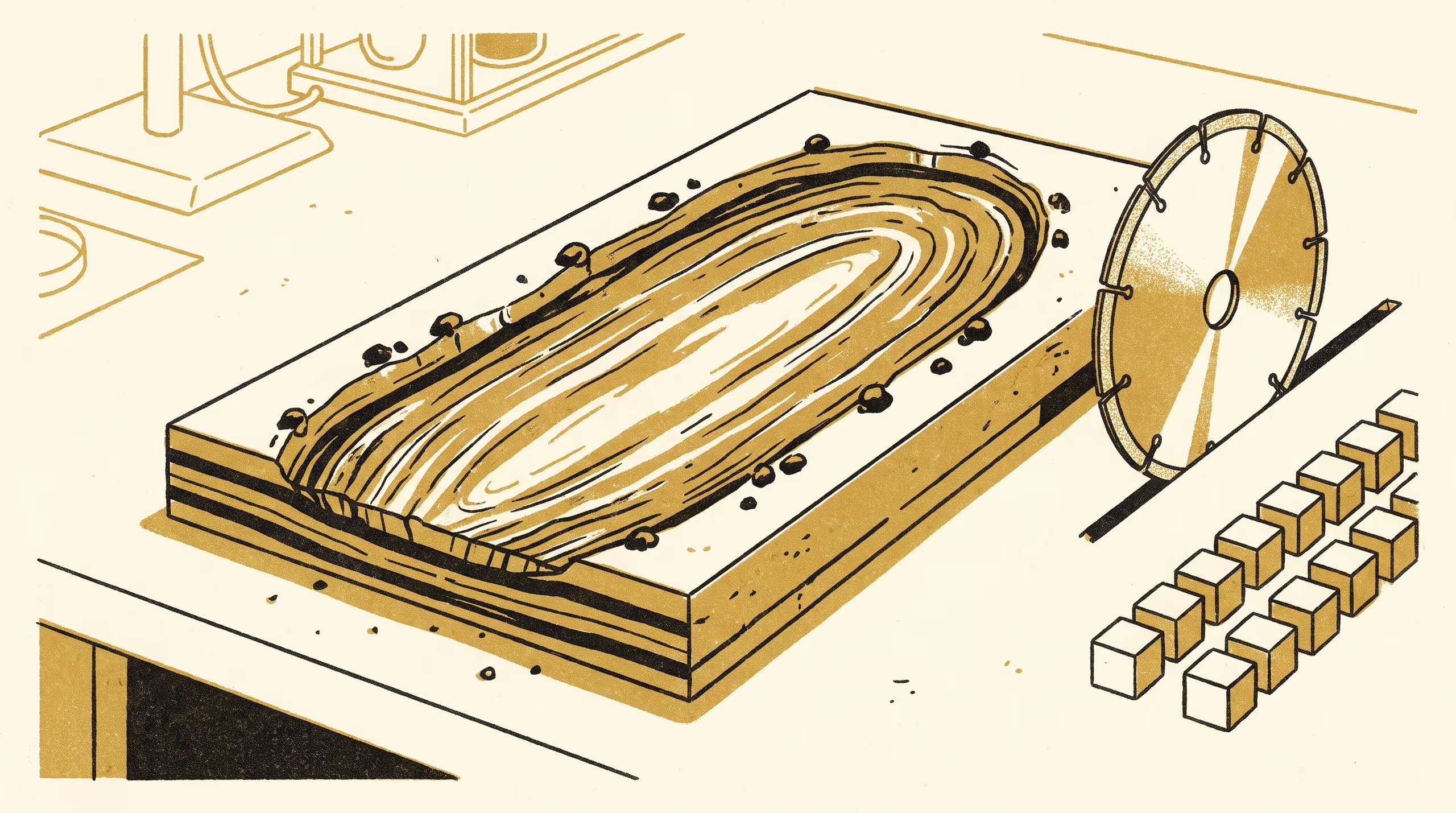
A new paper from the School of Underlying Conditions sections a worn-out sputtering target from the face down, finds that its years of service changed only a thin outer skin, and sinters the rest into a second target that performs close to the first.
A paper from the School of Underlying Conditions cuts open a retired zinc oxide sputtering target and makes a new one from what its service left untouched
A spent sputtering target, it turns out, is for the most part an unspent one. That is the finding of What the Racetrack Leaves, a new paper by Dr Brynjar Obiora, Senior Research Fellow in the School of Underlying Conditions, and Dr Bram Ntuli, Lecturer and Convenor of Improvement Grand Rounds in the School of Continuous Improvement.
I spent twelve years writing down what lay under other people’s paddocks, and I had assumed the habit would stay in the paddock. It came indoors with me without asking, and I am more grateful to it than I expected to be.
— Dr Brynjar Obiora, Senior Research Fellow, School of Underlying Conditions
Bringing the descriptive practice of field survey into conversation with the materials of thin-film deposition, the authors took a retired zinc oxide target apart section by section, characterised the layer its service had altered, and reconstituted the material beneath it into a second-generation target. The paper situates that work within a wider agenda of stewardship for the laboratory’s consumables, from the moment a target is bought to the moment someone decides what becomes of it.
It is the kind of patient, practical inquiry the University has always hoped its Schools would find in one another’s company, and it adds a careful new layer to the institution’s growing materials research.
Dr Ntuli said the collaboration had “left both Schools with a slightly different idea of what counts as finished”.
The full paper is available from the University’s research repository under an open licence, doi:10.5555/slop.cwui8k.