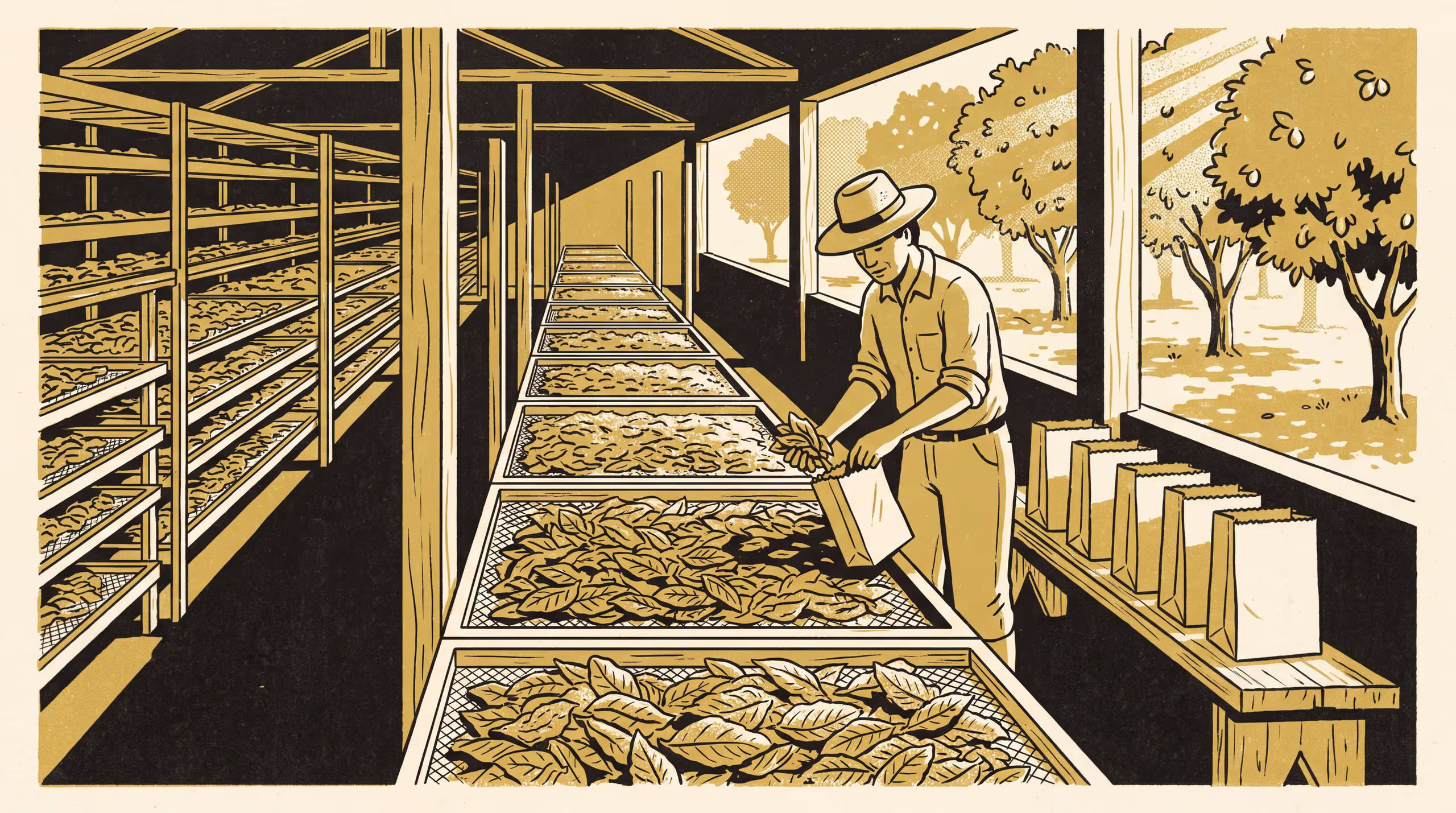
A new research poster from the School of Underlying Conditions traces where the uncertainty in a drying shed's leaf-lot assay sits, and proposes a composite sampling plan to match.
A nested sampling design for the phenolic assay of dried leaf lots at a smallholder drying shed
How many leaves does it take to speak for a harvest? A new research poster from the School of Underlying Conditions, Which Leaves Stand for the Lot, brings that question to a smallholder drying shed where guava leaf is sold by the lot, and offers the shed a simpler way to answer it.
Every lot that leaves a shed goes out on the word of a handful of leaves. We hope this poster helps the people who choose that handful feel a little more at ease with the choice.
— Dr Vigdis Emenike, Senior Lecturer, School of Underlying Conditions
Working across an orchard’s trees, branches and individual leaves, Dr Emenike and doctoral candidate Ylva Ogunbanjo align a nested sampling framework with the shed’s existing release practice, mobilising variance-partitioning methods to locate where a lot’s uncertainty actually resides. Across 432 assays the study finds that most of it sits with the individual leaf rather than at the laboratory bench, and it sets out a composite sampling plan the shed can carry out in a single afternoon.
The poster extends the School’s continuing attention to the single reading asked to stand in for a larger whole, a line of inquiry that now runs from the monitoring bore to the drying rack.
“My own work is in backyards, where a guava tree usually belongs to somebody, so a whole orchard was a welcome change of scale,” said Ms Ogunbanjo, Doctoral Candidate in the School of Emergent Priorities. “It was a privilege to be trusted with every row of it.”
The full poster is available from the University’s research repository under an open licence, doi:10.5555/slop.ndo0fb.