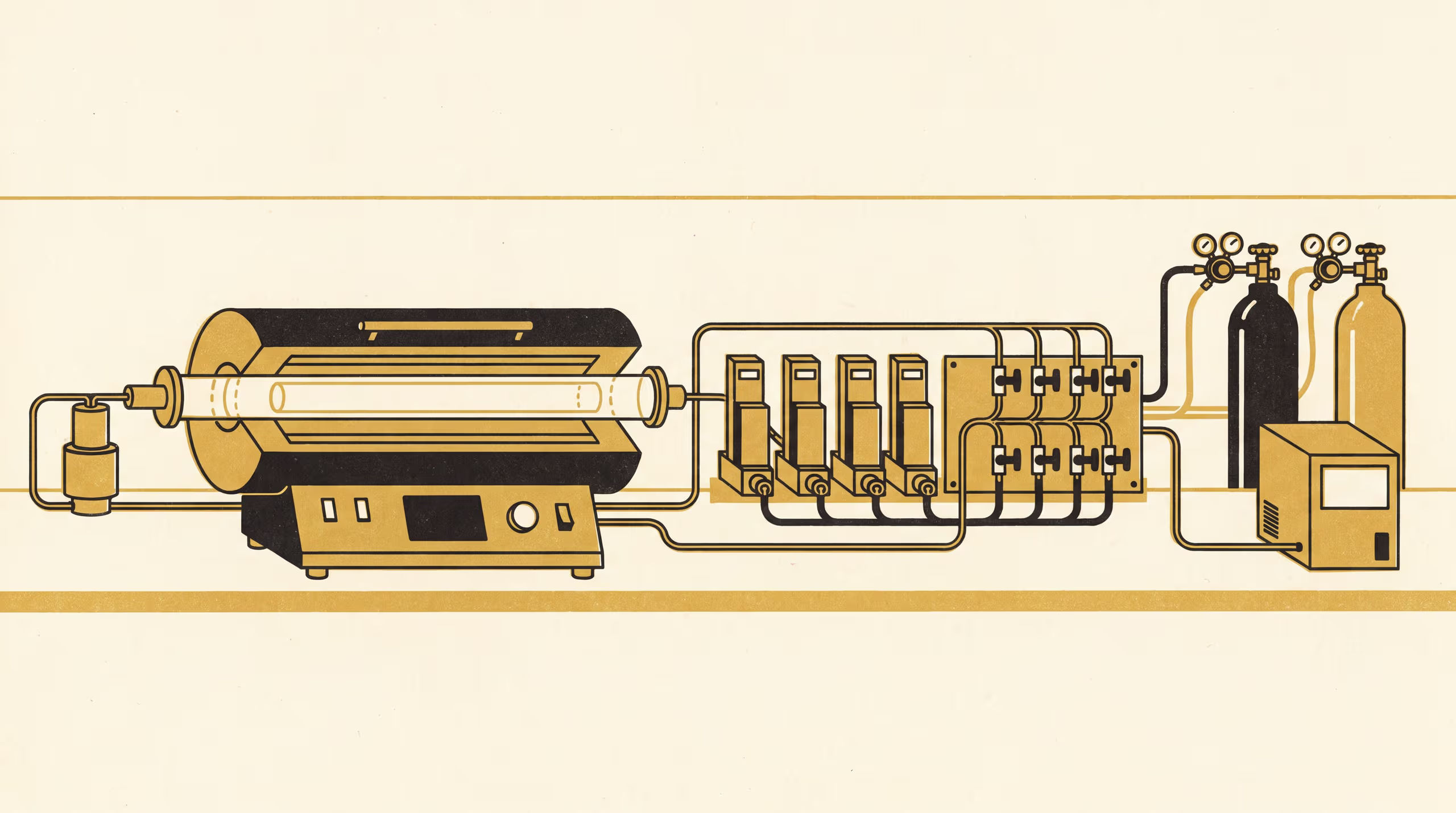
A new research poster from the School of Underlying Conditions follows the captured carbon through every stage of a capture-and-conversion cycle, and finds that a longer pause between the steps sends more of it out with the nitrogen.
A bench-scale carbon capture cycle keeps the most methane when the sweep between its two steps lasts about thirty seconds
Between the step that captures carbon dioxide and the step that turns it into methane, a well-run reactor pauses to clear its lines. A new research poster asks how long that pause ought to be, and arrives at an answer measured in seconds.
How Long to Purge is by Associate Professor Ragnhild Uzoma, Lead of the Basement Relations Group, and Associate Professor Casimir Beng, Lead of the Adaptive Metrics Lab. Working across fourteen campaigns on a bench-scale rig, the team brought capture, sweep and conversion into a single carbon account, so that every portion of the captured gas could be followed to the end of its journey. A sweep of around thirty seconds kept the most methane; the eight-minute sweep the rig had carried over from earlier work sent more than a fifth of the captured carbon to the vent.
Every rig in the University runs on settings that someone chose for good reasons on a different day. We are grateful to the colleagues who keep those reasons in the logbook, and glad to have added a few lines of our own.
— Associate Professor Ragnhild Uzoma, Lead, Basement Relations Group, School of Underlying Conditions
For Associate Professor Beng, whose lab sequenced the valve timings, the collaboration was a natural meeting of process and practice. “A sequencer does whatever it was last told,” he said. “It has been a pleasure to tell it something new.”
The poster joins a widening seam of process research in the School of Underlying Conditions, and the University regards it as a steady contribution to its carbon dioxide programme.
The full poster is available from the University’s research repository under an open licence, doi:10.5555/slop.pkqlgj.