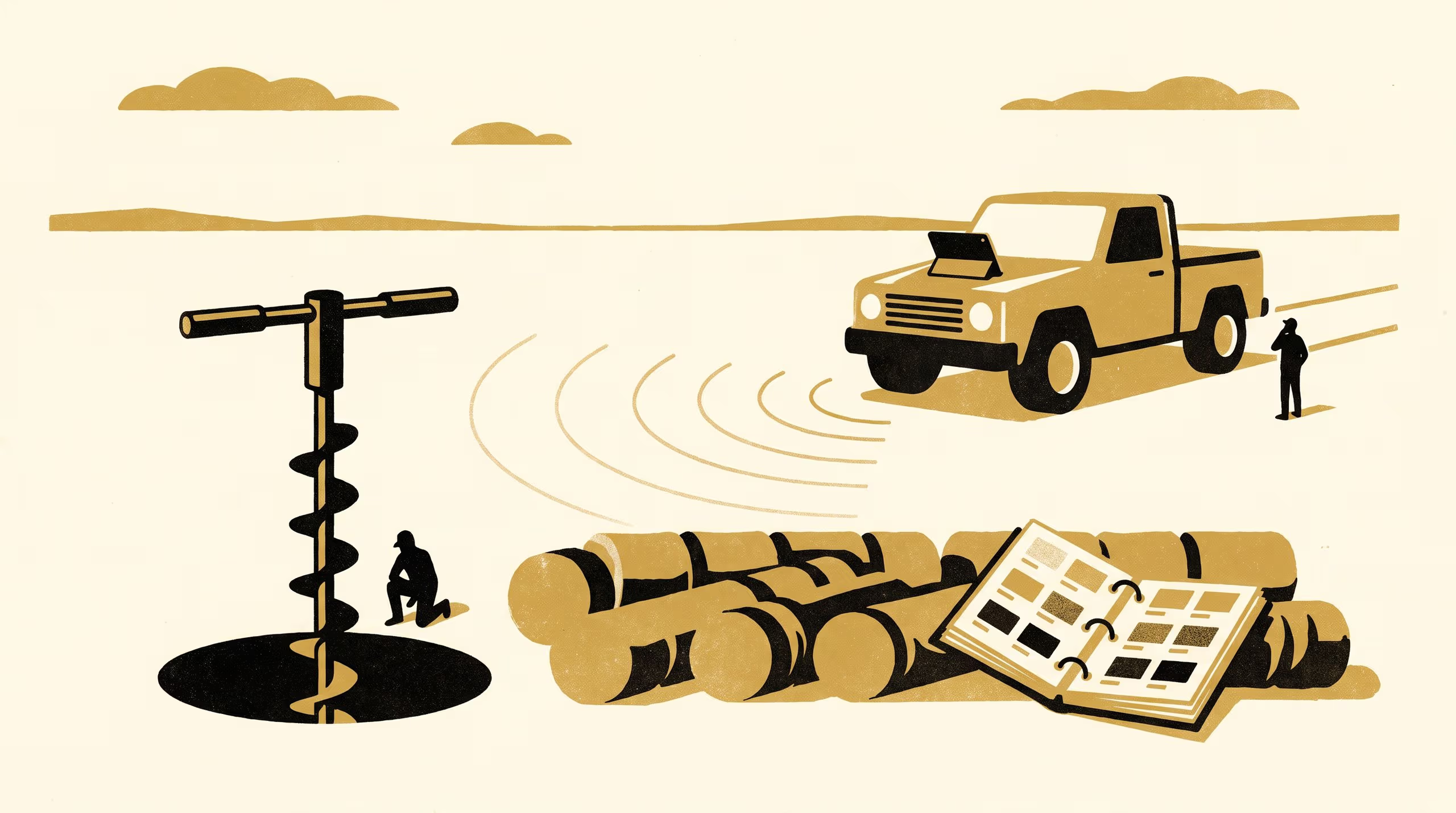
A new paper from the School of Underlying Conditions and the School of Continuous Improvement listens to soil survey crews calling colours across open ground, and finds that the quickest way of checking a call is also the one most likely to let a mishearing through.
Recordings of two-person survey crews show where a misheard colour call finds its way into the field record
When a crew calls a colour across a paddock, the person writing it down is doing the same work as anyone who reads an instruction back over a radio, and nobody had stopped to listen to it. We have now listened to a great deal of it.
— Dr Solveig Adeyemi, Lecturer and Deputy Convenor, Review Cadence Observatory, School of Continuous Improvement
That listening is the substance of Four-Three?, a new paper by Dr Brynjar Obiora, Senior Research Fellow in the School of Underlying Conditions, with Dr Vigdis Emenike, Senior Lecturer in the same School, and Dr Adeyemi of the School of Continuous Improvement. It follows eighteen two-person soil survey crews, nine of them including a member with hearing loss, as one member calls each soil colour aloud from the hole and the other enters it some metres away.
The paper sets conversation analysis and the psychology of listening to work on the everyday practice of field description, framing the exchange between hole and tablet as a shared accomplishment of hearing, attention and record-keeping. Across 2,914 recorded calls, it finds that crews adapt readily to the hearing in their midst, and that the briefest way of checking a call is also the one most likely to carry a near-miss into the record.
“Every surveyor I trained with called colours to someone,” said Dr Obiora. “It took the three of us, and a season of recordings, to hear what we had been saying to each other.”
The work extends a conversation between two of the University’s schools that the University is keen to see continue, and gives its newest School a further reason to keep listening at the edge of the paddock.
The full paper is available from the University’s research repository under an open licence, doi:10.5555/slop.3qqjkx.