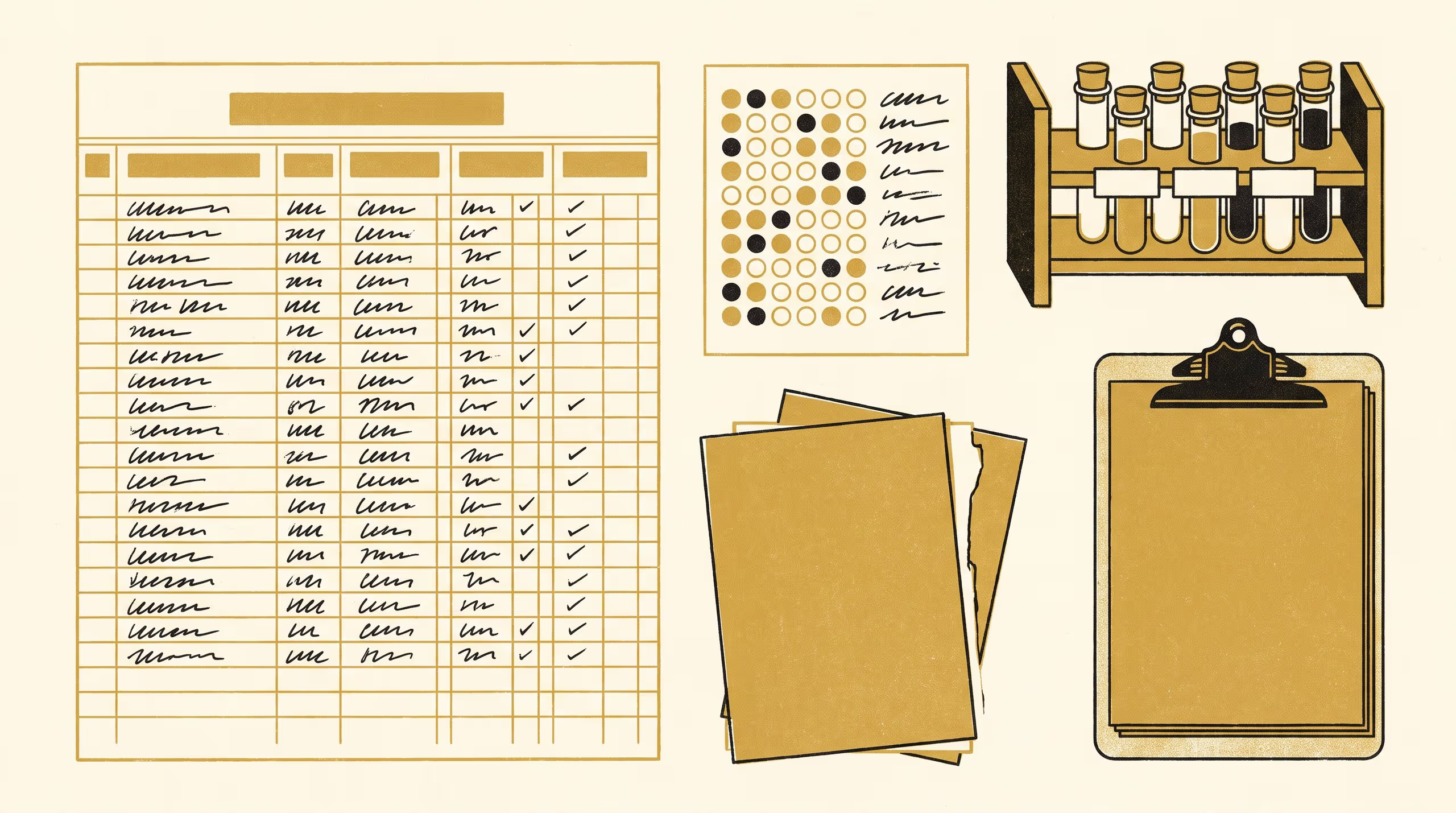
A new paper from the School of Continuous Improvement resolves 6,214 compound-code instances in one screening laboratory's plate maps and scripts against its own register, and finds the failures concentrated in the library's workhorses.
A records audit finds the codes hardest to trace belong to the compounds a laboratory uses most
Six thousand two hundred and fourteen times, a code written on a plate map was looked up against the register that issued it. That is the work behind Codes That No Longer Resolve, a new paper by Dr Dagny Okafor, Lecturer and Convenor of the Evaluation of Evaluation program, with Ms Signy Okpara and Mr Eskil Nwabueze, Doctoral Candidates in the School of Continuous Improvement.
You can tell a great deal about a group from the parts of its record that everyone there already knows. We spent a year reading those parts, and it has quietly changed how our own School keeps its files.
— Dr Dagny Okafor, Lecturer and Convenor, Evaluation of Evaluation, School of Continuous Improvement
Aligning a compound register, five years of plate maps and a generation of analysis scripts within a single resolution framework, the paper traces how an internal identifier moves between the records that carry it, and where that movement leaves a reader unable to recover which compound was meant. Codes resolved to a single register entry in 91.7 per cent of instances; the exceptions gathered around the compounds the laboratory requests most often.
The paper extends the University’s standing interest in the records an institution keeps about itself, and in what a record stops being able to say.
Mr Nwabueze said the audit had left him fond of the batch suffix, “the smallest mark in the whole record and easily the busiest”.
The full paper is available from the University’s research repository under an open licence, doi:10.5555/slop.k1w0j3.