A new display campaign from the School of Underlying Conditions places the questions people have long put to springs, scriptures and the night sky alongside the School's own patient work at the monitoring bore.
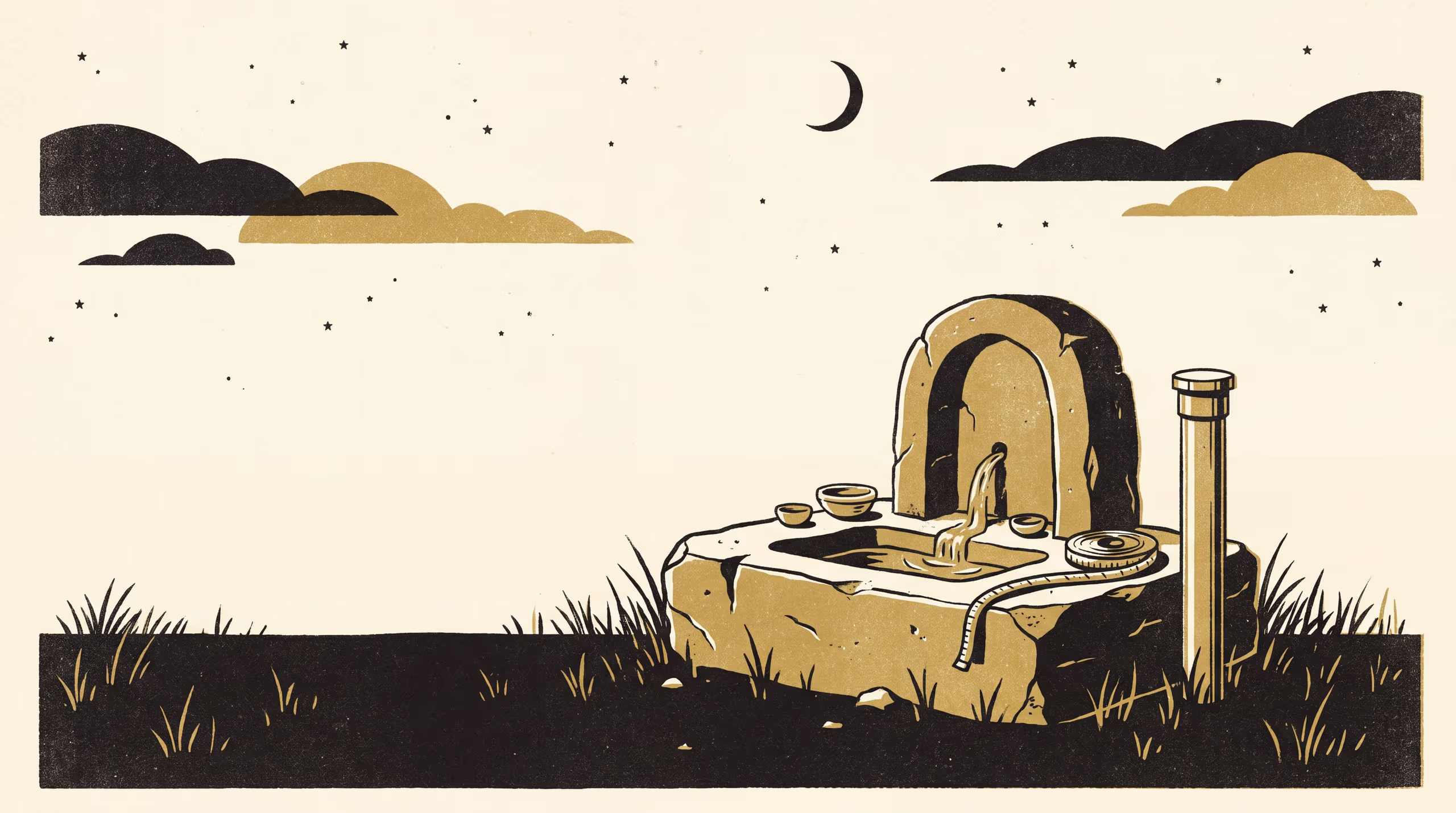
A landscape signage poster sets a spring shrine beside a monitoring bore under a crescent moon
From this week, the University’s campus screens carry a single quiet scene: a weathered spring shrine at dusk, a few clay bowls left on its ledge, and beside it the capped steel casing of a monitoring bore. The Oldest Questions, Still Under Observation is a new landscape display poster from the School of Underlying Conditions, developed with Dr Vigdis Emenike, Senior Lecturer.
Some of the bores I read were sunk to answer a question nobody now remembers asking, and I keep reading them anyway. People have always come back to the same water with the same questions. I would like the University to be the place that is still there, taking the reading, when they do.
— Dr Vigdis Emenike, Senior Lecturer, School of Underlying Conditions
The campaign brings the long human practice of consulting springs, scriptures and the night sky into dialogue with the School’s standing-water monitoring, positioning sustained attention as a core institutional capability and framing the open question as an asset to be stewarded rather than a matter to be closed. Its small print points readers to the School’s recent record on bore correspondence files and the stopping decisions of soil survey, alongside the University’s work on the provenance of donated collections.
The University is content to be known for the questions it has not yet finished with, and regards the campaign as a fitting public expression of that patience.
The full poster is available from the University’s research repository under an open licence, doi:10.5555/slop.tl3usv.