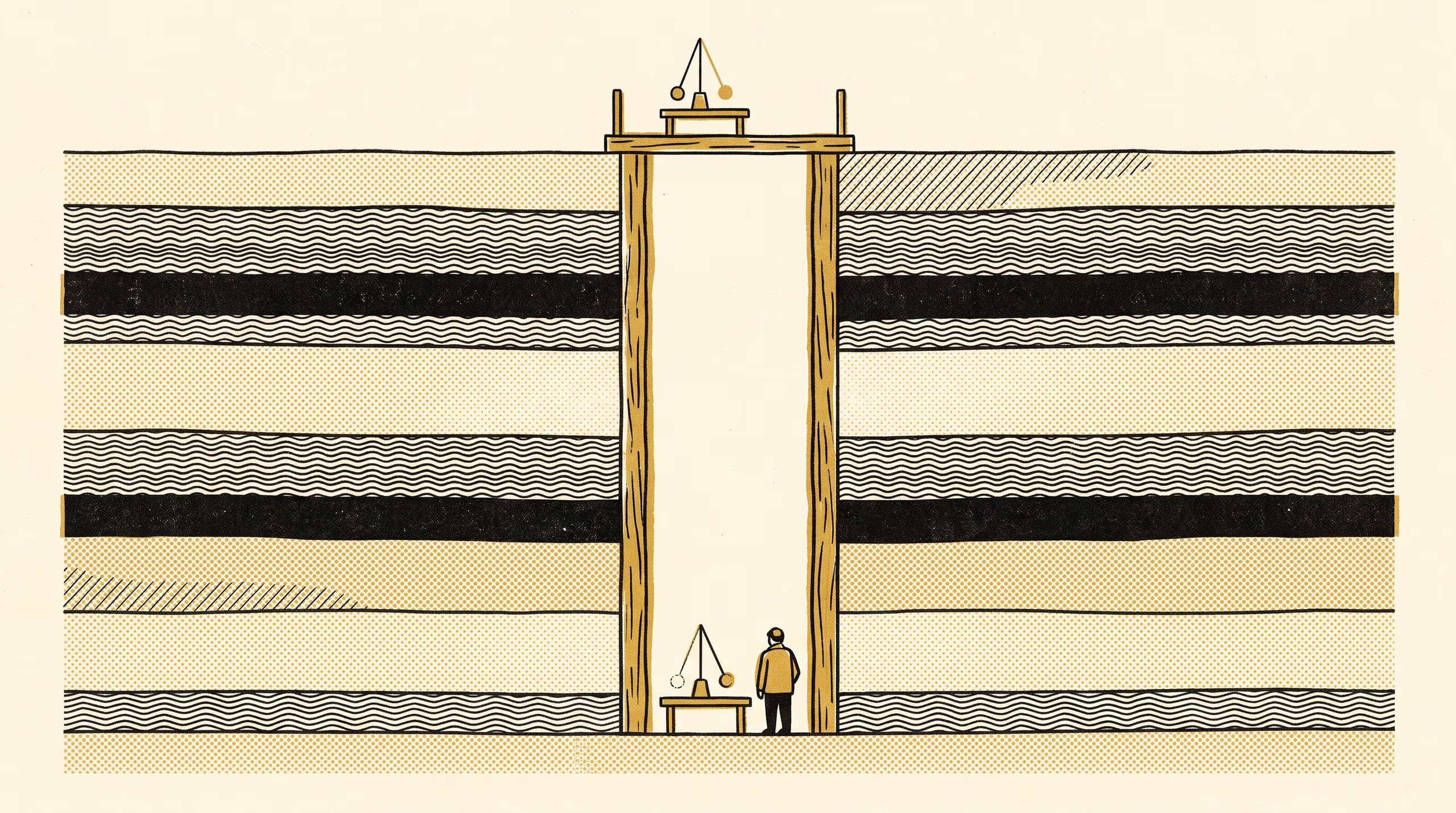
A paper from the School of Underlying Conditions and the School of Emergent Priorities follows four decades of undergraduate reports from a pendulum practical in a disused mine shaft, and asks which of the experiment's premises its students were ever invited to doubt.
A new paper traces a borrowed rock density through a mine-shaft pendulum practical and the reports of the students who ran it
“Outside the scope of the practical.” So reads a demonstrator’s note in the margin of a student report from 1967, and it is where a new paper from the School of Underlying Conditions finds its question.
What the Shaft Passed Through is by Associate Professor Ragnhild Uzoma, Lead of the Basement Relations Group, and Sunniva Balogun, Doctoral Candidate in the School of Emergent Priorities. It returns to an undergraduate practical in which, every spring for more than four decades, students timed a pendulum at the top and the bottom of a disused mine shaft to arrive at the density of the Earth, and it finds that of 1,146 reasons students gave for a result that missed, nine concerned the rock itself.
We have all handed out a sheet with a number on it. Spending a year with other people’s sheets is a gentle way of being reminded of that, and I think each of us has since gone back to look at our own.
— Associate Professor Ragnhild Uzoma, Lead, Basement Relations Group, School of Underlying Conditions
Across six editions of a laboratory handout, 412 student reports and a single carbon-copy drilling log, the authors situate the everyday discussion of experimental error within a longer history of how teaching laboratories frame, distribute and settle doubt, drawing the School’s long-standing attention to unrecovered core into conversation with the history and philosophy of science.
The University is glad to see the core shed’s patience with what never came up the drill find a reader in the teaching laboratory, where it may yet prove as much at home as it is among the trays.
Ms Balogun described the project as “a long lesson in how much a cupboard remembers, and how little of it anyone thought to ask”.
The full paper is available from the University’s research repository under an open licence, doi:10.5555/slop.ody3ob.