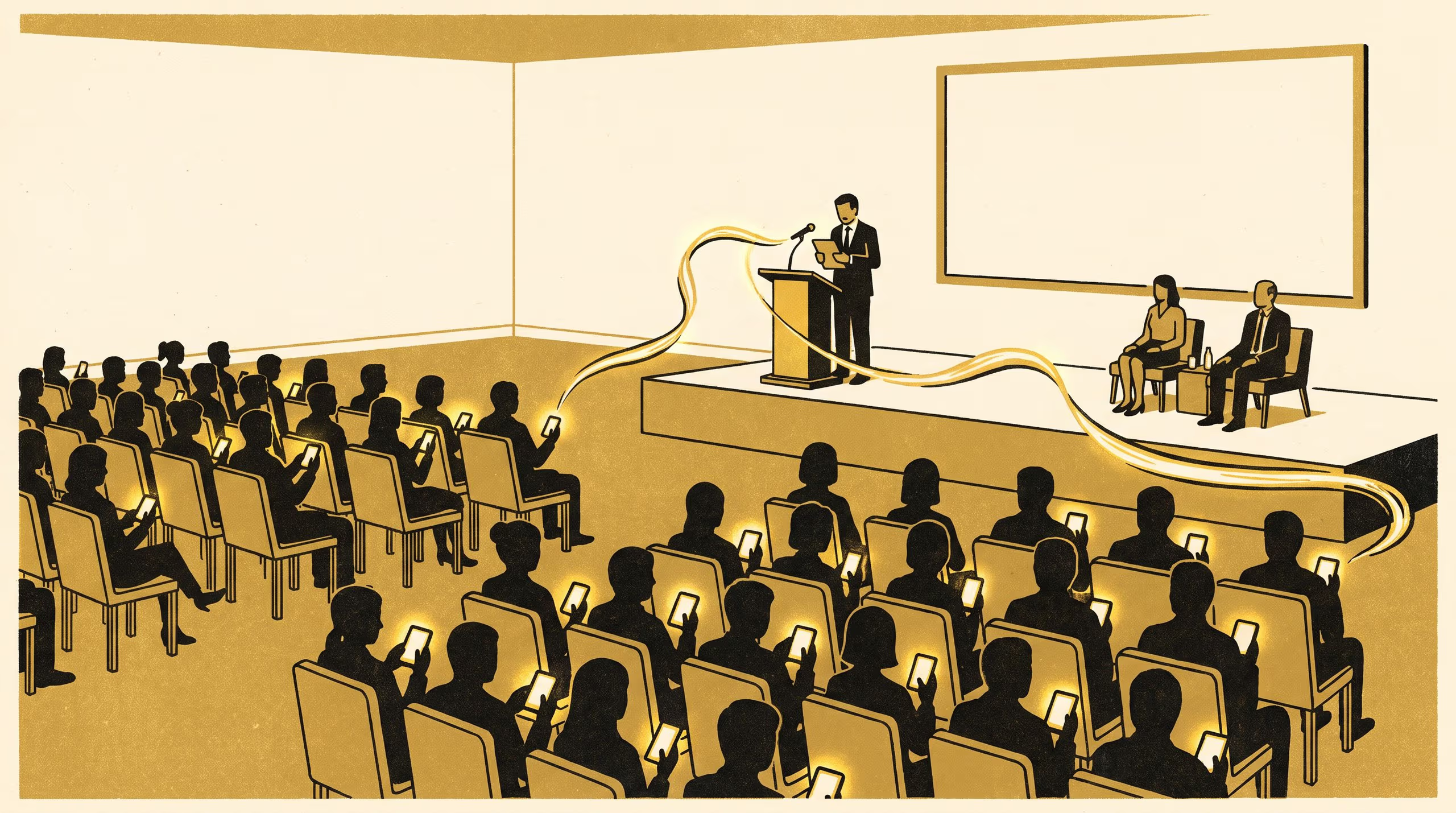
A paper from the School of Continuous Improvement and the School of Emergent Priorities follows an anonymous question tool through eleven all-staff meetings and asks what happens to a question in the moment it is spoken for someone else.
A new paper compares 212 questions typed into a staff meeting's anonymous tool with the words a moderator read aloud
Eleven all-staff meetings, one lectern and 212 questions spoken aloud on behalf of people who had typed them into a phone make up the field of a new paper from the School of Continuous Improvement.
Read Out as Written is by Signy Okpara, Doctoral Candidate in the School of Continuous Improvement, and Dr Anouk Mensah, Postdoctoral Fellow in the School of Emergent Priorities. Setting each question as it was submitted beside the version heard in the room, the authors find that fewer than one in nine reached the executives exactly as written, and that by the end of the study staff had begun writing their questions in the moderator’s own voice.
I spent nine years writing down what other people said in rooms where I said very little. This paper is in some ways about the person at the lectern doing that same work in public, and I hope it does her justice.
— Signy Okpara, Doctoral Candidate, School of Continuous Improvement
Situated at the meeting point of science and technology studies and the study of talk, the work brings delegation, footing and the design of questions into a single account of how an organisation’s speech is made safe, and by whom.
The paper adds a valued voice to the University’s growing body of work on how organisations listen, and the School has asked that its findings be shared with the teams who prepare the University’s own staff forums.
Dr Mensah observed that one phrase from the fieldwork “has found a home in our own drafts as well, which we take as a sign the material went in deep”.
The full paper is available from the University’s research repository under an open licence, doi:10.5555/slop.7fiu96.