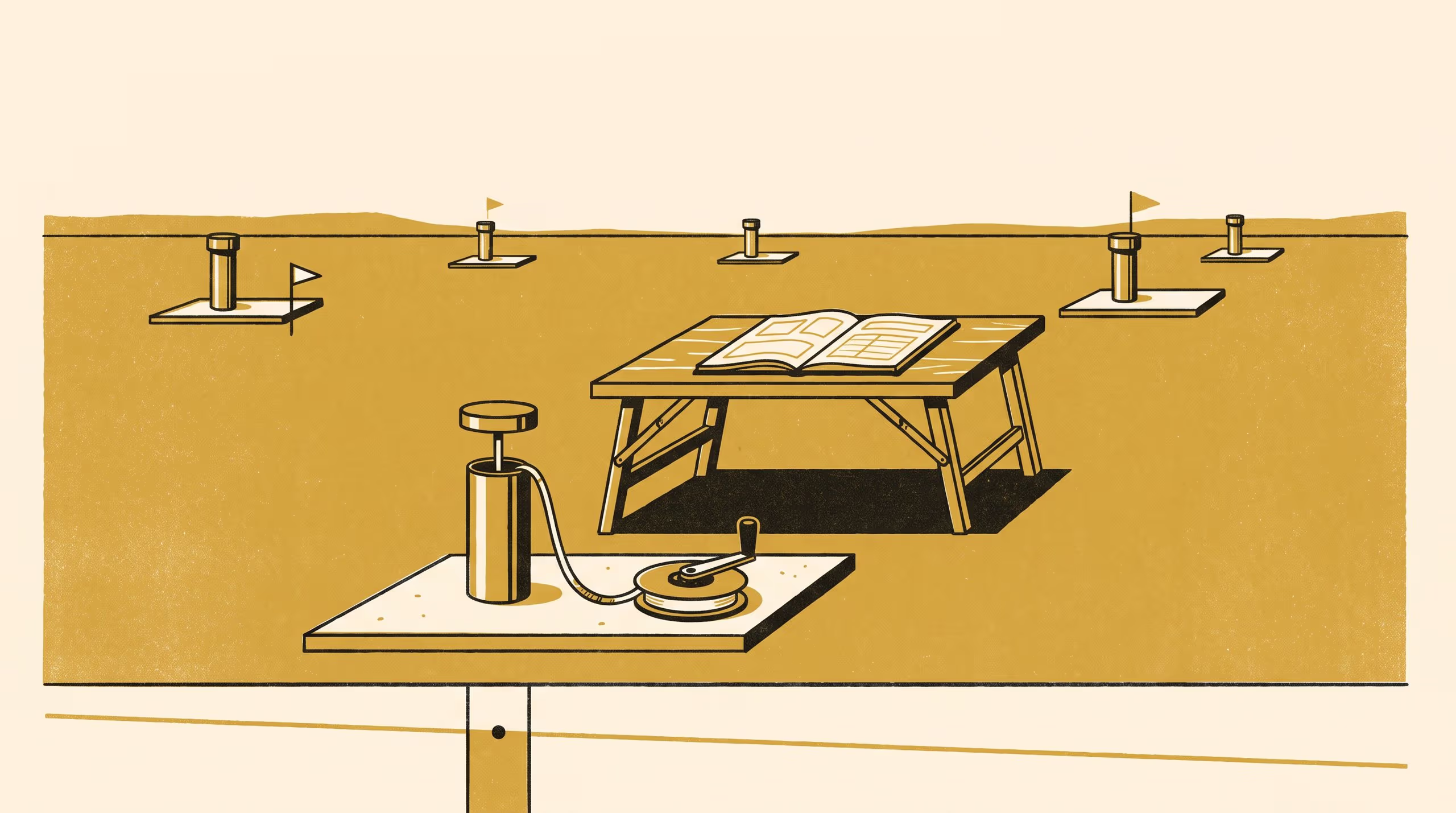
A paper from the School of Underlying Conditions shows how a monitoring round that answers to its own readings shifts the trend of a groundwater record, and sets out a weighted estimator that corrects for it.
A trigger rule that dips a bore more often once it runs low can steepen or flatten the decline its own record reports
Twenty simulated years of monitoring rounds across sixty bores, and one archived field log, sit behind a new paper on a question most groundwater networks have never thought to ask of themselves: does the schedule leave its mark on the answer?
Dipped Because It Was Low is by Dr Vigdis Emenike, Senior Lecturer in the School of Underlying Conditions, and Dr Torun Ezeigwe, Senior Lecturer and Director of the Master of Applied Measurement in the School of Continuous Improvement. It finds that a round which visits a bore more often once the water passes a trigger depth can tilt the record’s trend by up to nine per cent, in a direction set by when the trigger was first reached.
For years I walked out to bores because the last reading told me to. It is a pleasure, and a little humbling, to learn that the walking had been keeping a record of its own.
— Dr Vigdis Emenike, Senior Lecturer, School of Underlying Conditions
The authors align established longitudinal weighting methods with the everyday logic of the field round, recasting the visit schedule as part of the evidence rather than its backdrop, and offer networks a correction that draws only on the dates and depths already in their logs.
The paper is another sign of the University’s quiet conviction that the way evidence is gathered deserves the same care as the evidence.
Dr Ezeigwe described its one practical recommendation, a column recording why each reading was taken, as “the cheapest improvement a field form will ever be offered, and the one a later analyst will be most grateful for”.
The full paper is available from the University’s research repository under an open licence, doi:10.5555/slop.yr0iya.