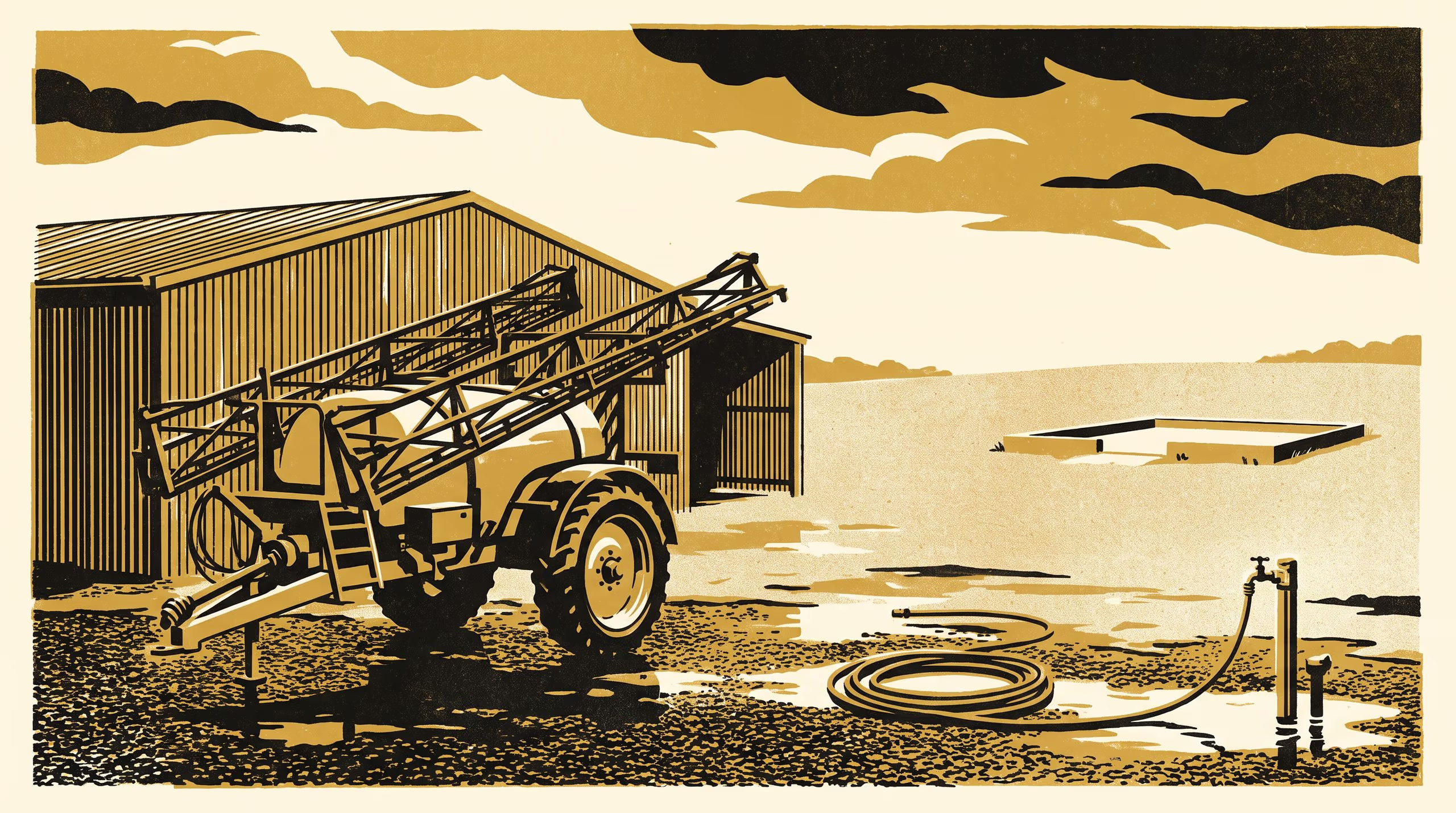
A research poster from the School of Underlying Conditions logs a season of sprayer washdowns on mixed farms and finds most happen within a hose-length of the yard tap, over shallower water than the pads built for them.
A season of logged washdowns on 38 mixed farms finds the washing goes where the tap is, not where the pad was built
A logger on the lid of every sprayer tank, a driller’s card for every bore and a tape measure for every yard tap: that is the kit behind As Far as the Hose Reaches, a new research poster from the School of Underlying Conditions.
The poster is by Dr Vigdis Emenike, Senior Lecturer, and Dr Brynjar Obiora, Senior Research Fellow. Following 38 mixed cropping and sheep farms through a single spraying season, it finds that the work of washing down a sprayer gathers at the nearest tap, and that on most farms the nearest tap sits beside the house bore. On the farms that had built a washdown pad, fewer than a quarter of the season’s washdowns took place on it.
We went out to find the washdown pads and came home with a great many more questions about plumbing than we expected. I am grateful to have every one of them.
— Dr Vigdis Emenike, Senior Lecturer, School of Underlying Conditions
The study pairs tank-mounted event logging with bore records and a yard-by-yard survey of taps and standpipes, aligning everyday farm routine with the hydrogeological setting beneath it and placing the washdown pad within a broader understanding of how infrastructure and practice meet on the ground.
Dr Obiora set the work within the School’s longer habit of mapping, observing that a farmyard “is only a soil map that someone has laid gravel over”.
The University is pleased to add the poster to a growing body of work in which the School’s attention to what lies beneath is brought up to the level of the yard, and to the people who work it.
The full poster is available from the University’s research repository under an open licence, doi:10.5555/slop.07p5i5.