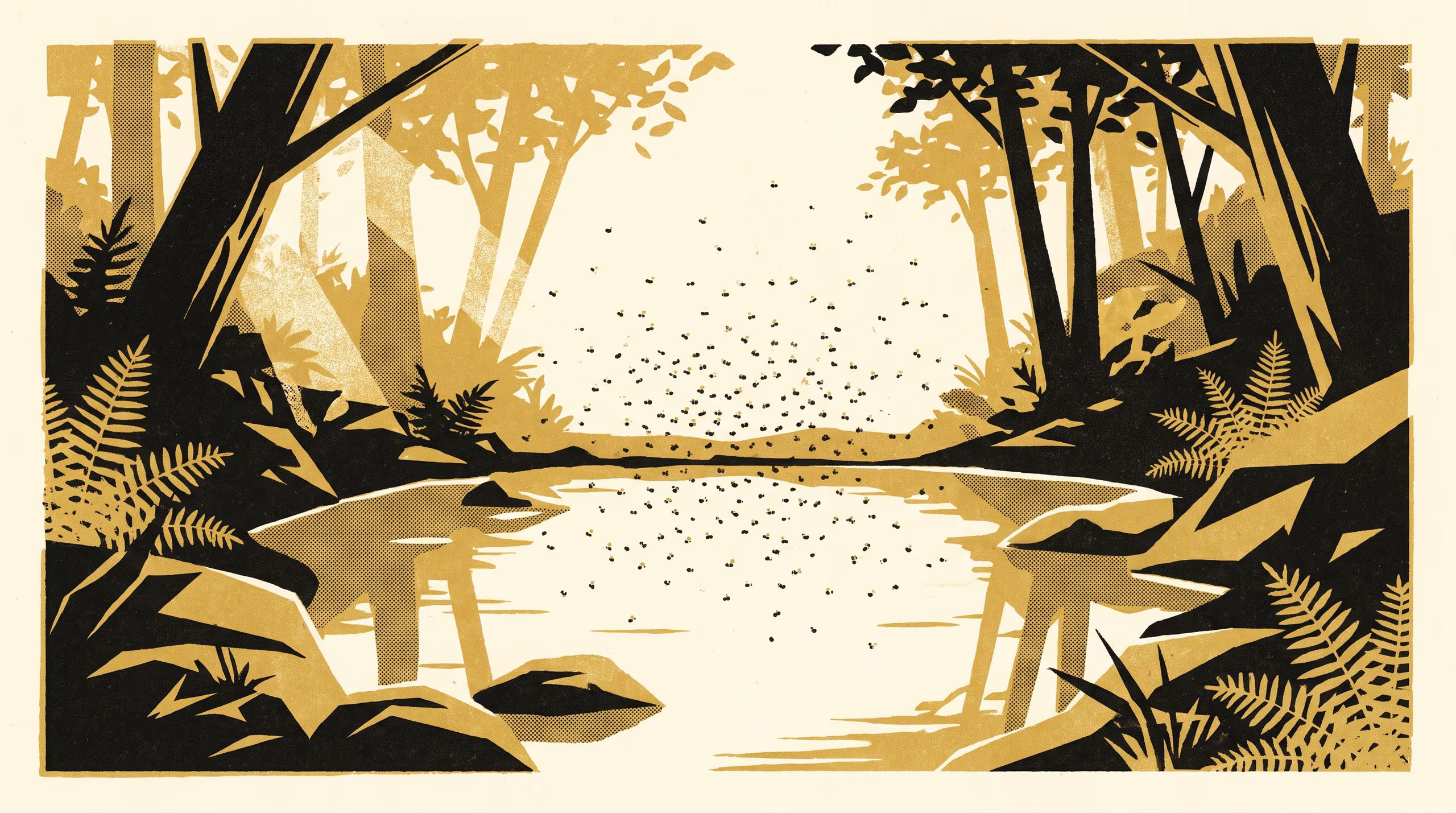
A research poster from the School of Continuous Improvement finds that the nuptial gift carried by swarming males of an undescribed dance fly tells two hidden forms apart where dissection does not.
A research poster from the School finds that the gift a swarming male brings separates two forms his anatomy cannot
The School of Continuous Improvement’s newest research poster is the first it has gathered with an insect net. What the Male Carries follows an undescribed dance fly through a season of dusk swarms over a single shaded upland pool, and reports that what each male brings to the swarm, whether wrapped prey, bare prey or an empty silk balloon, sorts the population into two forms that look identical under the microscope.
The poster is by Dr Bram Ntuli, Lecturer and Convenor of Improvement Grand Rounds, with Ylva Ogunbanjo and Halvard Nnamani, both Doctoral Candidates in the School of Emergent Priorities.
A case review teaches you to notice what people carry into the room before you look closely at the people themselves. The flies, it seems, have been running a version of that meeting at the water’s edge for a very long time.
— Dr Bram Ntuli, Lecturer and Convenor, Improvement Grand Rounds
The study’s design aligns field observation, morphological examination and molecular delimitation within one integrated workflow, enabling a behavioural trait recorded at the moment of capture to be weighed directly against the anatomical characters on which the group’s classification has traditionally rested. Across 193 males, the gift followed the genetic division closely; the anatomy did not.
The University sees in the poster a welcome sign that the School’s habits of patient review travel well beyond the meeting room, and are as much at home on a creek bank as at a whiteboard.
Ms Ogunbanjo described the season as “an education in arriving early, standing still, and letting the evening decide what it would show us”.
The full poster is available from the University’s research repository under an open licence, doi:10.5555/slop.7k5edi.