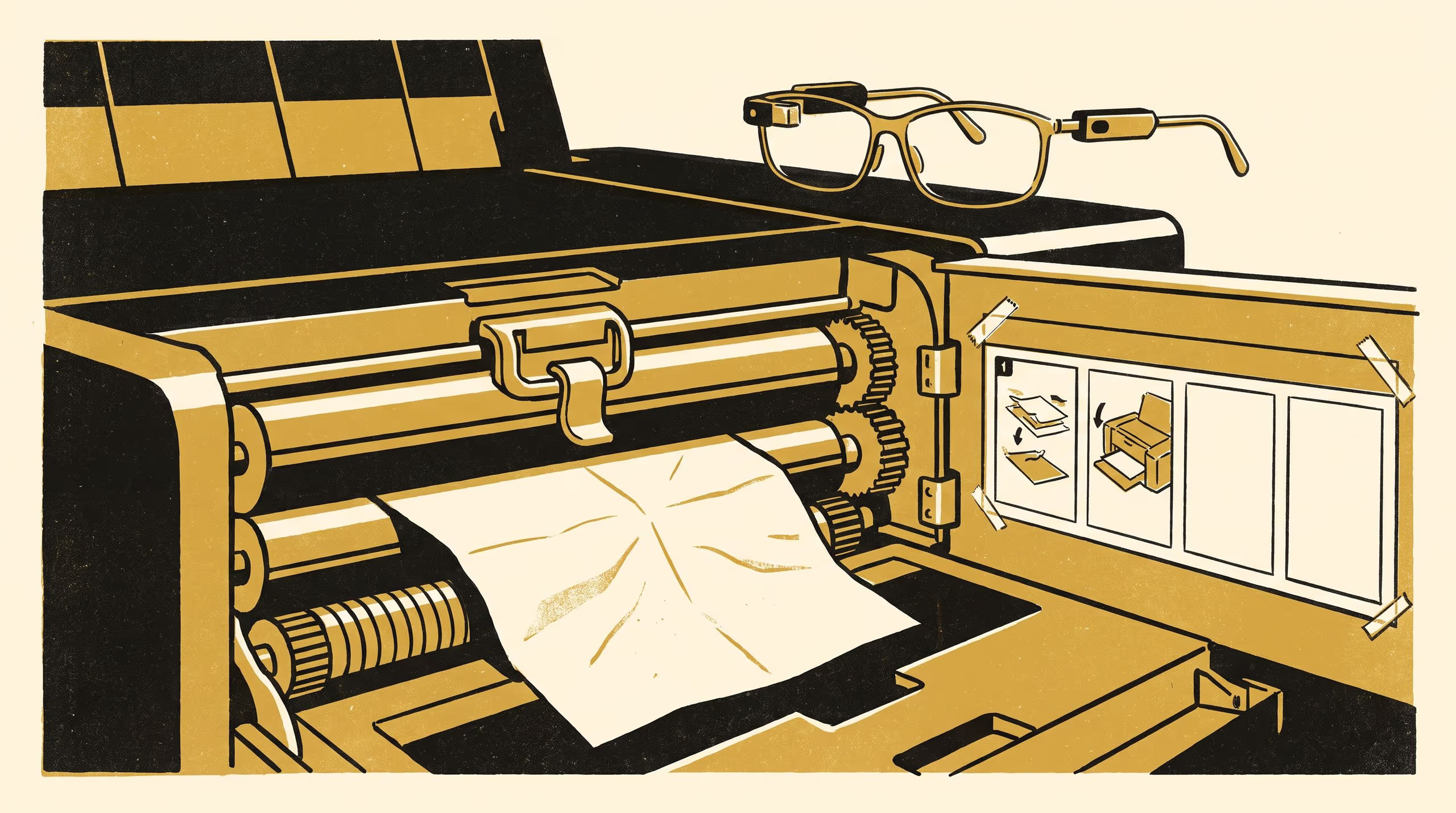
A research poster from the School of Continuous Improvement records the pupils of 72 new staff learning to clear a printer jam from fully worked, faded and problem-only instruction cards, and finds the effort arrives at the first step the card leaves out.
A research poster follows the eye as a printer's worked example is handed back to the learner, one step at a time
Induction is where the University first meets its newest colleagues, and a new research poster from the School of Continuous Improvement asks what happens in the minutes they spend working on their own. Where the Card Stops is by Edda Nwafor, Doctoral Candidate, Signy Okpara, Doctoral Candidate, and Dr Ingeborg Nwachukwu, Lecturer and Convenor of the Capability Sprints.
The School has always believed that induction is a conversation. This project let us listen to the other side of it a little more closely than usual, and I am grateful to everyone who sat down at the printer with us.
— Edda Nwafor, Doctoral Candidate, School of Continuous Improvement
The team invited 72 staff in their first fortnight to learn a nine-step jam-clearing procedure from laminated cards that were fully worked, gradually faded or left blank, while lightweight eye-tracking glasses recorded the size of each learner’s pupil. Bringing the cognitive science of worked examples into conversation with the everyday infrastructure of the shared office, the poster positions the instruction card as a site of learning in its own right, and finds that effort gathers at the first step a card hands back.
Dr Nwachukwu described the work as “an invitation to keep asking where the handover happens, in the printer room and well beyond it.”
The University is pleased to see one of its own most ordinary documents become the object of such careful attention, and looks to the Capability Sprints to carry the work into its short-course offerings over time.
The full poster is available from the University’s research repository under an open licence, doi:10.5555/slop.5yq9lg.