A paper from the School of Underlying Conditions reads the growth lines in one family's kept baby teeth the way a geologist reads drill core, and finds a single line that may run from one child into the next.
The School of Underlying Conditions brings its thin-section laboratory to one household's tin of kept deciduous teeth
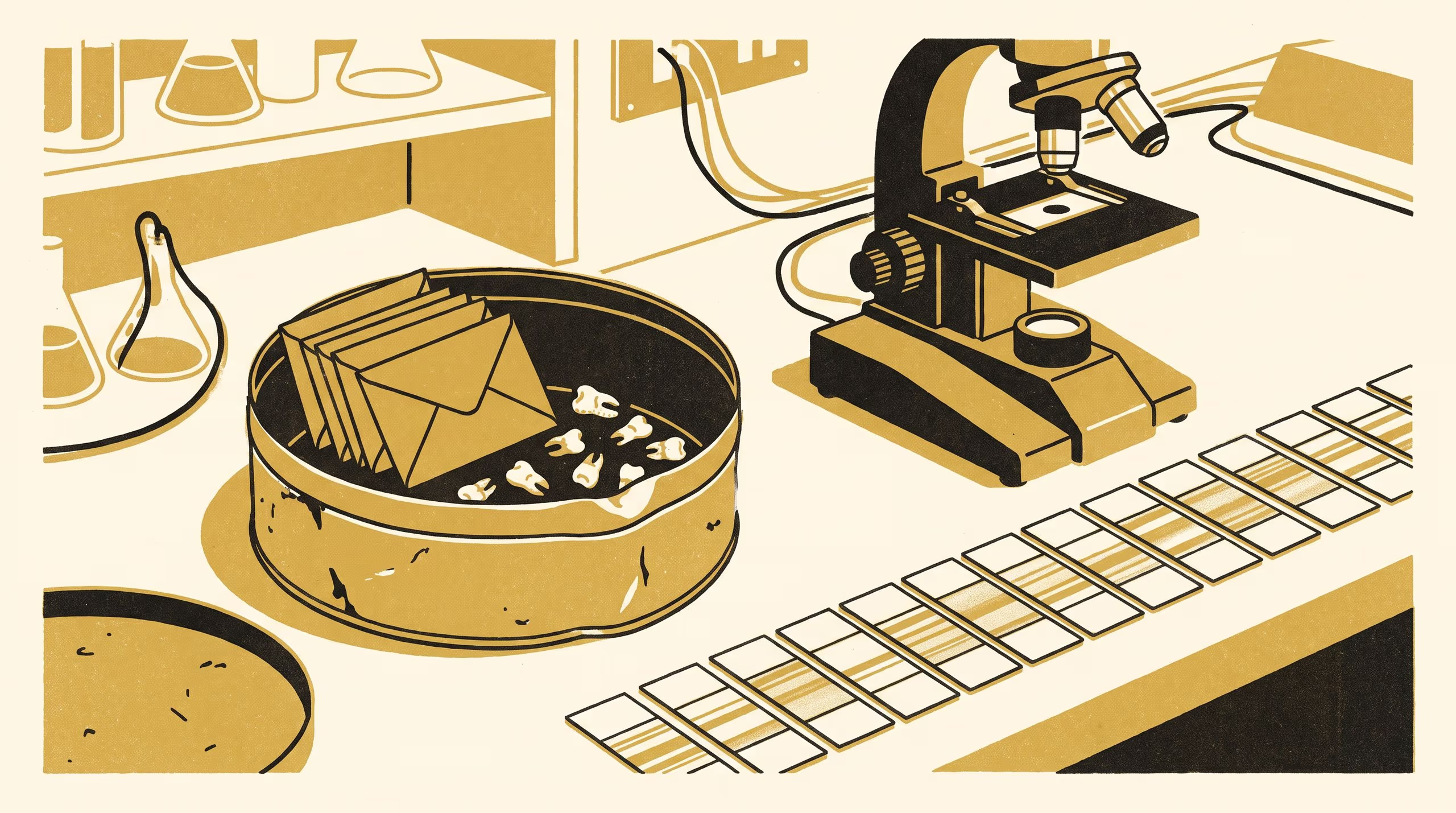
For decades a tin of small paper envelopes sat in a family cupboard, each holding a tooth one of three children had lost. Today it has become the subject of A Line Across Two Children, a new paper from the School of Underlying Conditions.
None of this happens without a parent who kept every envelope and three grown children who said yes. We are very conscious that we were trusted with something that was never collected for us, and we have tried to look after it in that spirit.
— Associate Professor Ragnhild Uzoma, Lead, Basement Relations Group
Associate Professor Uzoma and her co-author, Dr Brynjar Obiora, Senior Research Fellow, carried the School’s core-logging and field-correlation practice into dental development. Applying the rock-preparation laboratory’s established workflows to 30 thin-sectioned teeth, the team built a correlation panel that positions each child’s enamel record within a shared household timeline, and identified one growth line that may pass from the elder child’s molars into the younger child’s incisors in the same week. The authors draw the connection as provisional, in keeping with the conventions of their discipline.
Dr Obiora said the study had left the team “with exactly the right number of unanswered questions, and a good idea of which colleagues across the University will enjoy asking them”.
For the University, the paper is a welcome reminder that a well-equipped laboratory seldom has only one subject, and that the School’s habits of patient recording travel further than its boreholes.
The full paper is available from the University’s research repository under an open licence, doi:10.5555/slop.ssnuu6.