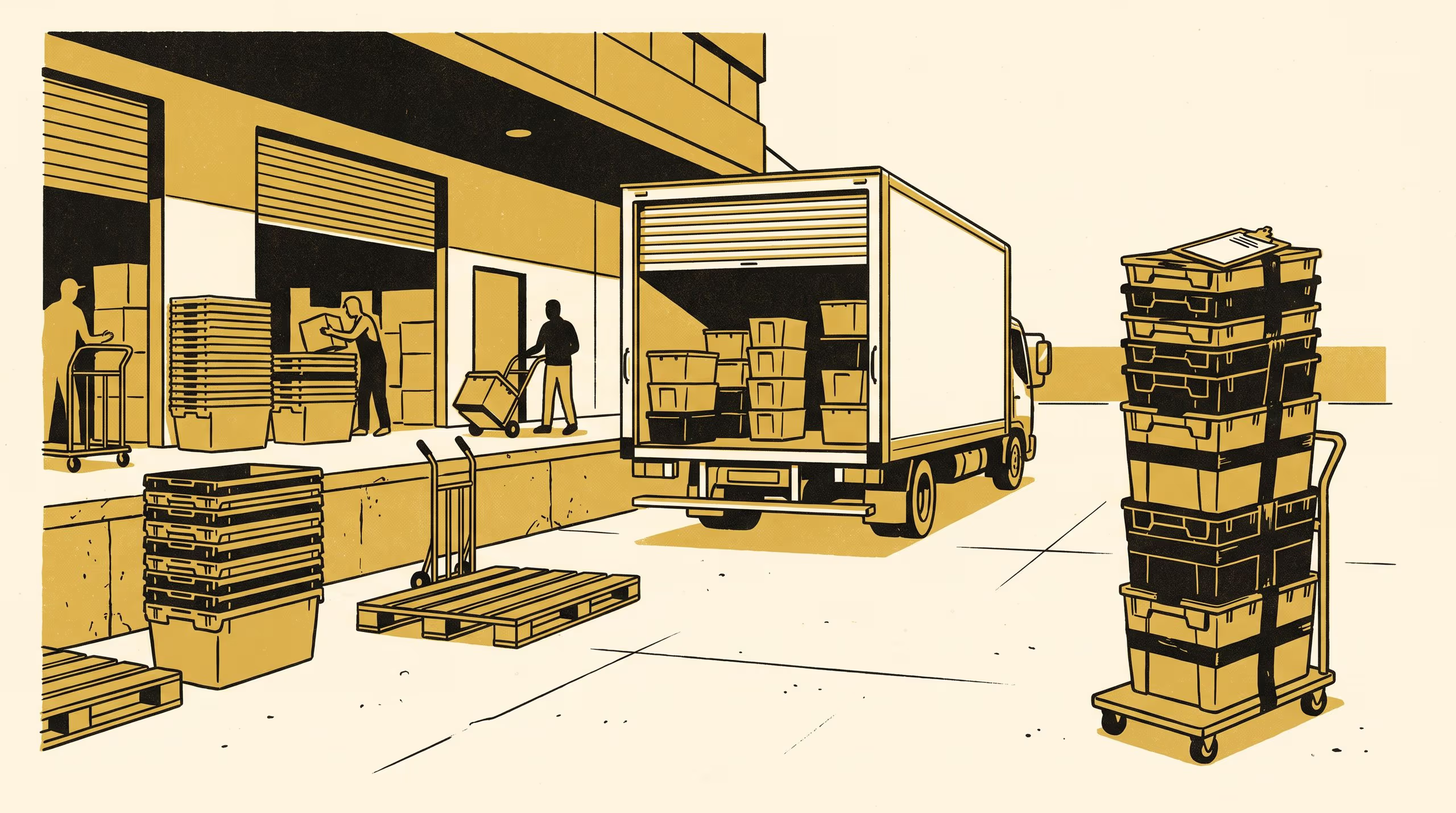
A research poster from the School of Emergent Priorities tests three ways of deciding how many crates to hire for a staged office move, and finds that the crates carried from stage to stage unopened cost more than any choice of order rule.
A School of Emergent Priorities doctoral poster sets office-move crate hire as a newsvendor problem and replays it across 41 archived restacks
Among the decisions the School of Emergent Priorities studies most closely are those an organisation has to make before it knows what it will need. The Crate Nobody Opens Is Still on Hire, a research poster released today, takes up one of the most practical of them: how many crates to hire before an office begins to pack.
Ms Hedvig Anyanwu, Doctoral Candidate, prepared the poster with Dr Bram Ntuli, Lecturer and Convenor, Improvement Grand Rounds, and Dr Ronja Oyelaran, Senior Lecturer and Deputy Convenor, Strategic Drift Survey. Revisiting the hire and packing records of 41 staged office restacks, the team set three ordering approaches against one another and found a simple rule from the operations-research literature serving coordinators well at every stage. The larger opportunity, the poster suggests, lies with the crates that travel on from one stage to the next without ever being opened.
My thanks go to the move coordinators whose dockets made this work possible. They kept their records for whoever came after them, and it is a privilege to have been the one who did.
— Ms Hedvig Anyanwu, Doctoral Candidate, School of Emergent Priorities
The poster brings the School’s attention to anticipatory decision-making into conversation with the established methods of inventory theory, and positions workplace relocation as a setting where priority, logistics and evidence meet. Dr Ntuli described it as “the kind of question a doctoral project ought to leave on the table for the rest of us.”
The University counts the poster among the clearest signs yet that its doctoral cohort is carrying the School’s agenda into new methodological territory.
The full poster is available from the University’s research repository under an open licence, doi:10.5555/slop.f8arwc.