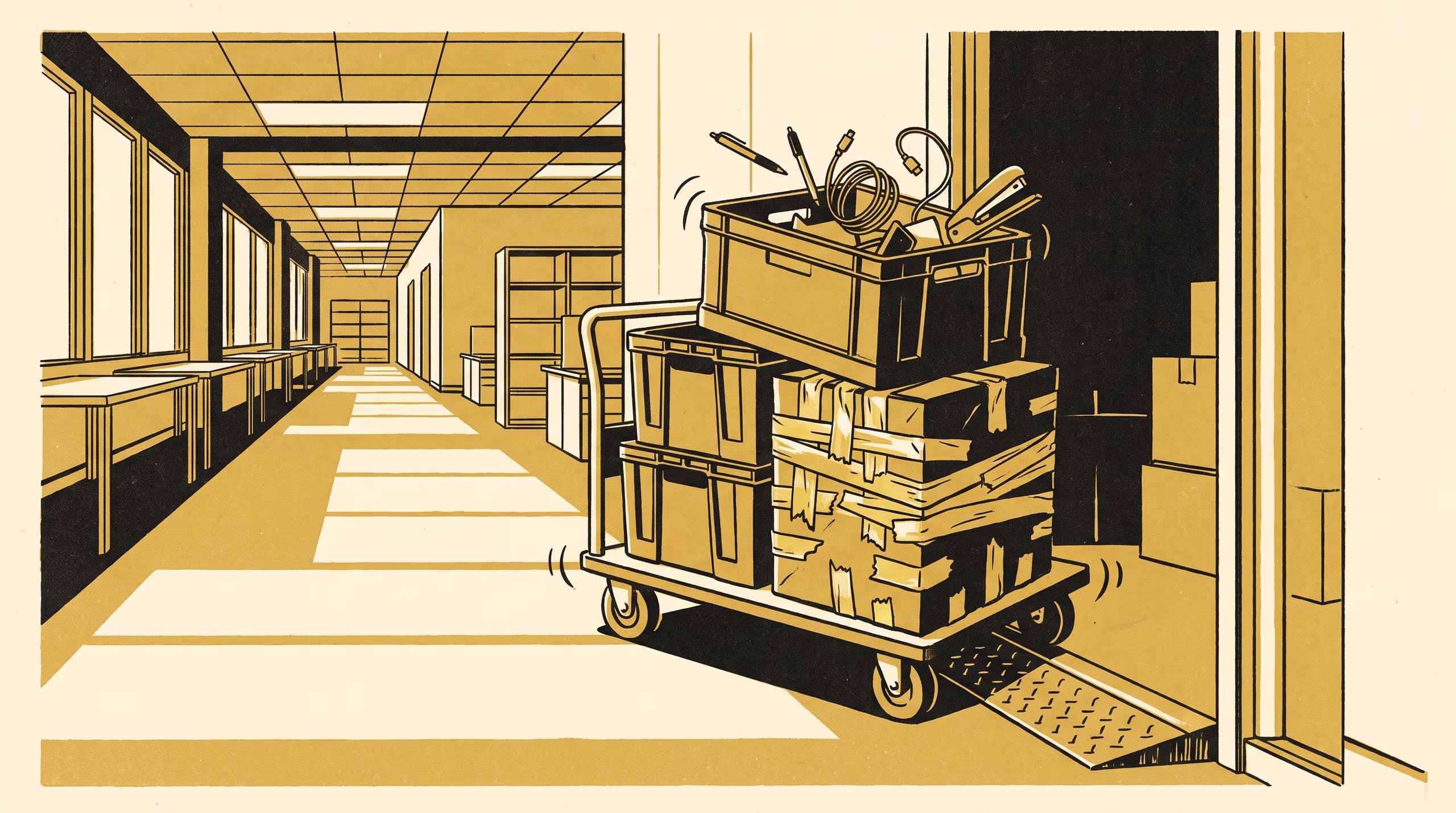
A paper from the School of Emergent Priorities and the School of Underlying Conditions brings Edwards' statistical mechanics of granular matter to the office move, and finds that a sealed crate's state is set by its history.
A statistical-mechanics study of four office restacks finds repacked crates settle together on a shared trolley, while crates carried forward sealed never do
By reading the fill line of a plastic crate after every corridor, lift and door sill, a team from two of the University’s schools has brought the statistical mechanics of granular matter to moving day. The Trolley as a Bath, a paper released this week, follows 212 crate-moves through four office restacks at three organisations.
The paper is the work of Ms Hedvig Anyanwu, Doctoral Candidate in the School of Emergent Priorities, with Dr Brynjar Obiora, Senior Research Fellow in the School of Underlying Conditions, and Dr Ronja Oyelaran, Senior Lecturer and Deputy Convenor of the Strategic Drift Survey.
Every field has a system it reaches for when it wants to be sure of itself. We are glad that, for a few months, ours was a trolley.
— Dr Brynjar Obiora, Senior Research Fellow, School of Underlying Conditions
Bridging the physics of jammed packings and the everyday logistics of the workplace, the study treats the trolley run as a controlled drive and the crate as a measurable system. Crates opened and repacked for a move came to share a single temperature-like quantity within four runs, whatever they held. Crates carried forward unopened from earlier restacks did not, and the more moves they had made, the further they stood from their neighbours.
Ms Anyanwu said the work had left her “with a great deal of respect for packing tape, and rather more for whoever eventually cuts it”.
The University counts the paper among the clearest signs yet that a question asked in one school can be answered with the instruments of another, and that its doctoral candidates are carrying such questions further each term.
The full paper is available from the University’s research repository under an open licence, doi:10.5555/slop.vobkbu.