A new research poster from the School of Underlying Conditions follows primed mealworm larvae for four weeks and finds that the question of when their protection ends has more than one honest answer.
Two accepted tests, applied to the same 2,100 larvae, place the end of protection weeks apart
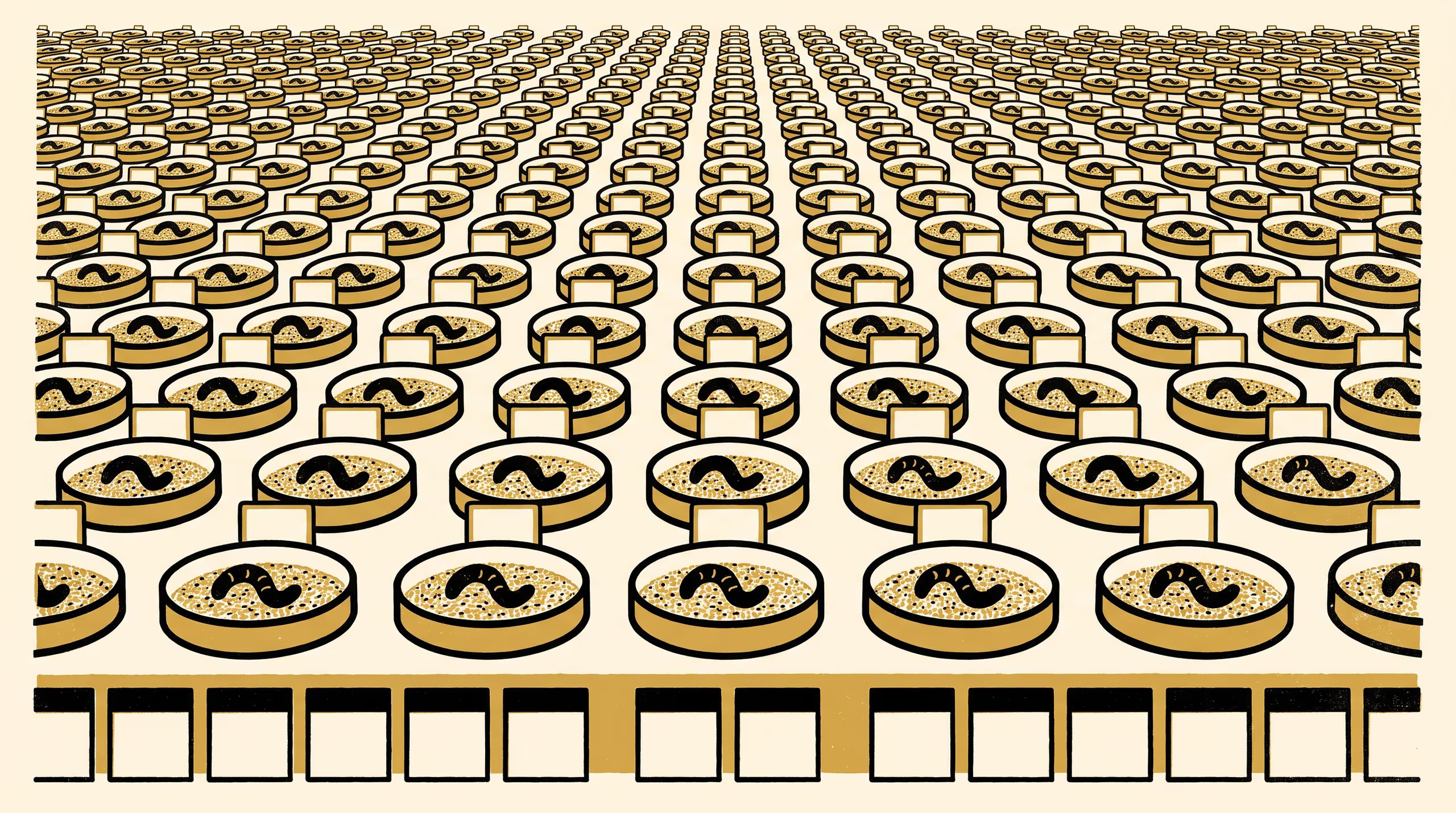
Two thousand one hundred mealworm larvae, each in a well of its own, are at the centre of Where the Primed Window Closes, a research poster released today by the School of Underlying Conditions. The larvae were primed against a bacterial challenge and then tested on one of seven days across four weeks, so that the team could say when the benefit of that priming runs out.
The answer turned out to depend on how the question is put. Read one way, the protection is gone after the first week; read another, it cannot be called finished until the fourth. Between the two lies a stretch of days on which the evidence declines to choose.
We went looking for a day and came home with the better part of three weeks. The School has become quite at ease with reporting a margin where others would draw a line.
— Dr Brynjar Obiora, Senior Research Fellow, School of Underlying Conditions
The poster brings together Ms Ylva Ogunbanjo, Doctoral Candidate in the School of Emergent Priorities, and Dr Dagny Okafor, Lecturer and Convenor of Evaluation of Evaluation in the School of Continuous Improvement, alongside Dr Obiora. Its approach aligns pre-registered decision criteria with a staged challenge design, positioning the end of a protective response as a zone to be reported rather than a date to be announced.
“Every good criterion is also a choice about what we are prepared to call finished,” Dr Okafor said. “We welcome the conversations that choice invites.”
The poster sits within the University’s continuing investment in work that attends closely to where one condition gives way to the next.
The full poster is available from the University’s research repository under an open licence, doi:10.5555/slop.n2u78p.