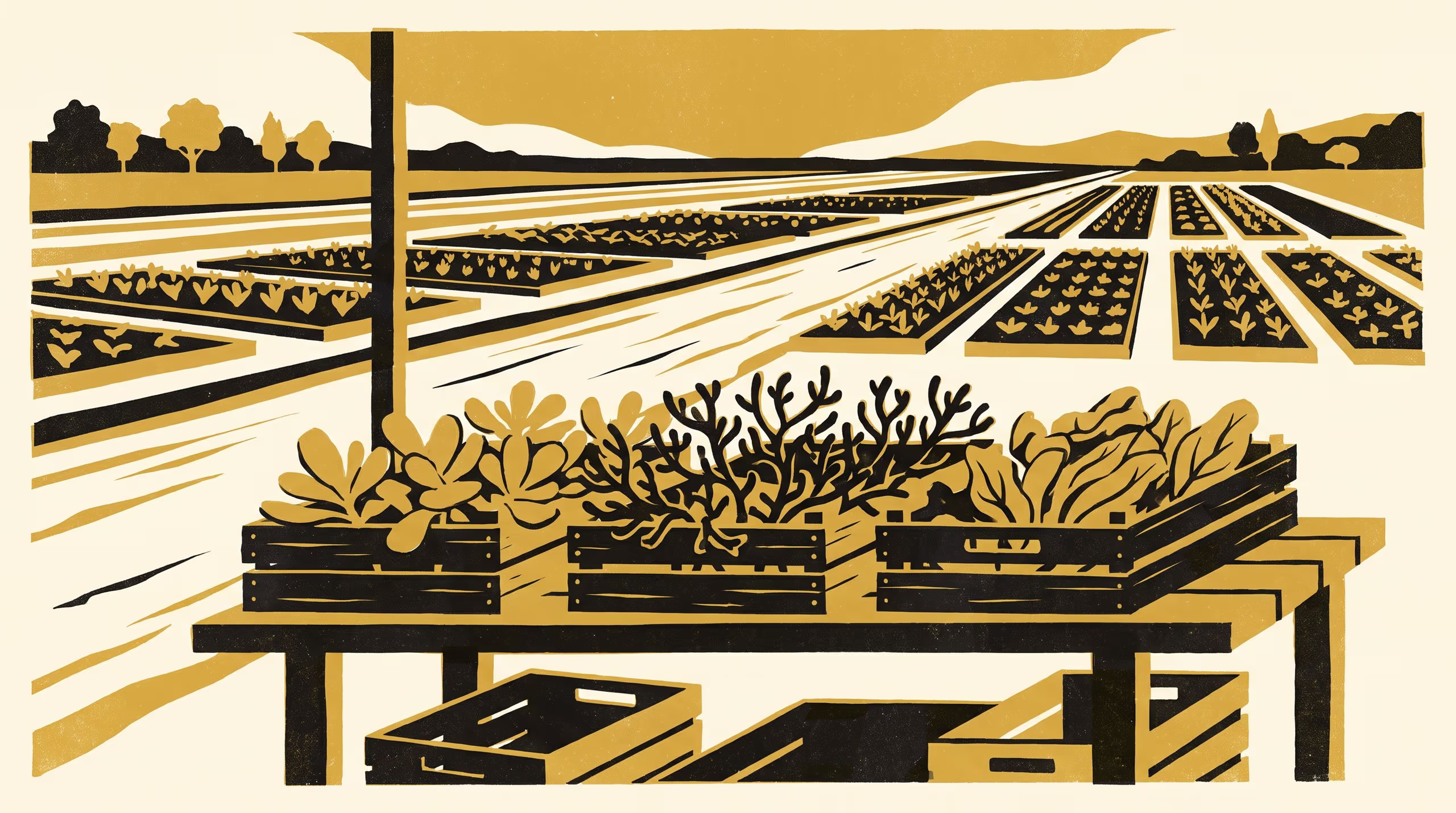
A research poster from the School of Underlying Conditions maps where growers along one river road stop calling purslane a weed and start calling it food, and finds the line sits further upstream for each younger cohort.
A river-road survey of 168 growers finds the naming line for purslane sits further upstream among younger speakers
Over a single growing season, a fieldworker carrying a fresh sprig of purslane asked 168 growers and stallholders along one river road what they called it. Their answers, gathered in Where Purslane Stops Being a Weed, a new research poster from the School of Underlying Conditions, trace a boundary in the district’s speech that crosses the market gardens as plainly as any line on a soil map.
The work is led by Dr Brynjar Obiora, Senior Research Fellow, with Ms Sunniva Balogun, Doctoral Candidate in the School of Emergent Priorities. Upstream, the plant is pulled from between the lettuces; downstream, it is sold by the bunch. Among the district’s youngest speakers, the point where one name yields to the other sits some fifteen kilometres further up the road than it does among their elders.
Every name a district keeps for a plant is a small decision about what the plant is for. We were fortunate to arrive while the district was still deciding.
— Ms Sunniva Balogun, Doctoral Candidate, School of Emergent Priorities
Carrying the instruments of dialect geography from the archive to the trestle table, the poster aligns speaker age, place and vocabulary into a single account of how a working community’s relationship with a familiar plant is renegotiated across generations.
The University counts the study among a widening family of inquiries in which the School of Underlying Conditions turns its survey methods towards the words people use for the ground they work. Dr Obiora expects the conversation to continue. “We will be back at the same stalls before long,” he said, “and we fully expect the plant to be there before us.”
The full poster is available from the University’s research repository under an open licence, doi:10.5555/slop.3azdnr.