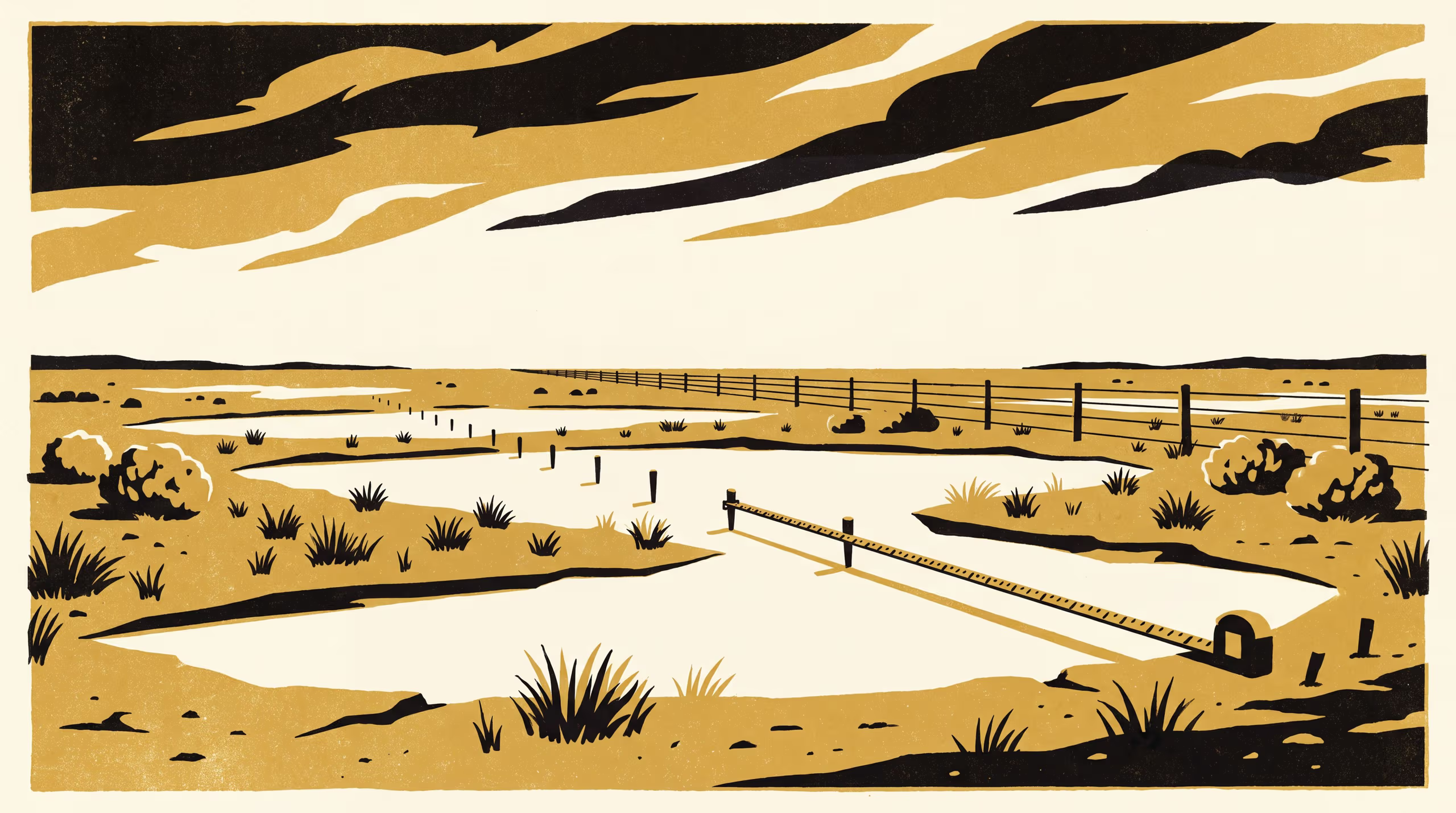
A research poster from the School of Underlying Conditions re-surveys the edges of bare scalds in one grazed paddock across eight seasons, and finds that fencing out the stock halted their advance without returning the ground.
Thirty-six pegged transects find the edge of a scald moves into the grass and does not come back
We owe a good deal to a paddock that let us come back eight times, and was every time exactly as good as its word.
— Dr Brynjar Obiora, Senior Research Fellow, School of Underlying Conditions
With those words Dr Obiora introduces The Scald Keeps Its Ground, a new research poster written with Ms Ylva Ogunbanjo, Doctoral Candidate in the School of Emergent Priorities. It reports on the boundary between grassland and the bare, sealed patches known as scalds, and on what that boundary does when grazing pressure is lifted.
Combining long-term field monitoring, soil physics and a fenced comparison, the study assembles a season-by-season account of how two neighbouring states of the same landscape negotiate the line they share. Across 36 pegged transects, the edges moved into the grass through two dry seasons. Where stock were then fenced out, they stayed close to where they had stopped, retreating only at the few places where the scald’s crust had cracked.
Ms Ogunbanjo spoke of the work as one chapter in a longer watch. “There will always be another season,” she said, “and we would like to be standing at the peg when it arrives.”
The University counts the poster among the steadier undertakings of a School that has made a habit of returning to the same ground and taking it seriously each time.
The full poster is available from the University’s research repository under an open licence, doi:10.5555/slop.mo0ysk.