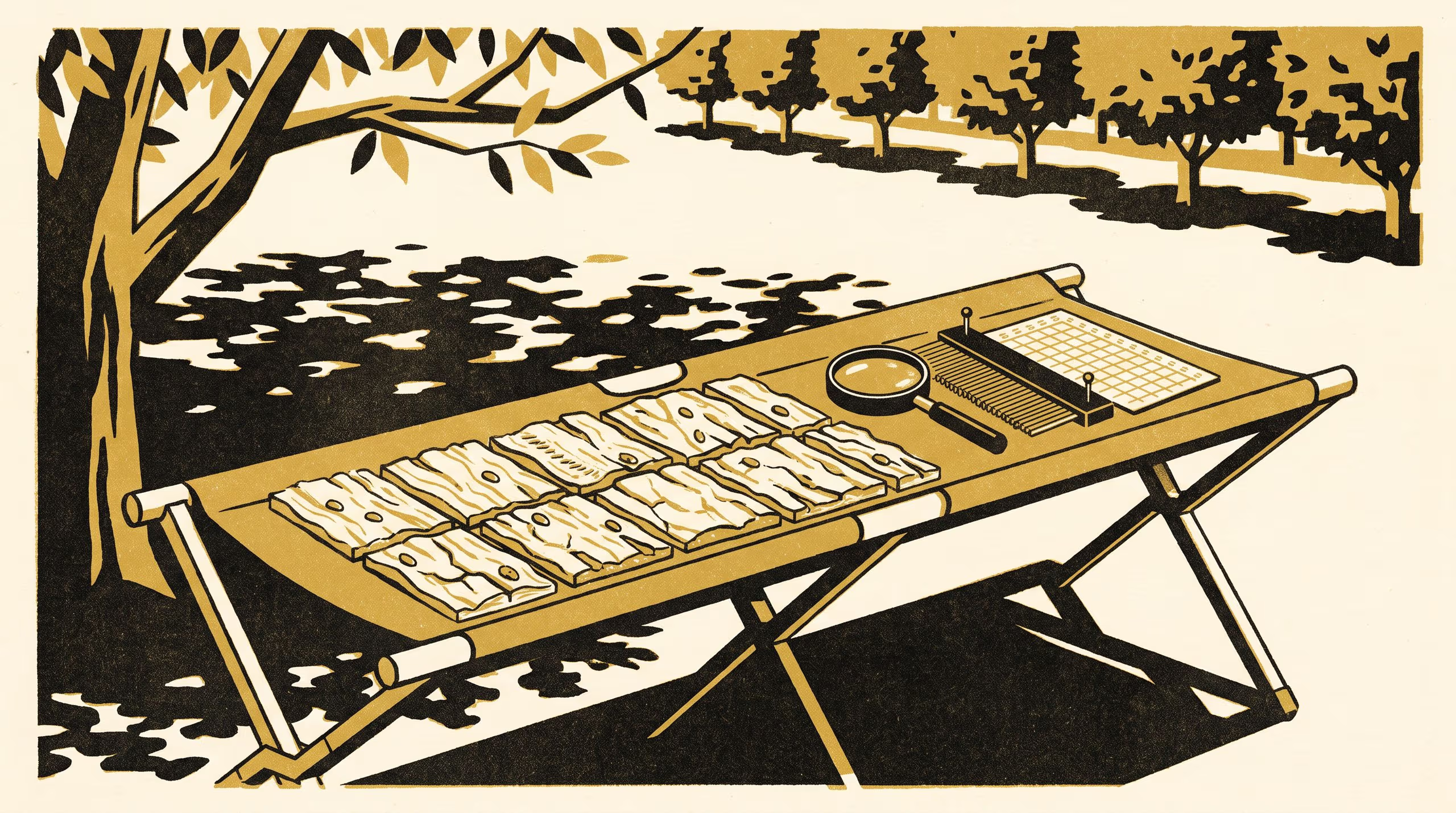
A research poster from the School of Underlying Conditions casts 96 panels of windbreak bark in silicone and finds armoured scale crawlers settling in fissures 2–4 mm deep far beyond their share of the surface.
On one orchard windbreak, armoured scale crawlers came to rest in the middle depths of the bark's fissures
Silicone casts of ninety-six squares of tree bark, each read across a fine grid, underpin Settled in the Seams, a new research poster from the School of Underlying Conditions. The work asks where on a fissured trunk an armoured scale crawler comes to rest, and why that place and not another.
It is led by Associate Professor Ragnhild Uzoma, Lead of the Basement Relations Group, with Dr Brynjar Obiora, Senior Research Fellow.
Across one windbreak row, the team set the 2,140 scale covers they mapped beside the relief available to them. Settlement gathered in the middle depths of the fissures, where 59% of covers sat on 28% of the surface, while ridge crests and the deepest channels were passed over. On panels whose bark had been lightly flattened before the crawlers emerged, scales settled just as densely, only without the preference.
I came to this from the drill core, where you are always asking what a surface is resting on. A tree trunk asks the same question at a smaller scale, and I would be delighted to hear from anyone who thinks we have answered it too quickly.
— Associate Professor Ragnhild Uzoma, Lead of the Basement Relations Group
The poster brings field mapping, casting practice and settlement survey into a single reading of the trunk surface, and extends the School’s attention to ground conditions upward into the canopy’s lower storey. Dr Obiora described the casts as “an archive the windbreak will keep adding to, whether or not we come back to read it.”
The University welcomes the poster as a further instance of its earth sciences reaching for what lies just below whatever surface is at hand.
The full poster is available from the University’s research repository under an open licence, doi:10.5555/slop.lvtvnr.