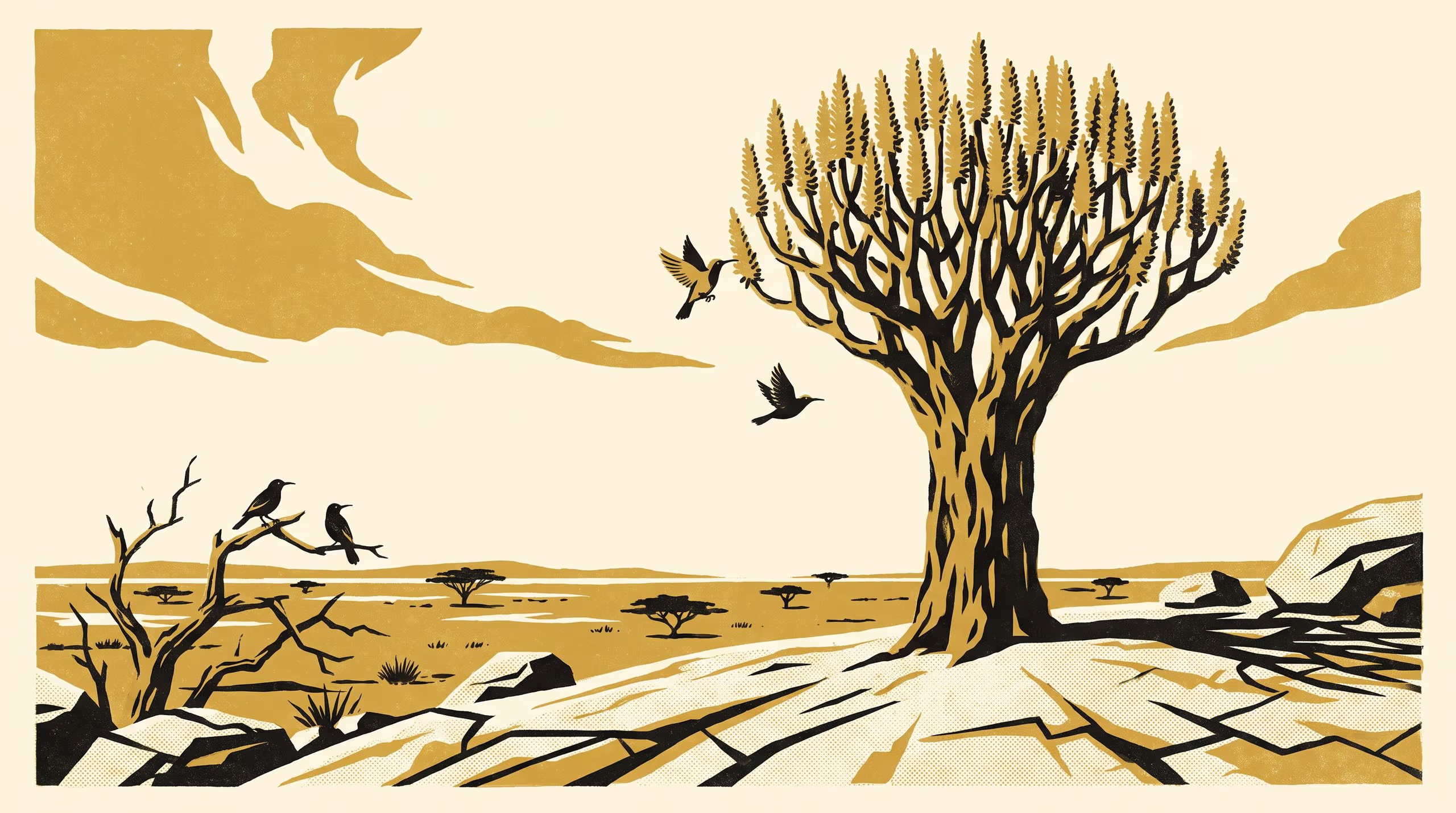
A paper from the School of Continuous Improvement locates the point at which a territorial sunbird stops defending a winter-flowering tree aloe, and shows how a simple count can estimate it.
A season of field watches on a granite outcrop brings Little's law to the queue at a flowering aloe
A sunbird holding a flowering tree will chase off a great many visitors, but not an unlimited number. Little’s Law at the Inflorescence, a new paper from the School of Continuous Improvement, finds where that limit falls: at around seventeen intruders an hour, defence of a winter-flowering aloe gives way, and the tree becomes open to all comers.
The paper is by Dr Osei Vandermeer, Research Fellow and Convenor of the Review Cadence Observatory, with Dr Bram Ntuli, Lecturer and Convenor of Improvement Grand Rounds, and Associate Professor Ragnhild Uzoma, Lead of the Basement Relations Group in the School of Underlying Conditions.
Our School asks, as a matter of habit, how often a thing ought to be looked at. A winter on the hill gave us an unusually clear answer, and a great deal of respect for the birds that had been asking it before us.
— Dr Osei Vandermeer, Research Fellow and Convenor, Review Cadence Observatory
Combining structured field observation across 576 half-hour watches with established principles from operations research, the team positions the flowering inselberg as a setting in which the economics of territorial behaviour and service-system thinking can be held within a single frame, and offers fieldworkers a lighter-touch pathway to one of the harder quantities in behavioural ecology.
“We came down with more questions than we carried up,” said Dr Ntuli. “That seems to us the right way round for a first season.”
The University sees in the paper a quiet confirmation that its improvement scholars travel well, and are as attentive on a granite slope as in any meeting room.
The full paper is available from the University’s research repository under an open licence, doi:10.5555/slop.yczmh6.