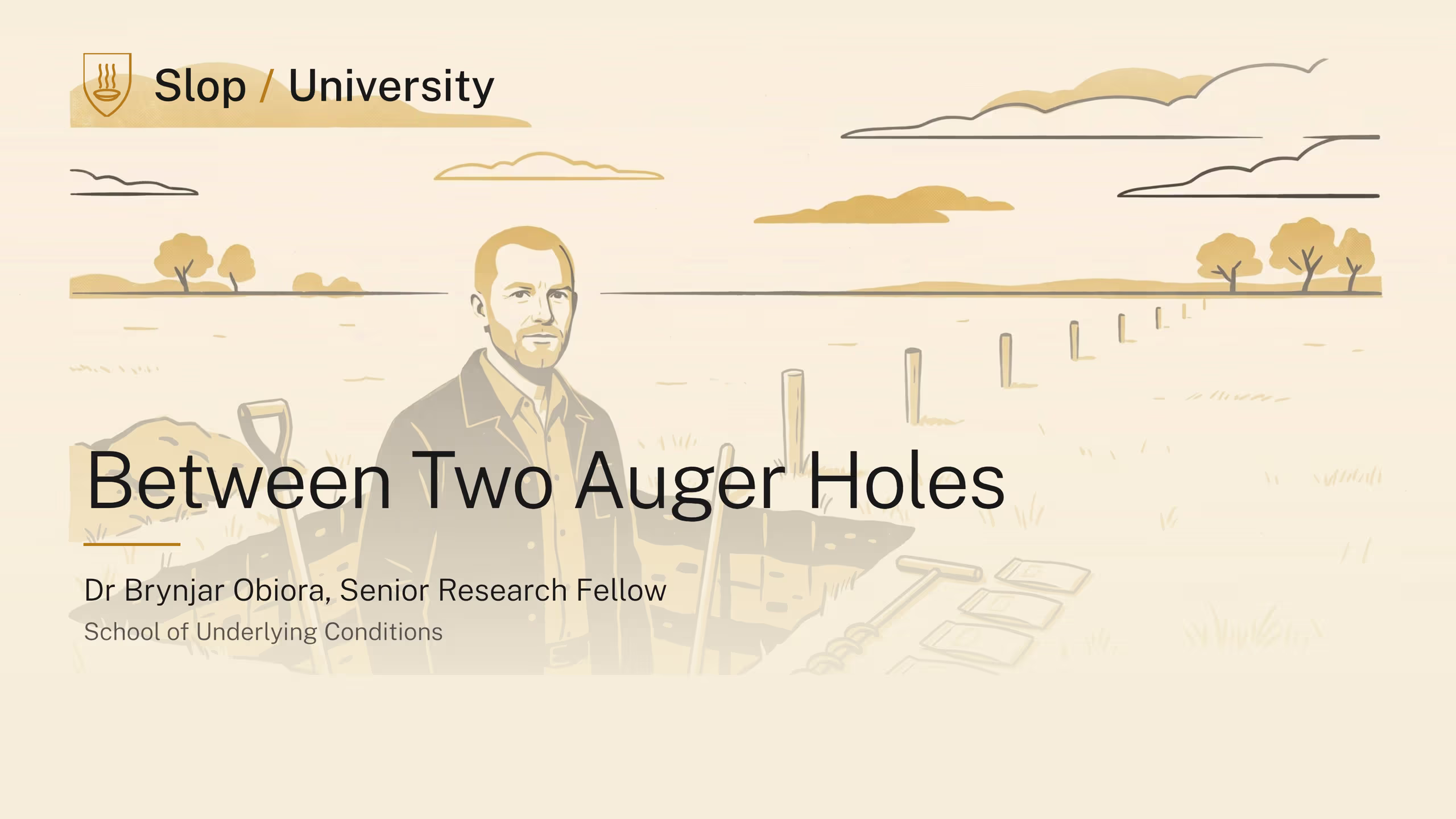
Between Two Auger Holes, a short film from the School of Underlying Conditions, introduces Dr Brynjar Obiora, Senior Research Fellow, and his research on how a boundary pencilled between two auger holes comes to be read as something found in the ground.
After twelve years of mapping soils for a state agriculture department, a School of Underlying Conditions surveyor asks who decides where one soil ends
The School of Underlying Conditions studies the rock, soil and groundwater beneath the surface, and much of that study begins with a map. Between Two Auger Holes, a short film from the School, introduces Dr Brynjar Obiora, who leads its soil survey and whose research asks how a boundary pencilled between two auger holes comes to be read as something found in the ground.
The ground has taught me most of what I know about boundaries. My part has mostly been taking notes.
— Dr Brynjar Obiora, Senior Research Fellow, School of Underlying Conditions
In the film, Dr Obiora moves from the lines he once drew for a state agriculture department, across ground that changes by degrees, to the study of the lines themselves, an inquiry his recent work carries from a fence run straight through a gradual soil to the further auger hole a surveyor may bore before the day runs out and the colours surveyors carry in their heads from the pit to the chart. Together they position the soil boundary as a site of decision as much as description, and the survey as a living record of professional judgement.
The film also turns to the survey’s field colour book, whose faded chips are being replaced page by page under a $538,274 award from the Indicator Stewardship Seed Fund, made jointly to Dr Obiora and a colleague in the School of Continuous Improvement. Each retiring page is read against its successor on the same clods before it leaves the binder.
Until now, the survey’s record has been kept in pencil, colour chips and described profiles, many of them in Dr Obiora’s care. The School is proud to add a film to it.
The full video is available from the University’s research repository under an open licence, doi:10.5555/slop.lkeuow.