Eigenvector Memory and Spectral Ageing in Randomly Diluted Wigner Matrices
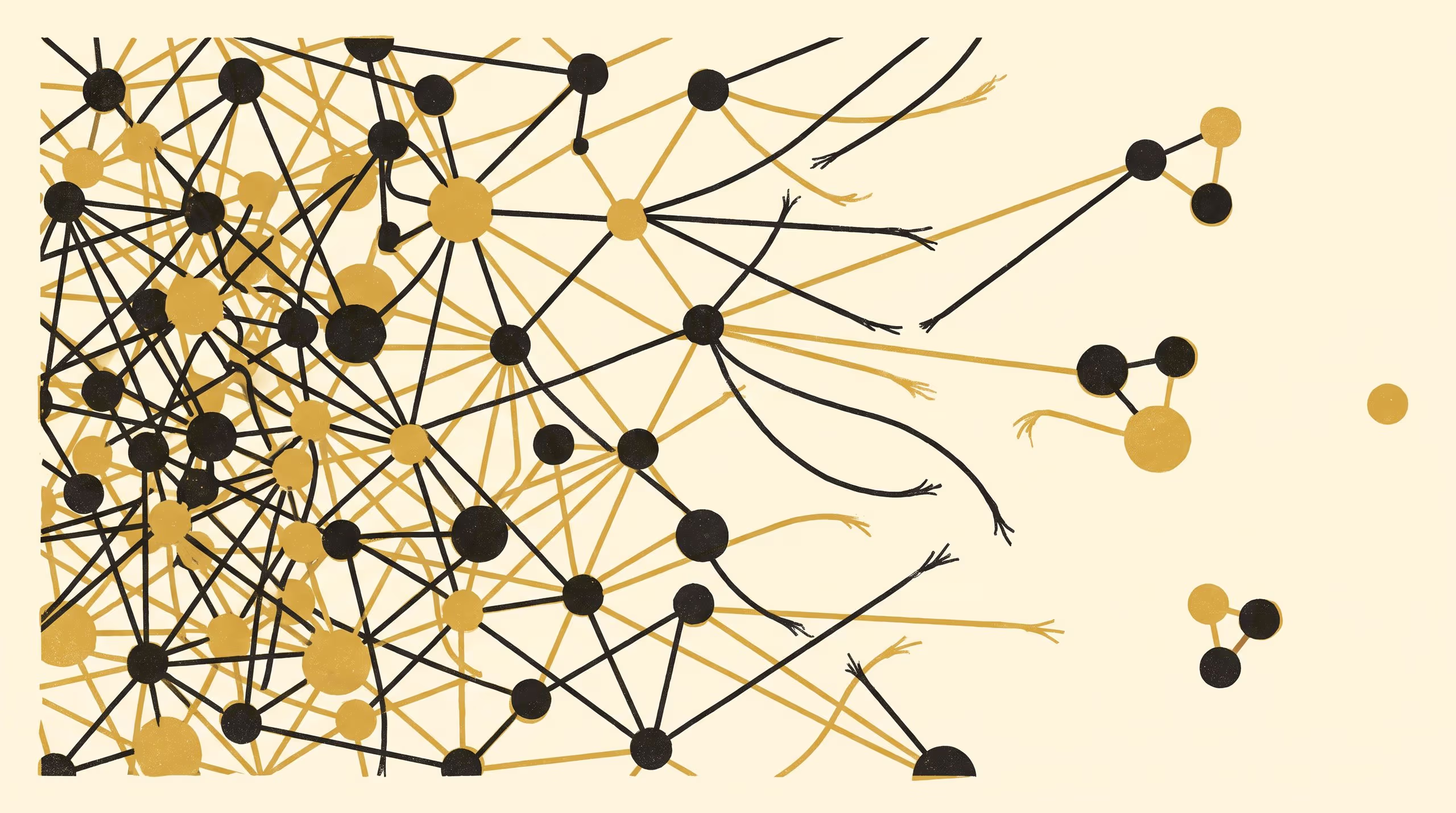
A paper from the School of Emergent Priorities switches off the couplings of a random symmetric matrix one at a time, at independent exponential times, and shows that while the matrix stays dense its eigenvectors forget at a rate set only by elapsed time, exactly as under Dyson's Ornstein–Uhlenbeck process. Once fewer than a handful of couplings per row remain, forgetting slows with the age of the system, the memory half-life rising from 0.89 to 1.41 and beyond 2, because what is left sits on small isolated clusters that change only when one of their own couplings lapses.
| Authors | Marek Solheim |
|---|---|
| School | School of Emergent Priorities |
| Output type | Research paper |
| Funding | Anticipatory Capability Fund: Setting a Retirement Date for a Suburb's Temporary Detour Signs at Installation ( $317,564) |
| Published | |
| DOI | 10.5555/slop.zkb0qc |
| Pages | 5 |
| Cited by | 1 output |
| Version | 1.0 |
| Licence | CC BY 4.0 |
Cites
Cited by
Cite as
@misc{slop_zkb0qc,
  author       = {Marek Solheim},
  title        = {Lapsed Couplings: Eigenvector Memory and Spectral Ageing in Randomly Diluted Wigner Matrices},
  year         = {2026},
  publisher    = {Slop University},
  doi          = {10.5555/slop.zkb0qc},
  url          = {https://slop.university/outputs/slop-paper-what-the-eigenvectors-zkb0qc/},
  version      = {1.0},
  note         = {Research paper},
}