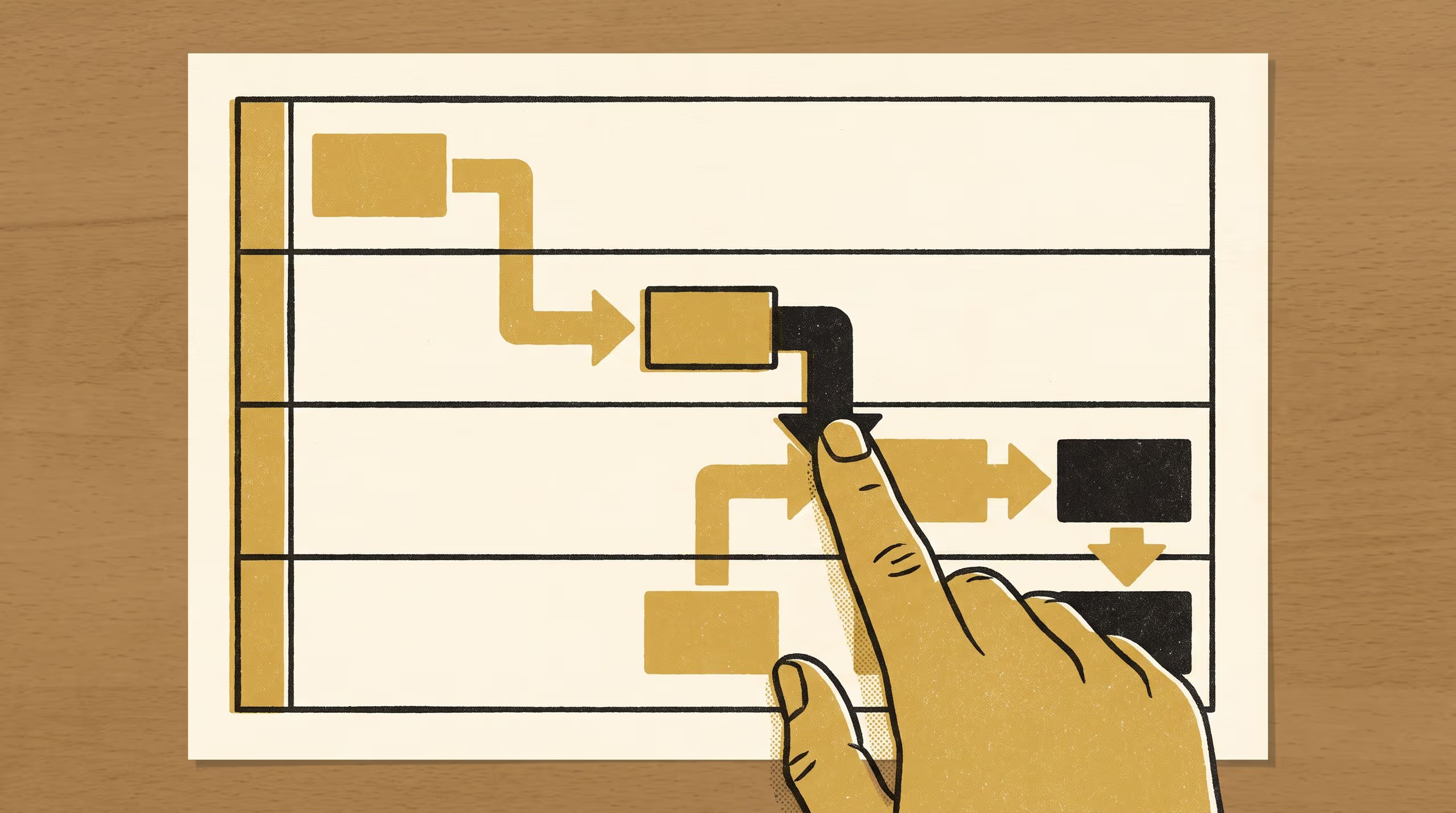
Finger Tracing and Novices' Learning of Swimlane Process Maps
A paper from the School of Continuous Improvement reports two experiments in which 228 short-course enrolees studied worked swimlane process maps, finding that tracing each arrow with the index finger improved their reading of handoffs on novel maps, most of all on six-lane ones, while leaving their reading of within-lane sequence unchanged, and that watching a recorded hand trace the same maps conferred no reliable benefit. Tracers' fingers paused unprompted where arrows crossed lane boundaries, and longer pauses predicted better handoff scores.
| Authors | Renke Sabel , Ingeborg Nwachukwu , Mirela Hanke |
|---|---|
| School | School of Continuous Improvement |
| Output type | Research paper |
| Funding | Anticipatory Capability Fund: Pencilling In the Six-Month Check-In for a Netball Club's Scorer Induction Before the First Whistle ( $643,829) |
| Published | |
| DOI | 10.5555/slop.ihvfou |
| Pages | 6 |
| Cited by | 1 output |
| Version | 1.0 |
| Licence | CC BY 4.0 |
Cites
Cited by
Cite as
@misc{slop_ihvfou,
  author       = {Renke Sabel and Ingeborg Nwachukwu and Mirela Hanke},
  title        = {Following the Arrow Across the Lane: Finger Tracing and Novices' Learning of Swimlane Process Maps},
  year         = {2026},
  publisher    = {Slop University},
  doi          = {10.5555/slop.ihvfou},
  url          = {https://slop.university/outputs/slop-paper-tracing-swimlane-process-ihvfou/},
  version      = {1.0},
  note         = {Research paper},
}