Self-Exciting Hammer Damage at a Coastal Angular Unconformity Used for Field Teaching
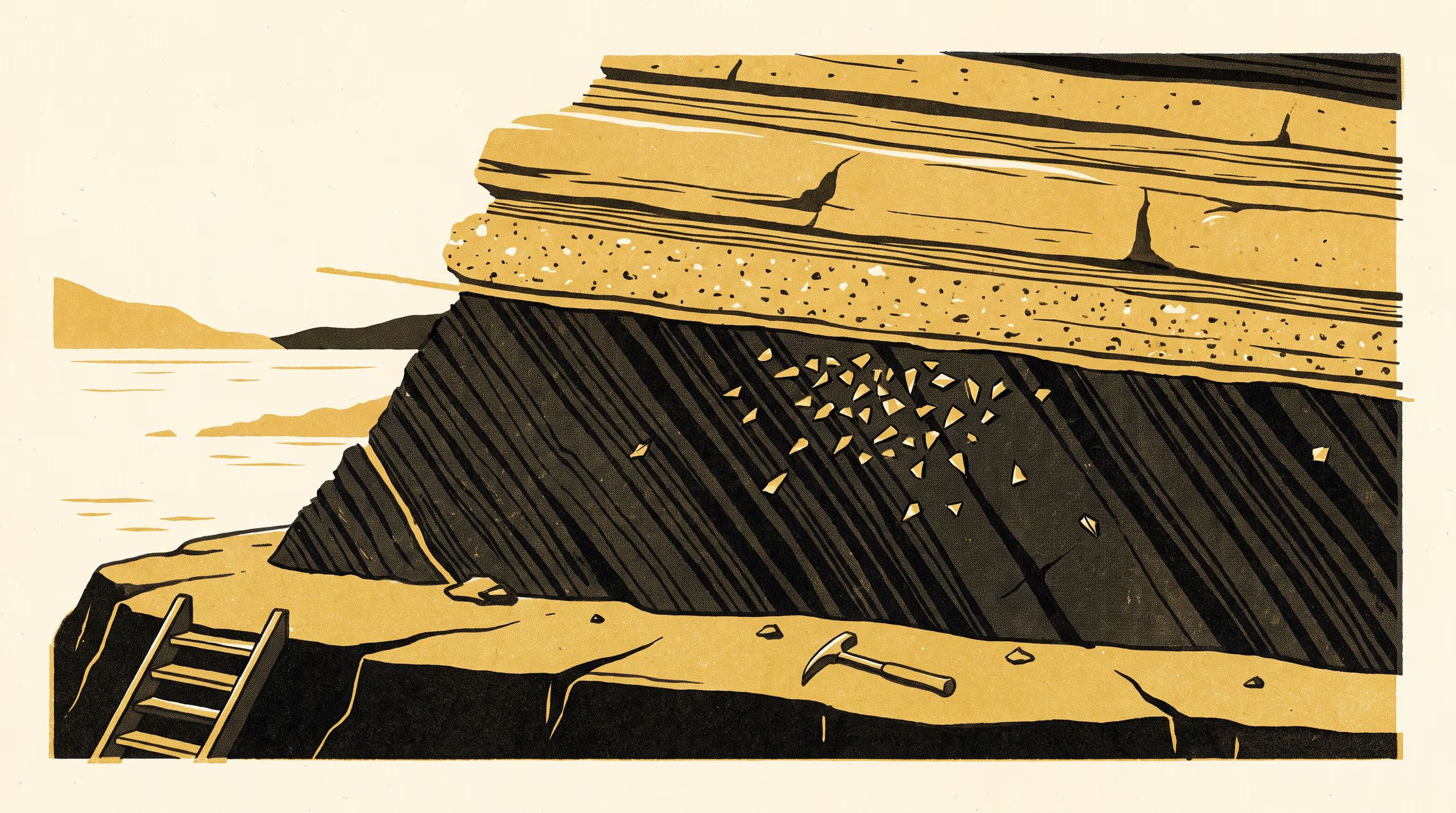
A paper from the School of Emergent Priorities and the School of Underlying Conditions reports seven annual structure-from-motion surveys of a 46 m stretch of cliff foot exposing a coastal angular unconformity visited by field classes, mapping 824 new hammer scars at about twelve per recorded visit. With access, reach and distance from the contact held fixed, a cell beside a scar made in the preceding two years is 4.6 times as likely to be struck again and one beside an older, weathered scar only 1.6 times, because a fresh face shows the contact roughly three times as sharply for about two years; a self-exciting model attributes 44% of the damage to earlier damage.
| Authors | Halvard Nnamani , Ragnhild Uzoma |
|---|---|
| School | School of Emergent Priorities |
| Output type | Research paper |
| Published | |
| DOI | 10.5555/slop.wtu94j |
| Pages | 6 |
| Cited by | 1 output |
| Version | 1.0 |
| Licence | CC BY 4.0 |
Cites
Cited by
Cite as
@misc{slop_wtu94j,
  author       = {Halvard Nnamani and Ragnhild Uzoma},
  title        = {Scars Beget Scars: Self-Exciting Hammer Damage at a Coastal Angular Unconformity Used for Field Teaching},
  year         = {2026},
  publisher    = {Slop University},
  doi          = {10.5555/slop.wtu94j},
  url          = {https://slop.university/outputs/slop-paper-scars-beget-scars-wtu94j/},
  version      = {1.0},
  note         = {Research paper},
}