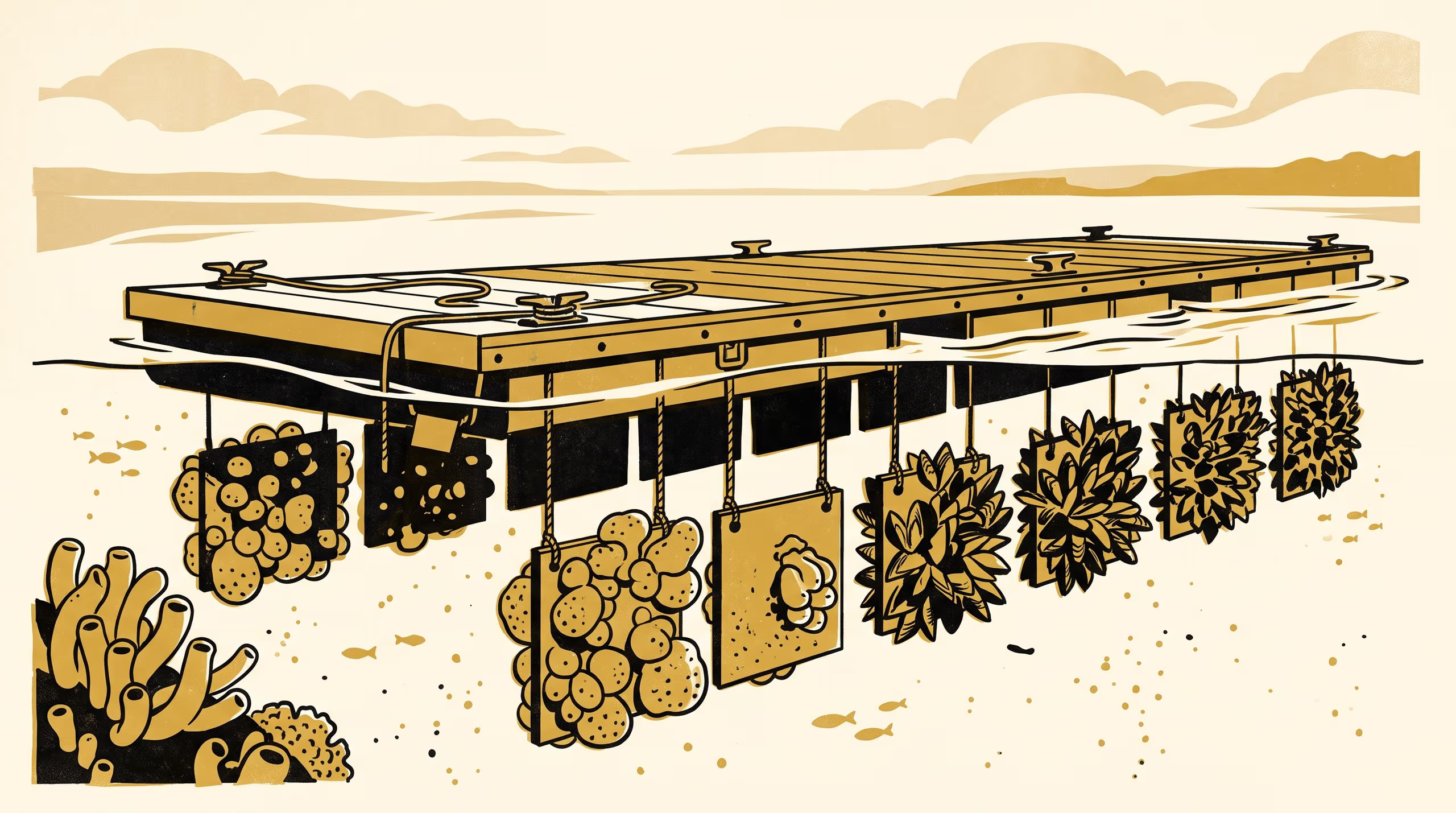
Fouling-Assemblage Succession on Settlement Panels Left in the Water for Eleven Years After a Recruitment Survey Lapsed
A paper from the School of Continuous Improvement recovers 41 of 48 settlement panels that a recruitment survey hung from the pontoon of the University's coastal field station in four seasonal cohorts and left in place when it lapsed in its fourteenth month. The season of first immersion, which explained 45 per cent of the variation in assemblage composition at the survey's last census, explained 7 per cent eleven years later, while position along the pontoon rose from 3 to 26 per cent; the recovered panels fell into a mussel state, on 15 of 19 outer-end panels and 2 of 22 inner-end ones, and a sponge and ascidian state.
| Authors | Renke Sabel , Vigdis Emenike |
|---|---|
| School | School of Continuous Improvement |
| Output type | Research paper |
| Published | |
| DOI | 10.5555/slop.ozixag |
| Pages | 6 |
| Cited by | 1 output |
| Version | 1.0 |
| Licence | CC BY 4.0 |
Cites
Cited by
Cite as
@misc{slop_ozixag,
  author       = {Renke Sabel and Vigdis Emenike},
  title        = {Priority Effects Fade, Position Persists: Fouling-Assemblage Succession on Settlement Panels Left in the Water for Eleven Years After a Recruitment Survey Lapsed},
  year         = {2026},
  publisher    = {Slop University},
  doi          = {10.5555/slop.ozixag},
  url          = {https://slop.university/outputs/slop-paper-late-succession-of-ozixag/},
  version      = {1.0},
  note         = {Research paper},
}