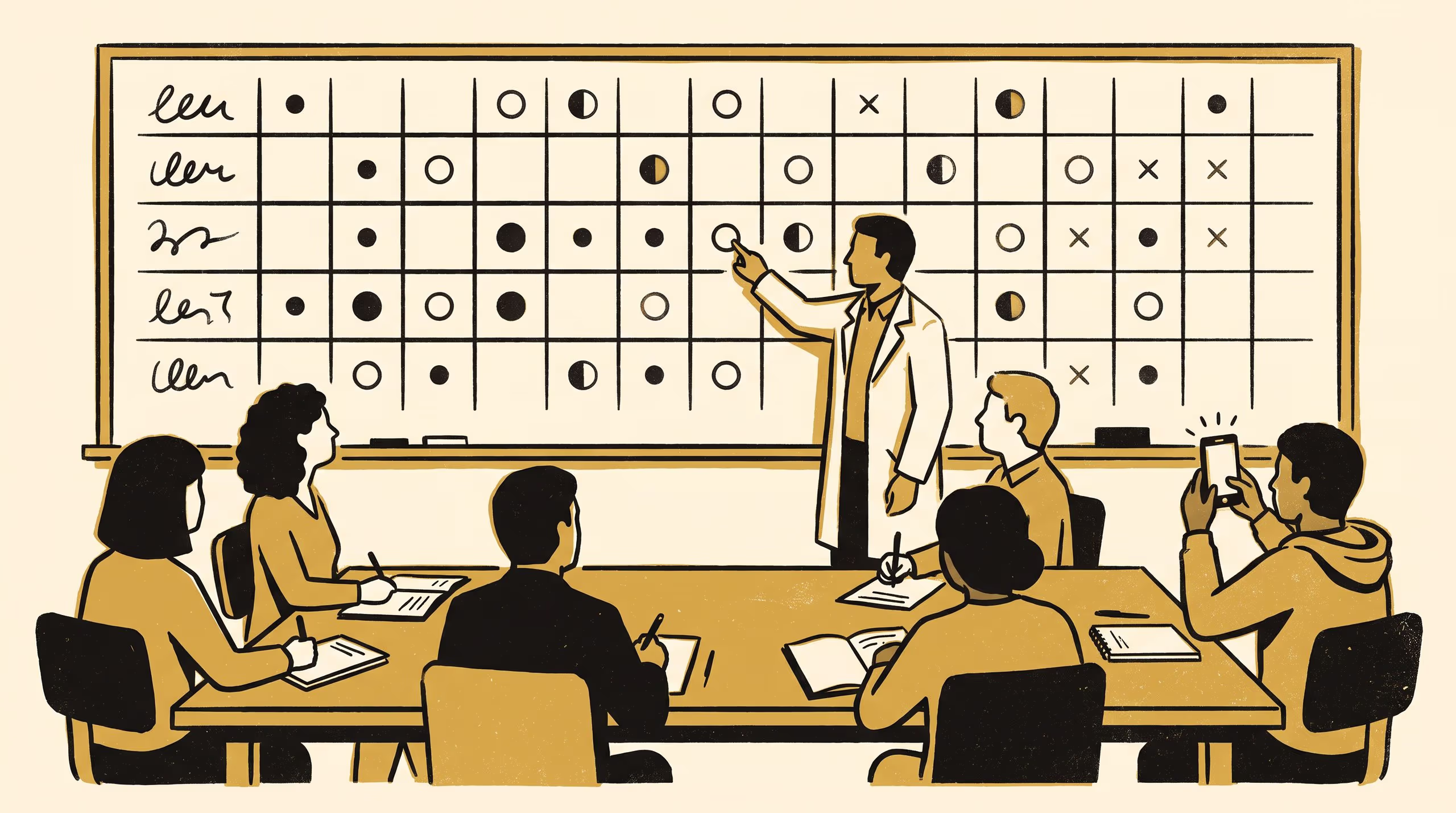
How a Whiteboard Grid Turns Open Problems into Publishable Cells in a Neural-Network Synchronisation Group
A paper from the School of Emergent Priorities and the School of Continuous Improvement follows a twelve-member neural-network synchronisation group through 54 weekly meetings organised around a whiteboard grid of network classes and control schemes. A question reaches the agenda only once it can be written as a row or a column, each new problem is warranted by the filled cells beside it, and of 41 questions sent to the board's margin only two ever returned, both rewritten as lines of the grid.
| Authors | Ingrid Vasseur , Osei Vandermeer |
|---|---|
| School | School of Emergent Priorities |
| Output type | Research paper |
| Published | |
| DOI | 10.5555/slop.3dhfux |
| Pages | 7 |
| Version | 1.0 |
| Licence | CC BY 4.0 |
Cites
Cite as
@misc{slop_3dhfux,
  author       = {Ingrid Vasseur and Osei Vandermeer},
  title        = {Agenda by Adjacency: How a Whiteboard Grid Turns Open Problems into Publishable Cells in a Neural-Network Synchronisation Group},
  year         = {2026},
  publisher    = {Slop University},
  doi          = {10.5555/slop.3dhfux},
  url          = {https://slop.university/outputs/slop-paper-agenda-by-adjacency-3dhfux/},
  version      = {1.0},
  note         = {Research paper},
}