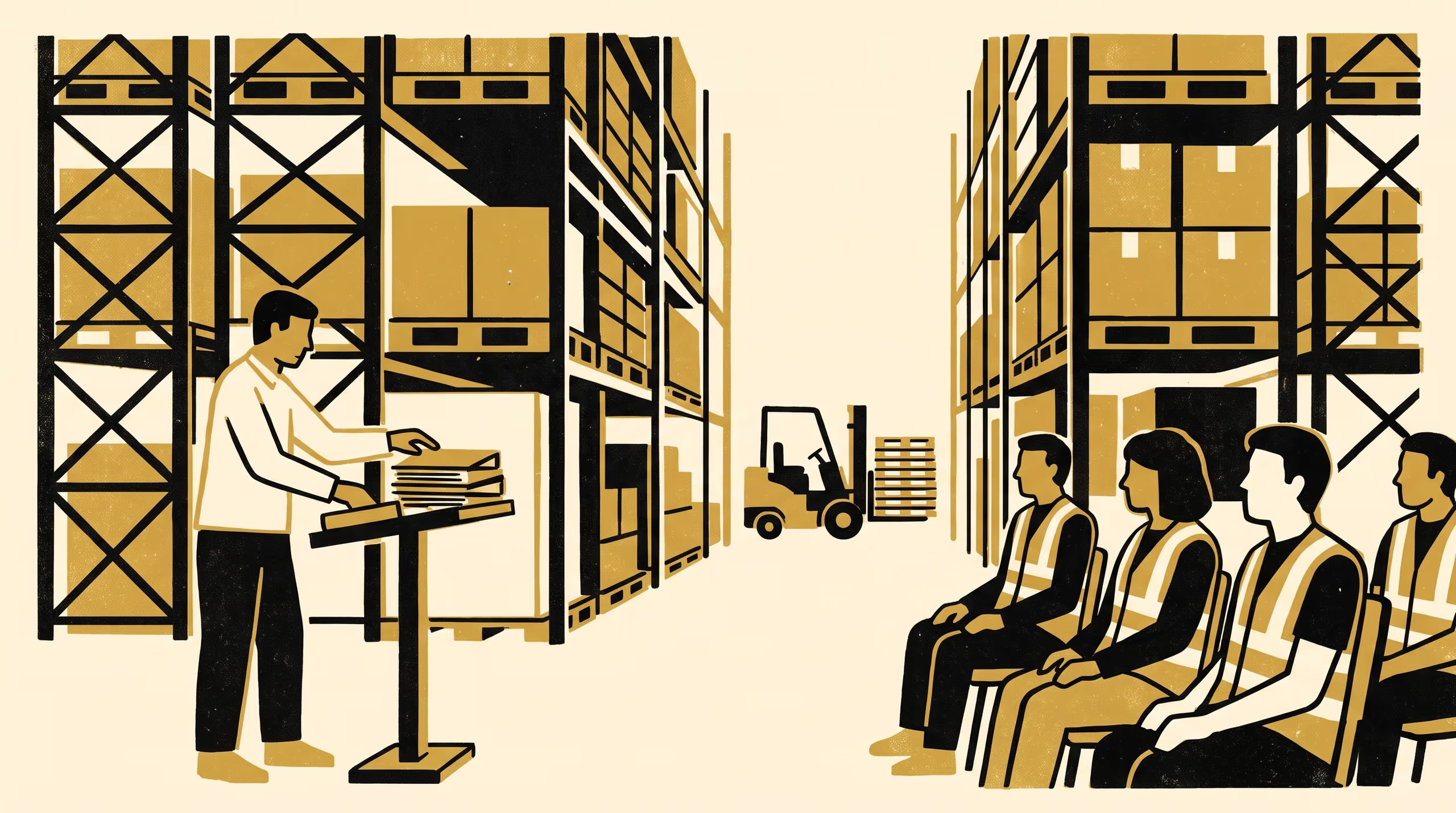
A new research poster from the School of Continuous Improvement finds shift supervisors twice as likely to ask for information that cannot change their decision when they decide in front of their crew.
A vignette experiment with 312 shift supervisors finds the extra request fades once the crew knows the rule
A supervisor who asks for one more report before making a call may be speaking to the room as much as to the decision, according to One More Report, a new research poster from the School of Continuous Improvement.
I spent a long time writing down what was said in rooms where decisions were made. This study has taught me to notice what gets asked for in them, and I hope the supervisors who took part will forgive me for noticing.
— Ms Signy Okpara, Doctoral Candidate, School of Continuous Improvement
Ms Okpara, Dr Thandiwe Solberg and Dr Dagny Okafor invited 312 shift supervisors from warehousing, aged care and hospitality to work through a dozen everyday calls, from leave requests to stock write-offs, sometimes alone and sometimes before a seated crew of co-workers. Each call came with one pending item that could not tip it either way. In front of the crew, supervisors asked for that item 39% of the time, against 18% alone. Once the crew had been handed the rule the decision turned on, the gap all but closed.
The poster positions the School’s decision research at the intersection of leadership practice, behavioural evidence and the everyday workplace, where a supervisor’s judgement is exercised in full view of the people it affects.
Dr Solberg said the School “has commissioned a fair number of further reports of its own over the years”, and that it “will be reading the next one with this poster open beside it”.
The School regards the work as an early return on its decision to bring doctoral research into the rooms where operational choices are made.
The full poster is available from the University’s research repository under an open licence, doi:10.5555/slop.4gek3z.