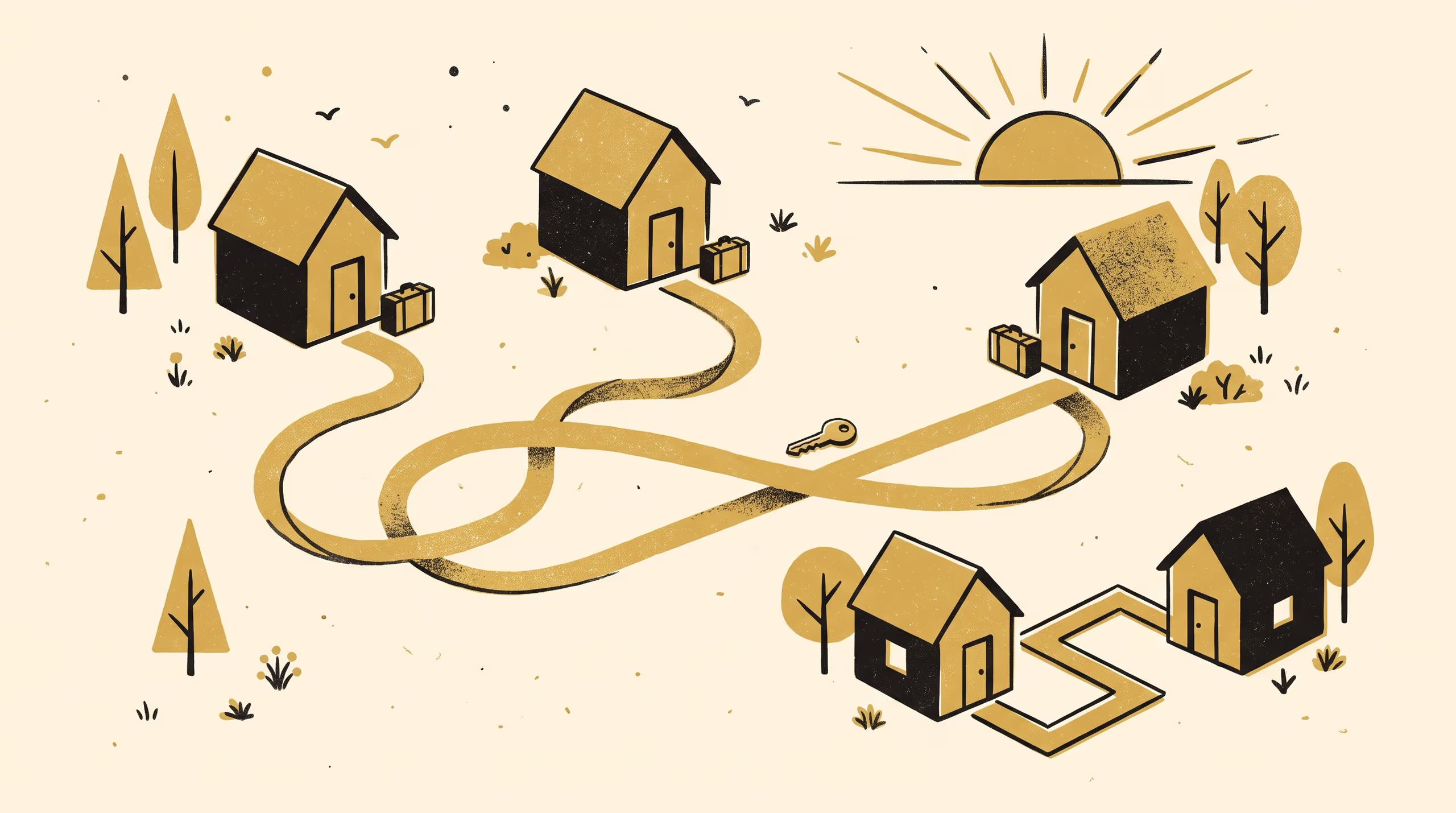
A new research poster from the School of Underlying Conditions counts every way a group of households can trade homes so that nobody stays put, and finds three-way rings outnumber simple swaps.
A count of complete exchange rounds finds the reciprocal pair the exception once more than a handful of households take part
When a group of households agrees to trade homes for a season, who ends up sleeping where? Most Rounds Close in Threes, a new research poster from the School of Underlying Conditions, brings the tools of pure mathematics to that question, and its answer departs from the familiar picture of two families simply exchanging keys.
Every house we read about belongs to somebody, and for one season this poster lets it belong to somebody else. For a University that has always cared where things are kept, that felt like a natural place for its mathematics to go next.
— Dr Clemency Tredinnick, Lecturer, School of Settled Matters
With Dr Brynjar Obiora, Dr Tredinnick set out every arrangement in which each household stays in another’s home and each exchange closes either as a pair or as a ring of three. Combining exact enumeration, generating functions and asymptotic estimation, the team traced how the mix of pairs and rings evolves as a round grows, working the counts out exactly for rounds of up to 400 households. Among twelve households alone they find 811,195 complete rounds, against 10,395 made of pairs only.
Dr Obiora said the School “would be delighted to hear from any household that has found a fourth way round”.
The University regards the poster as a confident first step for its pure mathematics into the everyday business of lending, borrowing and leaving the door open for a neighbour.
The full poster is available from the University’s research repository under an open licence, doi:10.5555/slop.9b17s9.