A new research poster finds that most of the volume a contract bottler lost from each batch of cleaning concentrate went into the mixing itself, and that blending by mass recovers nearly all of it.
A School of Emergent Priorities poster traces a contract bottler's short-filled batches to how its concentrate contracts on mixing, and to a recipe written in litres
Every recipe is a small promise about what will come out of the tank. This project gave us the chance to keep one of those promises company for a while, and the questions it leaves behind are ones the School is glad to have.
— Ms Gunnhild Ekwueme, Doctoral Candidate, School of Emergent Priorities
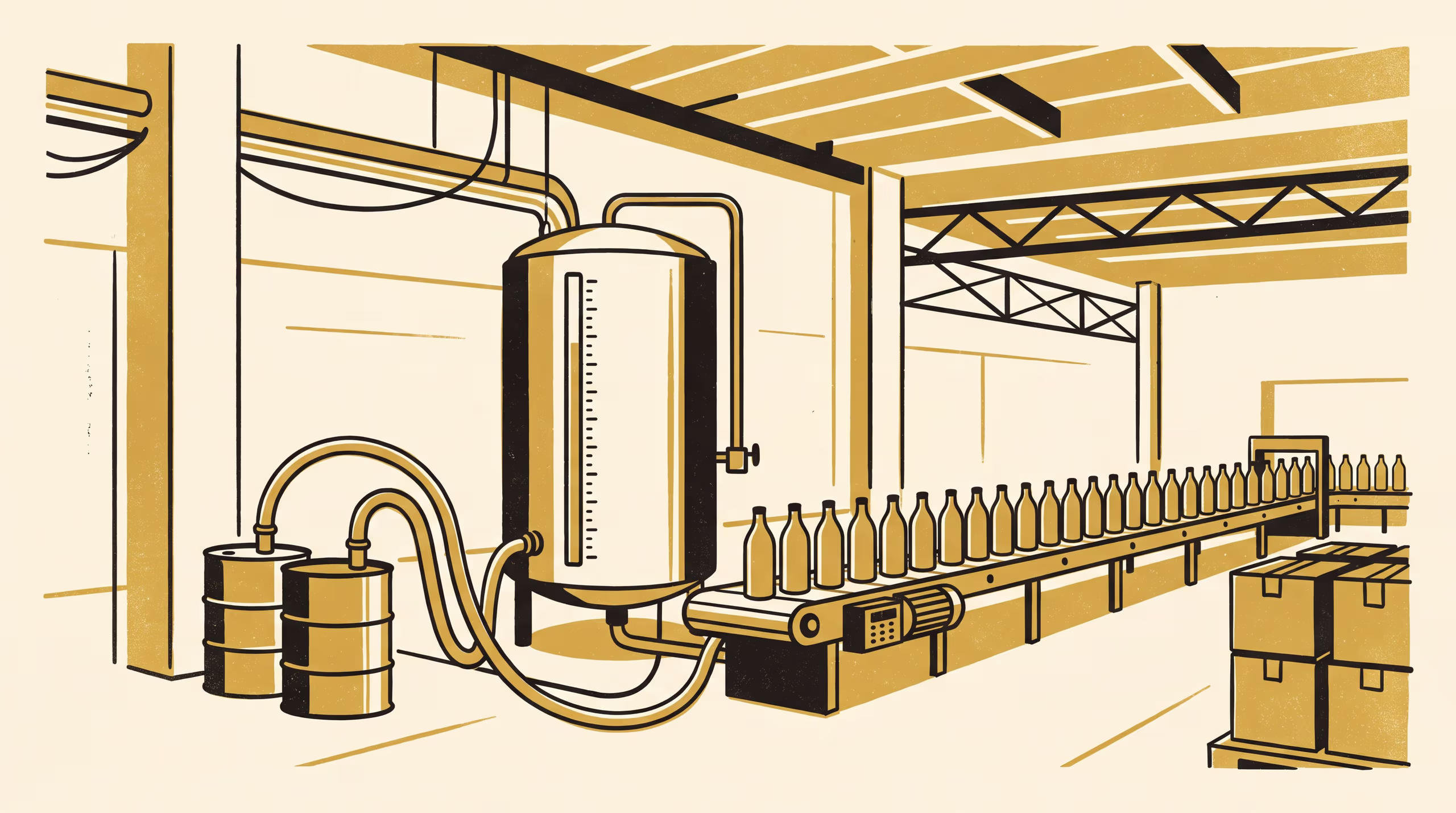
That is how the lead author describes Volumes That Do Not Add, a new research poster from the School of Emergent Priorities that follows a regional contract bottler’s cleaning concentrate from the blending tank to the end of the filling line.
The poster finds that a mixture of the product’s two ingredients takes up less room than the ingredients did apart, and that this accounts for 96% of the batch-to-batch variation in the shortfall the plant had been recording as line loss across 312 batches. In a short trial, blending by weight rather than by the litre recovered nearly all of it.
Working at the meeting point of laboratory practice, production planning and the everyday life of a recipe, the team brought bench measurement and fourteen months of batch records into a single conversation about yield, and found the two had a good deal to say to each other.
The work joins the University’s long-running attention to the space between what is planned and what is delivered, here pursued at the scale of a single tank. Mr Eskil Nwabueze, Doctoral Candidate in the School of Continuous Improvement, said the poster was “a welcome case of a figure at the bottom of a sheet turning out to have a reason, and a reason that can be written down.”
The full poster is available from the University’s research repository under an open licence, doi:10.5555/slop.avolbs.