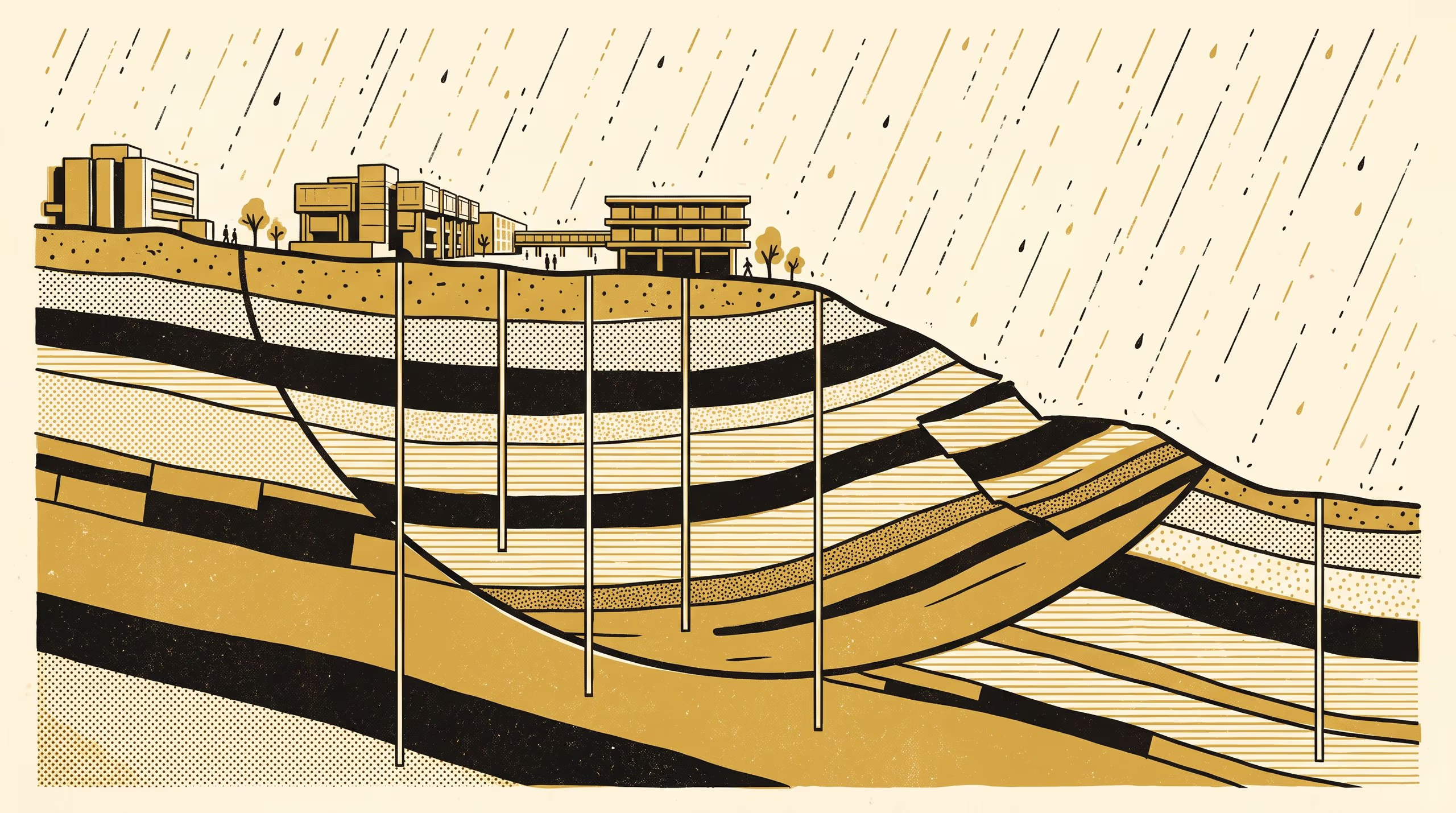
Slop University's Strategic Plan 2026-2031 commits the University to measuring the slow landslide beneath its lower terraces, building for it, and publishing a ranked register of the buildings it will eventually withdraw from.
A Strategic Plan for a campus on a slow landslide publishes the order in which the University will leave its most exposed buildings
Slop University has published the order in which it expects, one day, to leave some of its own buildings. Keeping Pace with the Hill, the University’s Strategic Plan 2026-2031, treats the slow landslide beneath the lower terraces of the campus as a lasting condition of the estate and sets out how the institution will live with it.
The plan brings together a consolidated network of survey marks and borehole instruments, a single Slope Register open to every School, and a design standard for anything built on ground that moves. At its centre is the Retreat Register: an annual ranking of every building on the moving ground, with the reasons for each position, which keeps a row for every building the University has already left.
A list always has a bottom row, whether or not anyone prints it. The University has chosen to print its own and to keep it, and I think the School will learn a good deal from watching how that feels.
— Eskil Nwabueze, Doctoral Candidate, School of Continuous Improvement
“The Horizon Register has always kept a row open for things that arrive slowly,” said Dr Fenna Okoro, Senior Lecturer and Convenor of the Horizon Register in the School of Emergent Priorities. “It is a pleasure to have one we can stand on.”
The plan marks a new stage in the University’s long acquaintance with its own hillside, and draws on published research from the School of Underlying Conditions, the School of Settled Matters, the School of Emergent Priorities and the School of Continuous Improvement.
The full plan is available from the University’s research repository under an open licence, doi:10.5555/slop.hqxt88.