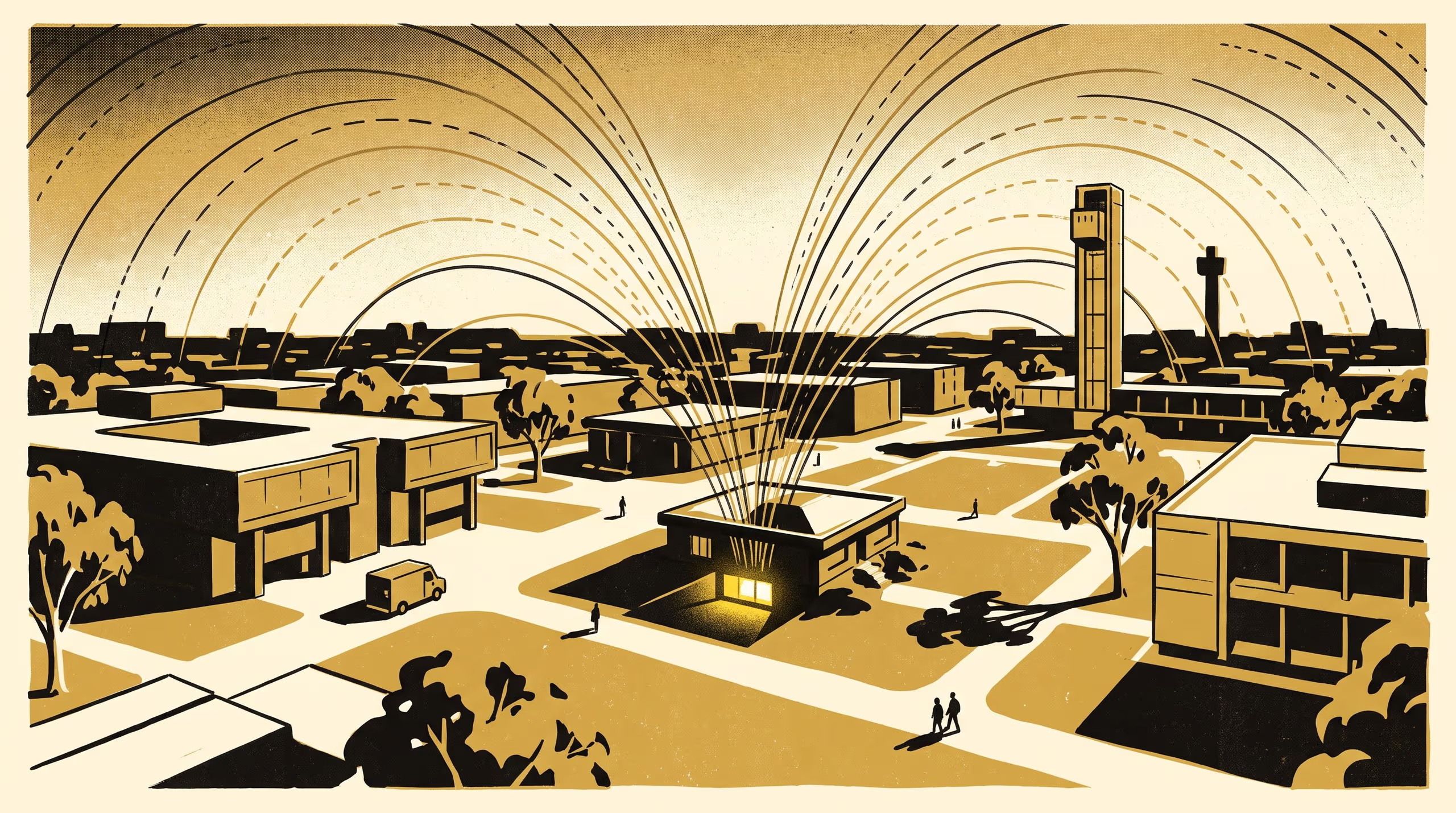
The University's Strategic Plan 2026-2031 treats the magnetic stillness its superconducting magnetometers depend on as a shared campus asset, to be recorded, budgeted and planned around across the estate.
A new Strategic Plan sets nightly Quiet Hours and a Steel Line around the shielded room beneath the School of Underlying Conditions
Lifts near the School of Underlying Conditions will soon spend part of every night waiting at the ground floor. A Quieter Field, the University’s Strategic Plan 2026-2031, sets out how a whole campus will hold its magnetic environment still enough for the superconducting magnetometers in one small shielded room to read the faint record kept in rock.
Most of the people this Plan asks something of will never see the room it protects. I hope a few of them will come down and visit, ideally outside the Quiet Hours.
— Associate Professor Ragnhild Uzoma, Lead of the Basement Relations Group, School of Underlying Conditions
Prepared by Associate Professor Uzoma with Dr Marit Osayande and Associate Professor Anselm Threlkeld, the Plan aligns continuous campus monitoring, estate planning settings and cryogen stewardship within a single framework for shared research capability. It introduces a register of every moving steel mass the room can detect, a Steel Line on the campus master plan, and a published sequence for allocating time on the instruments.
Dr Osayande, Convenor of the Living Dashboard, said a quiet night “should be something the whole University can see, not only the instruments”.
The Plan is the University’s clearest statement yet that the conditions its research depends on reach well beyond the laboratory door, and that a building’s materials, a delivery roster and a lift’s resting floor can each be part of a measurement.
The full plan is available from the University’s research repository under an open licence, doi:10.5555/slop.bqolzh.