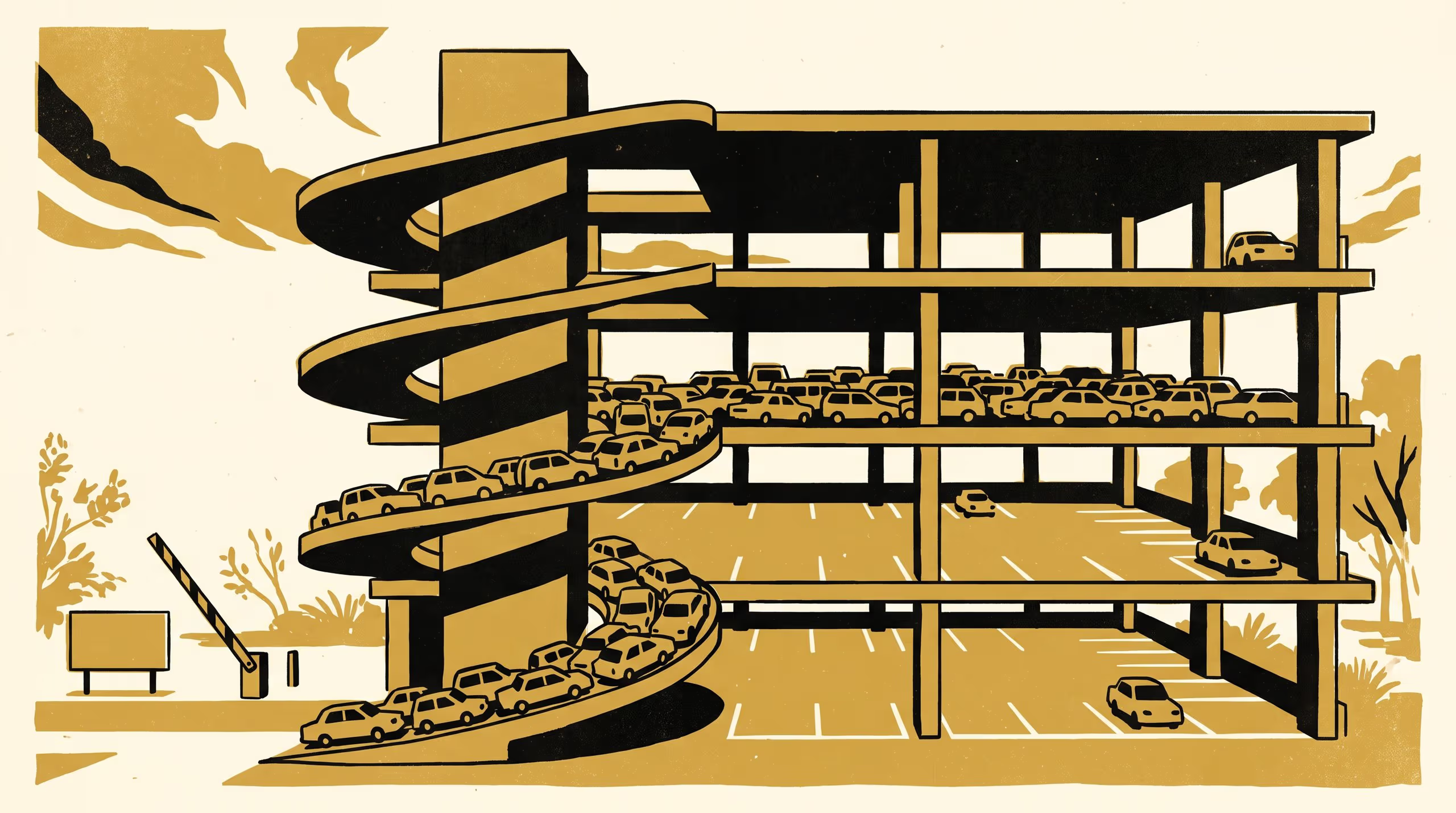
A new paper treats a multi-storey car park's level-by-level sign as a controller with a delay, and shows that assigning one level to each car at the gate cuts the share of drivers who reach a full level from 17.6% to 3.4%.
A campus car park's guidance sign was sending each wave of morning arrivals to the same level, and a rotating display at the boom gate now splits them up
Fewer drivers are climbing onto a full level during the morning rush at one of the University’s campus car parks, following Four Free on Level 3, a new paper from the School of Continuous Improvement. The work reads the familiar row of free-bay counts at the entrance as a control system in its own right, and finds that a sign which tells every arriving driver the same thing will tend to send them all to the same place.
I have spent most of my career watching one number reach a great many readers at the same moment. It has been a real pleasure to work on a case where the kindest thing to do was give each reader a slightly different one.
— Dr Sten Okwuosa, Senior Research Fellow and Convenor, Impact Pathway Atlas
Working from the building’s own gate and ramp records, the team assembled a detailed picture of how the car park fills each morning, tested a series of sign arrangements against it, and then took the most promising into the building itself over eight alternating weeks. The resulting display, which names a single level for each car as it passes the boom gate, brought the share of drivers reaching a full level down from 17.6% to 3.4%, with around four in five following its suggestion.
The School regards the paper as a fine example of the everyday infrastructure its researchers are increasingly ready to take seriously. “The Observatory usually thinks in quarters,” said Dr Osei Vandermeer, Research Fellow and Convenor of the Review Cadence Observatory. “It was a welcome change to spend a season thinking in minutes, and we expect to carry some of that back with us.”
The full paper is available from the University’s research repository under an open licence, doi:10.5555/slop.1gj1sv.