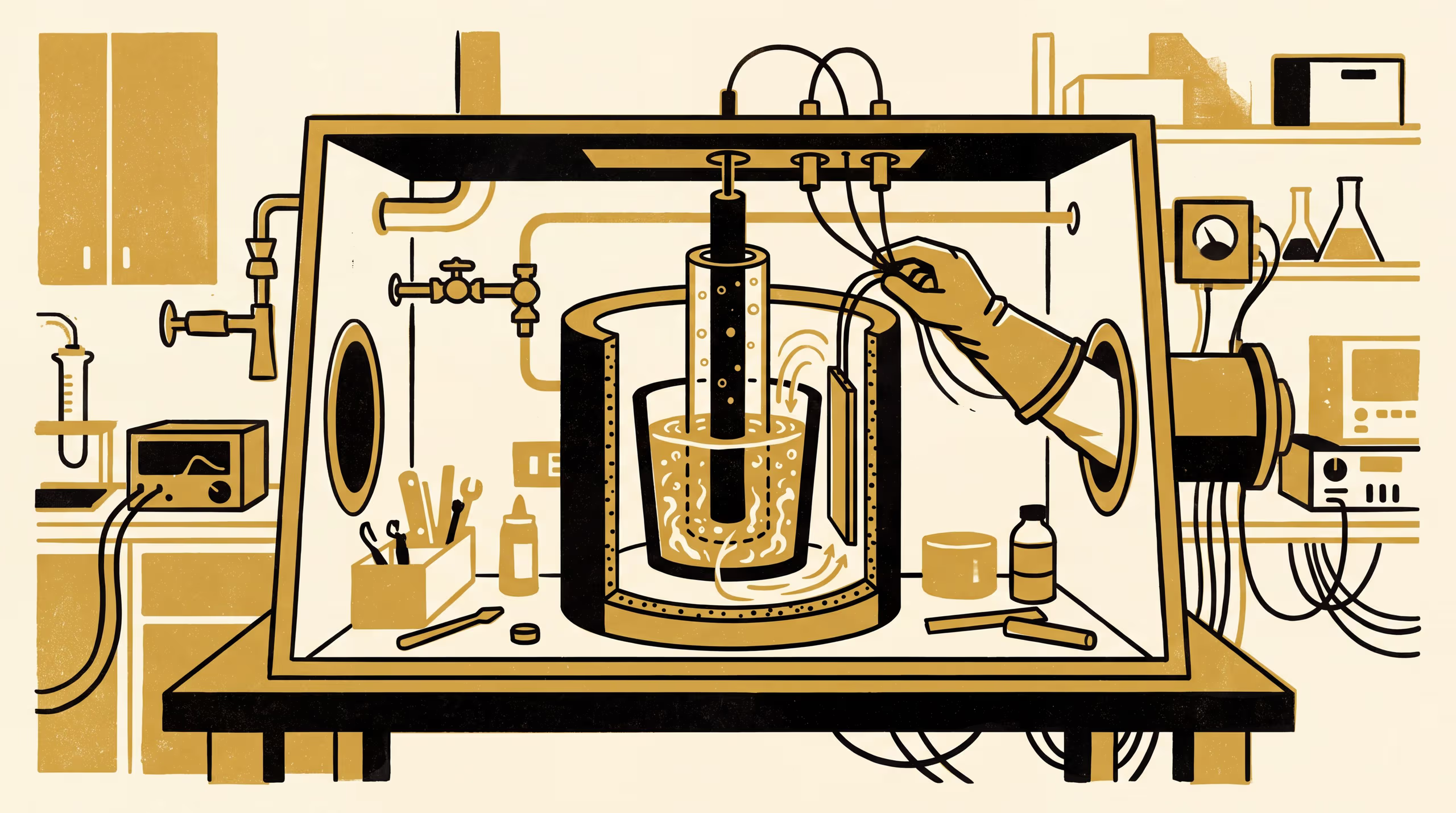
A new research poster from the School of Settled Matters shows how the gas a molten-salt cell already makes can be used to circulate its bath, evening out the cobalt deposited on its cathode without the loss that comes from letting that gas wander.
A draft tube around the anode turns a molten-salt cell's chlorine into the stirrer that evens out the metal on its cathode
The School of Settled Matters this week added a furnace to its familiar stock of statutes and second-reading speeches. Let the Chlorine Stir, a research poster led by Associate Professor Anselm Threlkeld with Dr Clemency Tredinnick and Dr Bram Ntuli, takes up a practical question from the bench: whether the gas an electrolysis cell gives off can be persuaded to do the stirring the cell has no room for.
We are grateful to everyone who kept the furnace warm through twenty-seven runs, and to a cell that turned out to have been offering us its help all along. We have tried to take it up on the offer carefully.
— Associate Professor Anselm Threlkeld, School of Settled Matters
The team fitted a simple sleeve around the cell’s anode and followed the molten bath as it moved, combining a cathode built in sections with a run-by-run reading of where each portion of metal settled. The resulting picture brings process design, careful measurement and a respect for small apparatus into a single conversation about how a cell’s own chemistry can be enlisted to keep it in motion. With the sleeve in place, the difference in metal between the bottom and the top of the cathode fell from a factor of 2.1 to 1.25.
Much depended on where the gas was allowed to leave. Dr Ntuli said the group would “be in no particular hurry to put a paddle back in”.
The poster is the sort of patient bench work the University is glad to see carried out under its name, and the School anticipates it will not be the last time its reading rooms send someone to the laboratory.
The full poster is available from the University’s research repository under an open licence, doi:10.5555/slop.6hs40k.