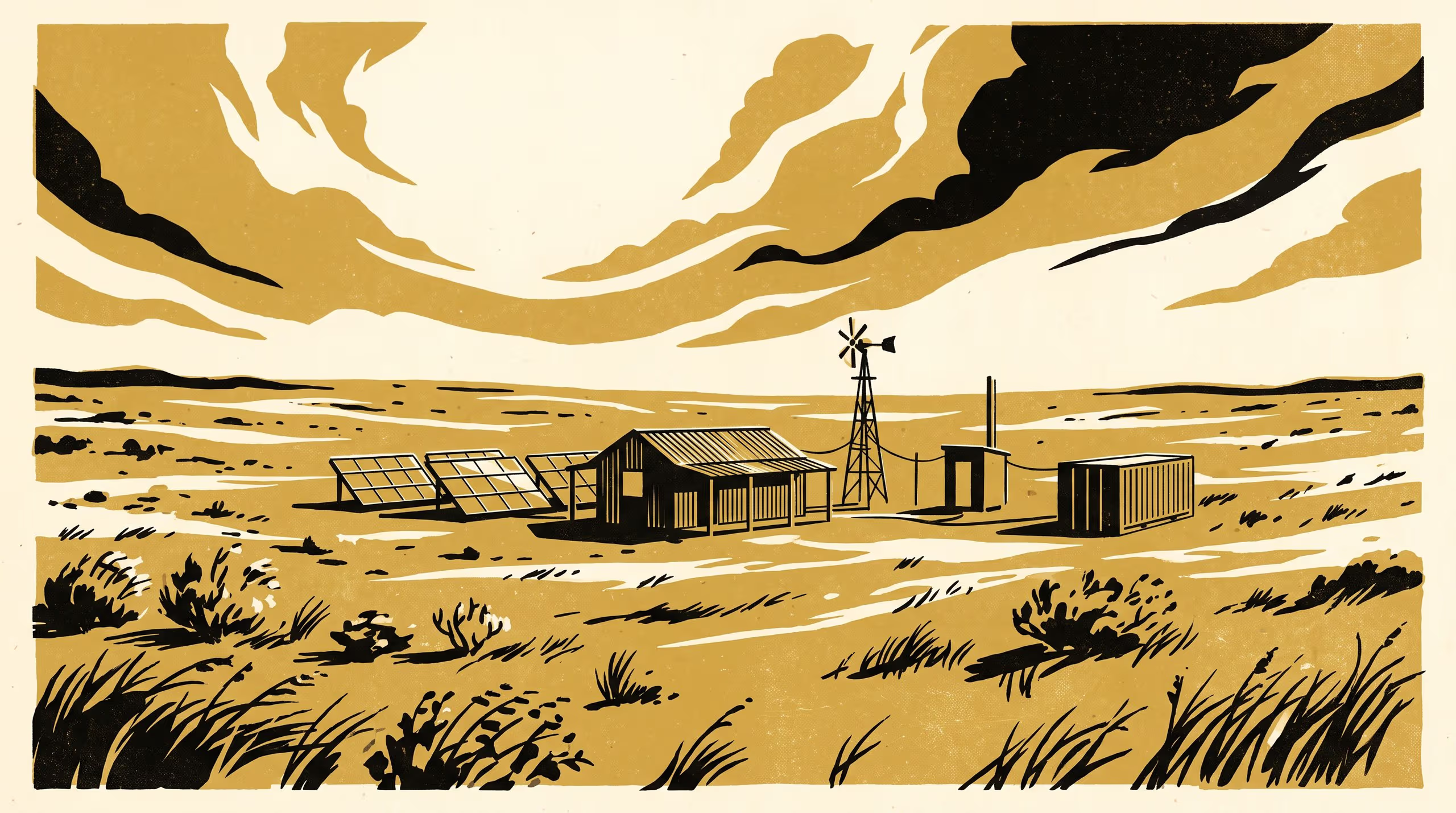
A paper from the School of Settled Matters finds that controller settings chosen at commissioning kept a remote field station's generator running long after most of its load had gone, and that re-tuning them halved the generator's hours over a winter trial.
A decade of logs shows a remote station's diesel still charging for a laboratory and cold room that left years ago
The University holds a good deal of country beyond the campus, and every corner of it has its own way of keeping the lights on. It has been a privilege to spend a winter attending to one of them, and to find it so ready to be attended to.
— Dr Clemency Tredinnick, Lecturer, School of Settled Matters
Since May, the diesel generator at one of the University’s remote field stations has been running about half as often as it did a year ago. The change follows Setpoints That Outlived Their Load, a new paper from the School of Settled Matters prepared with colleagues from two other Schools.
Dr Tredinnick, Dr Bram Ntuli and Dr Iben Chikere set a decade of the station’s own operating records against a validated model of its solar, wind, battery and diesel supply, then carried their findings into the field for a full winter. The result reframes a hybrid system’s control settings as part of its renewable estate, an asset to be revisited as the place it serves changes around it.
Dr Chikere, whose research concerns what a handover document keeps of a role, said the station’s next commissioning note “will be a little longer than the last one, and considerably more forthcoming”.
The University counts the paper among the steadier returns on holding land at a distance from campus, and the School expects to keep returning to the station’s logbooks.
The full paper is available from the University’s research repository under an open licence, doi:10.5555/slop.ushtgw.