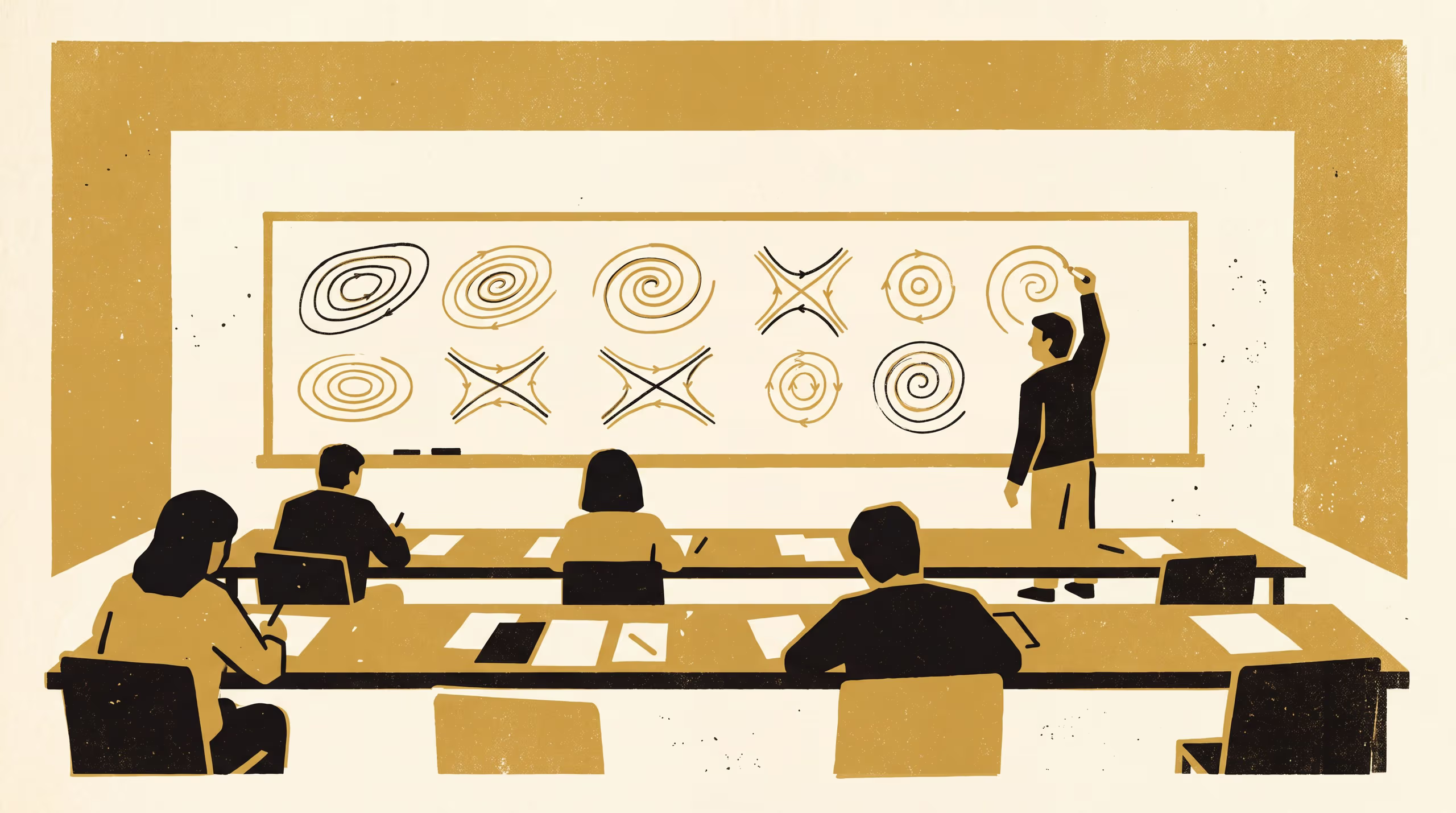
A new research poster finds that most second-year students call an equilibrium a centre whenever its linearisation is one, and that asking them to compute a long trajectory first helps on some problems and misleads them on others.
A School of Emergent Priorities poster follows second-year students through the equilibria their eigenvalues cannot classify, and tests one long trajectory as a remedy
For a generation of second-year mathematics students, the eigenvalues of a Jacobian have settled what an equilibrium is. Centres That Only the Linearisation Sees, a research poster from the School of Emergent Priorities, looks at the cases they cannot settle, and at what students decide when they get there.
Doctoral candidate Ms Ylva Onyekwere and Dr Runa Adegoke coded 214 end-of-semester exam scripts and sat with 18 students as they talked through their answers. Where the linearised system circled neatly and the full system did not, 71% of answers called the point a centre anyway. When the following year’s cohort was asked to compute one long trajectory before deciding, correct answers on those problems roughly tripled, while a genuine centre began to be mistaken for a slow spiral, the small outward drift in the course software’s stepping doing the persuading.
I spent a long time writing down what a committee had decided, and very little time asking whether it had. The students have been generous in letting us watch them do both at once, and the School is grateful to have been in the room.
— Ms Ylva Onyekwere, Doctoral Candidate, School of Emergent Priorities
The poster aligns the established literature on how students build mental pictures of mathematical ideas with the everyday practice of the undergraduate tutorial, positioning the computed trajectory as both an aid to judgement and a new site for it.
The School counts the study among the clearest signs yet of its growing presence in the teaching of mathematics, a presence Dr Adegoke described as “arriving, as these things do, a little before anyone had planned for it”.
The full poster is available from the University’s research repository under an open licence, doi:10.5555/slop.2h0xyq.