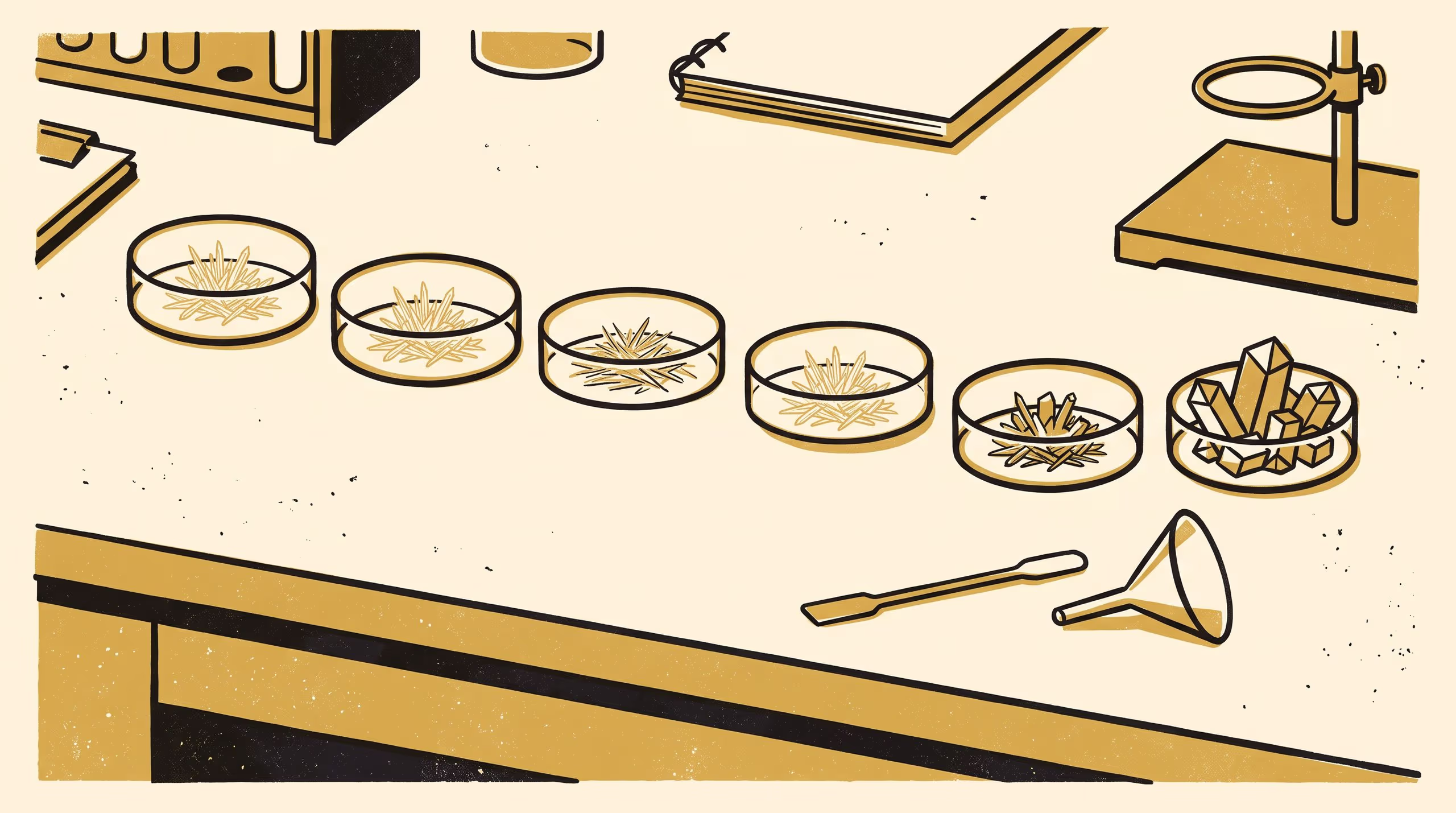
A new paper shows that a close chemical relative of an aryl amide sits inside one crystal form of the compound as a solid solution that repeated recrystallisation barely touches, and that a second crystal form leaves it behind in a single step.
Five recrystallisations of a model aryl amide left a methyl analogue in place, and one change of crystal form removed it
Slop University welcomes a new contribution to crystallisation science from the School of Settled Matters. What the Lattice Keeps follows a single stubborn impurity through five rounds of purification of a model compound, and asks why each round removed so little of it.
A crystal is a very orderly place to keep something, and the School has spent a happy season at the bench finding out what one will agree to keep. We hope there will be many more seasons like it.
— Dr Clemency Tredinnick, Lecturer, School of Settled Matters
Working across three solvents and two crystal forms, Dr Tredinnick and doctoral candidates Gunnhild Ekwueme and Eivind Onwuka combined partition measurements, wash and dissolution tests and structural evidence into one account of where an impurity resides once a crystal has taken it in. Their answer is that it resides in the lattice itself, at a share no solvent and no repetition could shift, and that a different arrangement of the same molecules declines to make room for it.
Eivind Onwuka said the team had “come to know a small amount of material very well indeed, and the material has been patient with us throughout”.
The University regards the paper as a fine instance of a school following its questions wherever they happen to be kept, including the inside of a crystal.
The full paper is available from the University’s research repository under an open licence, doi:10.5555/slop.e0ycms.