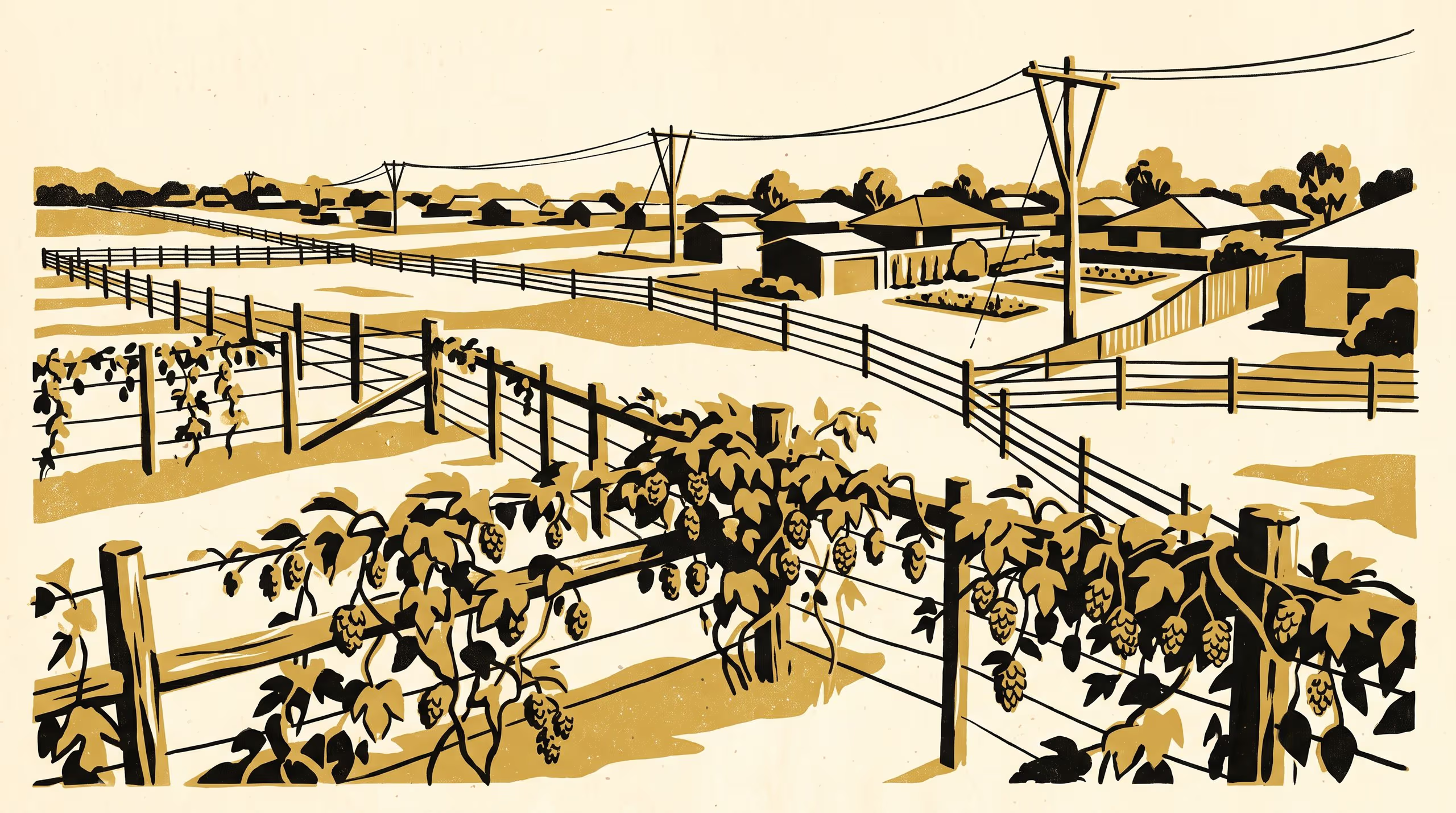
A new research poster from the School of Settled Matters reads the chemistry of feral hops on a subdivided former hop farm against its original survey plan, and finds the farm's own cultivar still growing where its rows once ran.
Feral hops on a subdivided estate keep to the rows and headlands the farm was planted along
The School of Settled Matters has long made a study of what a piece of land keeps hold of after it changes hands. With The Cultivar Keeps to the Old Lines, a research poster by Dr Clemency Tredinnick and Dr Brynjar Obiora of the School of Underlying Conditions, that interest reaches the hop bines growing wild along the fences of a former hop farm, decades after it was divided into house lots.
We went out along the fences expecting to find a few stray plants and came back with a great many more questions than sample bags. The lot-holders were generous with their gates, and we hope they will be just as generous next season.
— Dr Clemency Tredinnick, Lecturer, School of Settled Matters
Pairing laboratory chemistry with a careful reading of the estate’s original survey plan, the team characterised 64 feral plants across 19 lots and set each against cones of the cultivar the farm last planted. Three distinct chemical families emerged. Of the 29 plants that still carry the farm’s cultivar, 26 grow on fences that follow its old rows and headlands, while most of the remainder climb the fences put up when the land was subdivided.
Dr Obiora said the project had given the University’s soil surveyors “a rare reason to look up from the ground, and to find the old farm looking back”.
The poster sits comfortably within the University’s widening attention to the working landscapes around it, and to the plant chemistry those landscapes hold on to. The School intends to follow it with genetic work on the same plants.
The full poster is available from the University’s research repository under an open licence, doi:10.5555/slop.jx8omt.