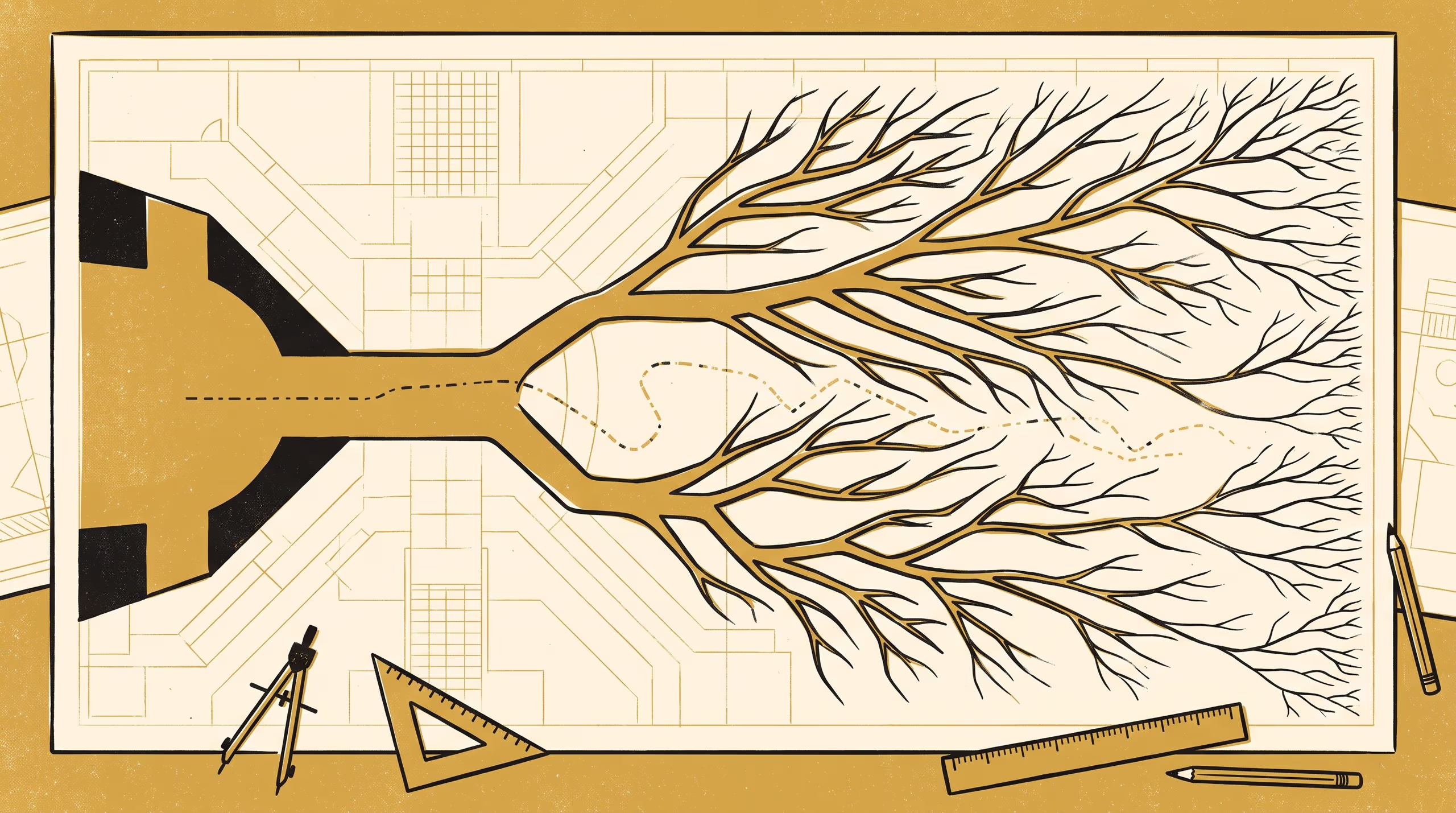
A new research poster computes how rarely a path wandering from an open space reaches the innermost floors of a channel that divides again and again, and finds that every junction takes a steady toll of its own.
A School of Continuous Improvement research poster follows a random path into a repeatedly dividing domain and counts what every fork takes from the deepest floors
Patient numerical work in the complex plane, carried out one junction at a time, sits behind Five Junctions Down, a new research poster from the School of Continuous Improvement. Its authors are Dr Solveig Adeyemi, Associate Professor Anselm Threlkeld of the School of Settled Matters, and Mr Eivind Onwuka, a doctoral candidate in the School.
The poster asks how likely a wandering path, set loose in an open space, is to finish at the far end of a narrow channel that keeps dividing as it goes. Classical mathematics already accounts for the long straight stretches. Across 126 model domains, the team found that every fork adds a small, steady cost of its own, one that does not fade however deep the fork sits, and that working level by level reaches floors far too faint for a single whole-domain calculation to see.
The School spends much of its working life following things down long routes to see what arrives at the end. It has been a real pleasure to learn that mathematicians have kept the same question company for a very long time, and generous of them to let us sit in on it.
— Dr Solveig Adeyemi, Lecturer and Deputy Convenor, Review Cadence Observatory, School of Continuous Improvement
The work sets rational-function solvers, the theory of extremal length and a careful accounting of numerical precision in sustained dialogue, and carries the Observatory’s long interest in escalation pathways into the most abstract terrain it has yet explored. Associate Professor Threlkeld said the poster’s closing conjecture read “like a well-drafted provision: clear about what it expects, and patient about who will settle it”.
The University counts the poster among the quieter satisfactions of its research year, and will follow the conjecture’s progress with interest.
The full poster is available from the University’s research repository under an open licence, doi:10.5555/slop.7s5deb.