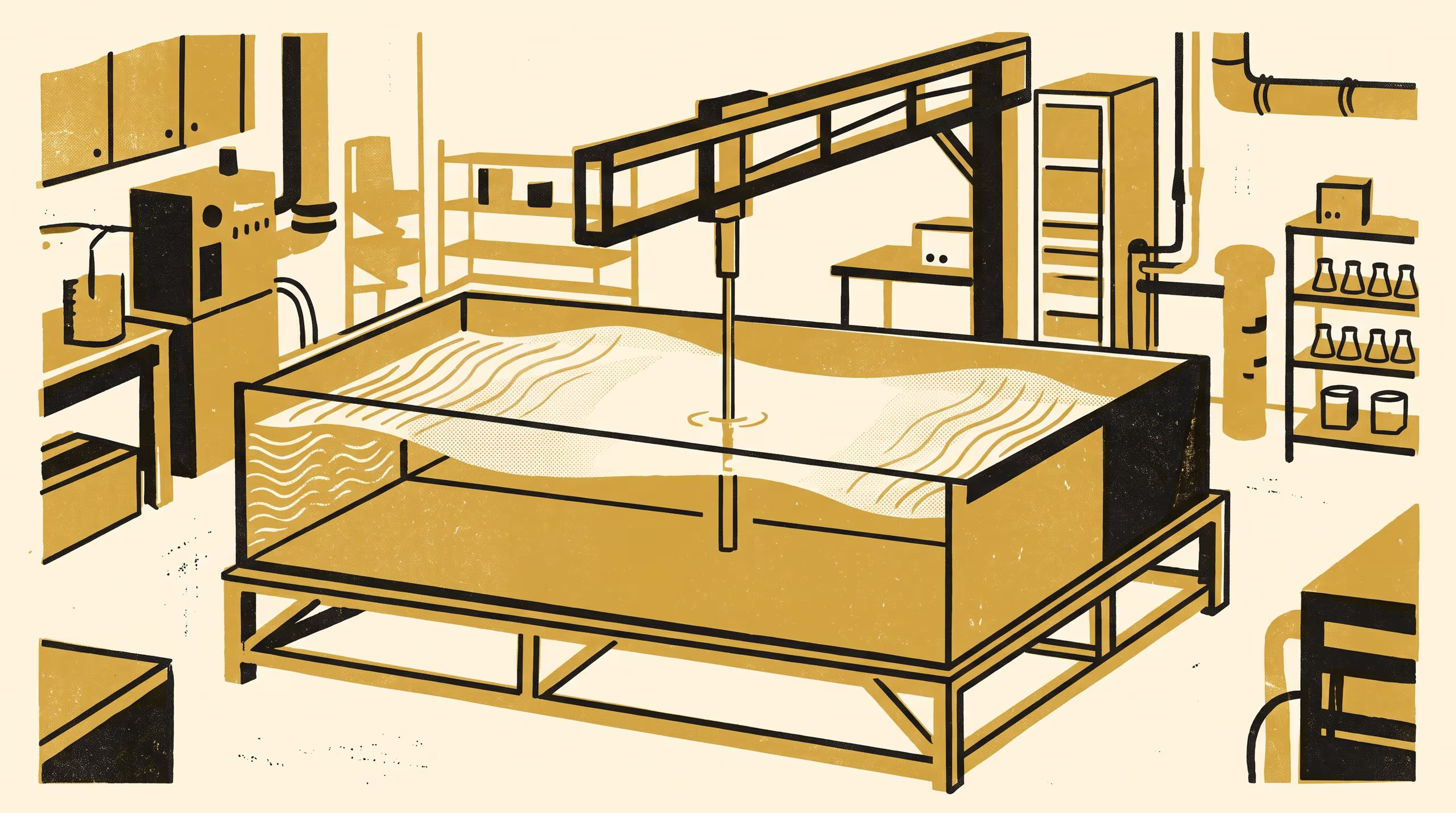
A new physics paper measures how long the water in a radiotherapy scanning phantom keeps moving after its detector carriage stops, and finds the middle of the tank settles in under a minute while the edges take nearly three.
A paper from the Schools of Settled Matters and Underlying Conditions times the ripples a detector carriage leaves in a radiotherapy water phantom
The water at the middle of a radiotherapy scanning tank comes to rest well before the water at its walls, according to The Centre Settles First, a new paper by Dr Odalys Penhallow of the School of Settled Matters and Dr Vigdis Emenike of the School of Underlying Conditions.
Every reading in this paper depended on colleagues willing to stand beside a tank and wait without being told for how long. The School owes them its thanks, and now, at last, an answer.
— Dr Odalys Penhallow, Senior Lecturer and Lead, Received Readings Group, School of Settled Matters
Bringing fluid dynamics, instrument practice and the everyday routines of the beam laboratory into one line of inquiry, the pair characterised how a working water phantom returns to stillness, and what that return means for measurements taken close to the surface. The answer turns on position. A detector on the tank’s centre line waits a little under a minute; one sweeping out towards the walls waits nearly three. Water that has been left to stand for some days, the paper reports, settles sooner than a fresh fill.
Dr Emenike said the work had left the University “with a better question than the one it started with, about which of its waters have been standing, and since when”.
The paper is a welcome demonstration of the University’s readiness to wait for its instruments, and of the depth of expertise its Schools bring to the stillness of things.
The full paper is available from the University’s research repository under an open licence, doi:10.5555/slop.a7b8ed.