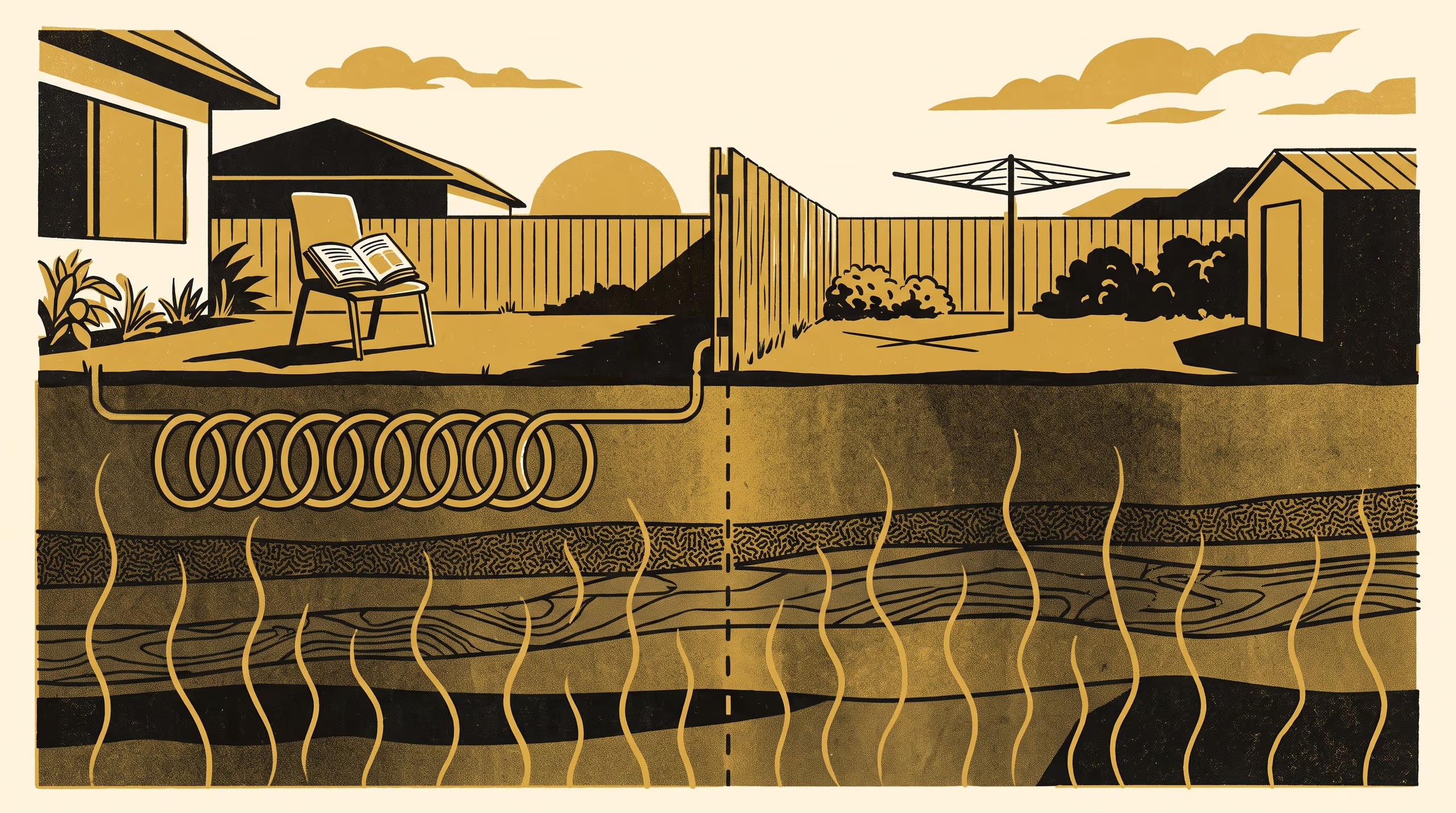
The School of Settled Matters carries its reading of property below the surface to the University's portrait signage, in an advertisement built around a single bore beneath a suburban house.
A portrait display advertisement runs a backyard bore down through the strata and points passers-by to the University's work on heat in the ground
The School of Settled Matters has extended its interest in property to a depth most land law leaves alone: the few metres beneath a suburban lot, where the ground holds much the same warmth through every season. Heat Rises. Title Does Not., a new portrait display advertisement from Dr Odalys Penhallow, now runs across the University’s signage panels and the campus digital rotation.
Most of the property law we teach stops at the lawn and is content to. Below it the School has found itself a good deal less content, which is usually the sign of a question that will keep us busy for some years.
— Dr Odalys Penhallow, Senior Lecturer and Lead, Received Readings Group
The advertisement sets a single bore descending through banded strata beneath a weatherboard house, and invites the travelling public to read further in the University’s published record. Its small print gathers three studies from the School of Underlying Conditions on heat moving through the ground, from flooded mine workings to the earth floor of a glasshouse, aligning the School’s interpretive capability with the University’s growing subsurface energy portfolio.
Dr Vigdis Emenike, whose work features in that small print, welcomed the campaign. “We spend our winters establishing where the heat goes,” she said. “It is reassuring to know that a colleague across the courtyard will, in time, establish whose it was.”
For the University, the campaign is one more instance of a disposition it has long cultivated across its Schools: patience with questions that take their time to close, and a willingness to put them where people wait.
The full advertisement is available from the University’s research repository under an open licence, doi:10.5555/slop.djwp5g.