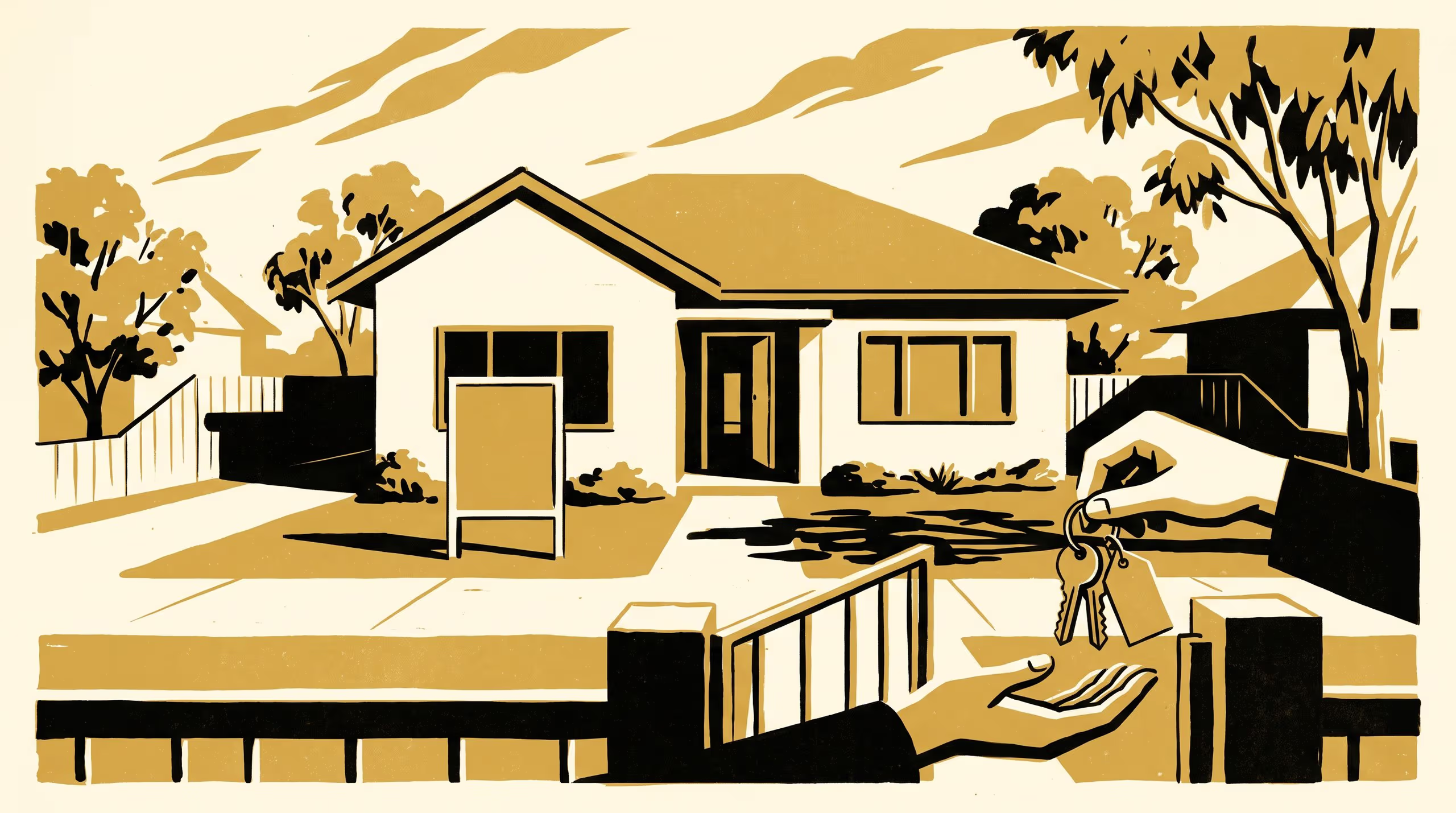
A new University advertisement for the portrait signage rotation places a ring of keys on an empty hall table and invites anyone waiting nearby to read its research on bereavement.
A portrait display advertisement points passers-by to a study of adult children selling a parent's house
A set of house keys left on a hall table, the front door standing open behind them, is the image the University has chosen for its newest display advertisement, now in the portrait rotation of its signage. Grief Has Its Own Settlement Date, prepared by Associate Professor Ragnhild Uzoma of the School of Underlying Conditions, invites anyone waiting for a bus to look up the University’s research on bereavement.
A poster at a bus stop is read by people on their way somewhere else, and some of them are carrying more than they let on. We hoped to keep them company for the length of a wait, and to leave the rest to the work itself.
— Associate Professor Ragnhild Uzoma, Lead, Basement Relations Group, School of Underlying Conditions
The advertisement’s hook is The Week the Keys Went Back, a research poster from the School of Settled Matters that followed 47 bereaved adult children through weekly diaries as each sold a dead parent’s house. Its finding, that yearning held steady when contracts were exchanged and rose in the week the keys were handed over, supplies the campaign line. Two further outputs, on the tasks a dead relative leaves part-way and on adult children checking an ageing parent’s pill organiser from a distance, are named in the small print.
The campaign extends the University’s practice of placing its published record where people already stand still, and of trusting one image and one line to carry a body of scholarship to an audience that did not come looking for it. Associate Professor Uzoma said the brief had turned out “closer to the School’s own work than it first appeared. We spend our days accounting for what did not come up with the rest.”
The full advertisement is available from the University’s research repository under an open licence, doi:10.5555/slop.us6ic7.