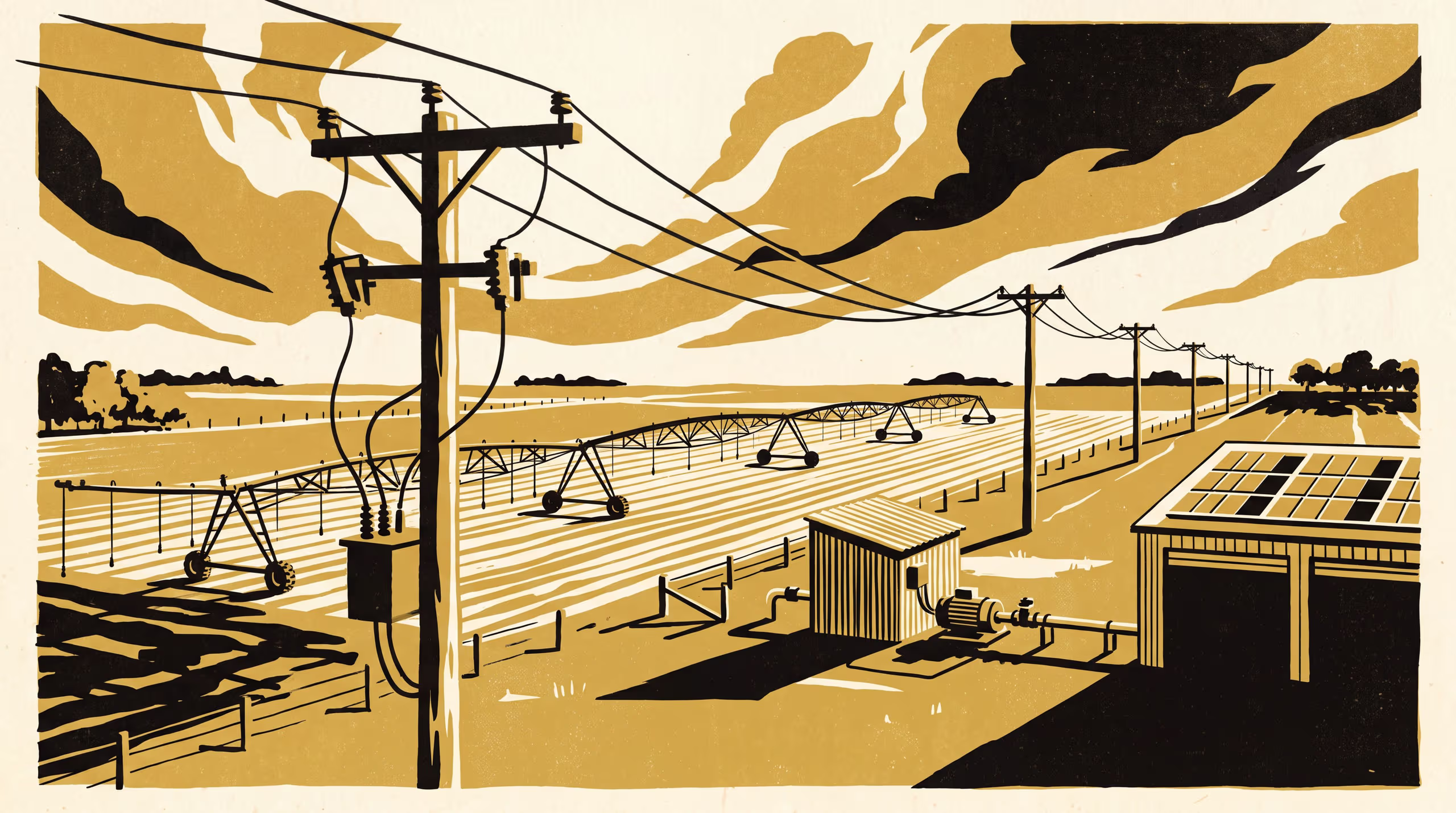
A new research poster replays 160 islanding events from a year of one rural feeder's records through a single frequency-relay setting, and finds the missed trips concentrated where irrigation motors carry the load.
A School of Settled Matters research poster replays a year of one rural feeder through a frequency relay, and finds pump season where the misses gather
One hundred and sixty times over the past year, a test rig at Slop University cut a rural power line away from the network and waited to learn whether the relay watching it would notice. The results now appear in The Pumps Hold the Frequency Up, a research poster by Dr Odalys Penhallow of the School of Settled Matters and Associate Professor Casimir Beng of the School of Continuous Improvement.
The poster reports that 40 of the 160 replayed events went untripped within two seconds, and that the misses gathered where irrigation pumps made up most of the line’s load: 2 in 40 when motors carried under a tenth of it, 21 in 40 when they carried more than two-fifths.
A protection setting is chosen once and then trusted for years by people who never saw the afternoon it was chosen. We are grateful to have been given a year of those afternoons to sit with, and we intend to ask for another.
— Dr Odalys Penhallow, Senior Lecturer and Lead, Received Readings Group
The work brings recorded network behaviour, laboratory replay and the School’s long habit of close reading into a single protection-assurance pipeline, positioning the University within a growing conversation about how rural networks are kept safe as more rooftops generate their own power. The University counts the collaboration among the clearest recent signs that its schools are prepared to follow a question wherever its records lead.
Associate Professor Beng said the Adaptive Metrics Lab had been pleased to lend its rig to the project, adding that “the School of Settled Matters has a way of booking equipment for an afternoon and returning it a season later, and the Lab is all the richer for the arrangement.”
The full poster is available from the University’s research repository under an open licence, doi:10.5555/slop.pdlmfq.